

















The confidential correspondence repeatedly refers to suspected fraud involving traffic terminating through the networks of Uganda’s largest telecom operators.A confidential dossier submitted directly to President Yoweri Museveni paints a disturbing picture of how Uganda may have lost billions of shillings in telecommunications revenue while repeated warnings from technical experts allegedly went unheeded for years.
The documents, marked confidential and dated June 2022, claim that sophisticated fraud schemes involving international call routing, SIM box operations and under-declaration of telecommunications revenues were repeatedly detected by the Telecommunications Intelligent Monitoring System (TIMS), yet little enforcement action followed.
The reports also raise uncomfortable questions about whether institutional failures, poor coordination among government agencies and regulatory inertia allowed revenue leakages to continue despite the Government already possessing technology capable of detecting them.
At the centre of the dossier is the Directorate of Revenue Intelligence (DRI), working with its technical service provider, Global Voice Group (GVG), which argues that Uganda had already invested in one of Africa’s most sophisticated telecom monitoring systems but failed to fully utilize its capabilities.
A letter addressed to the President
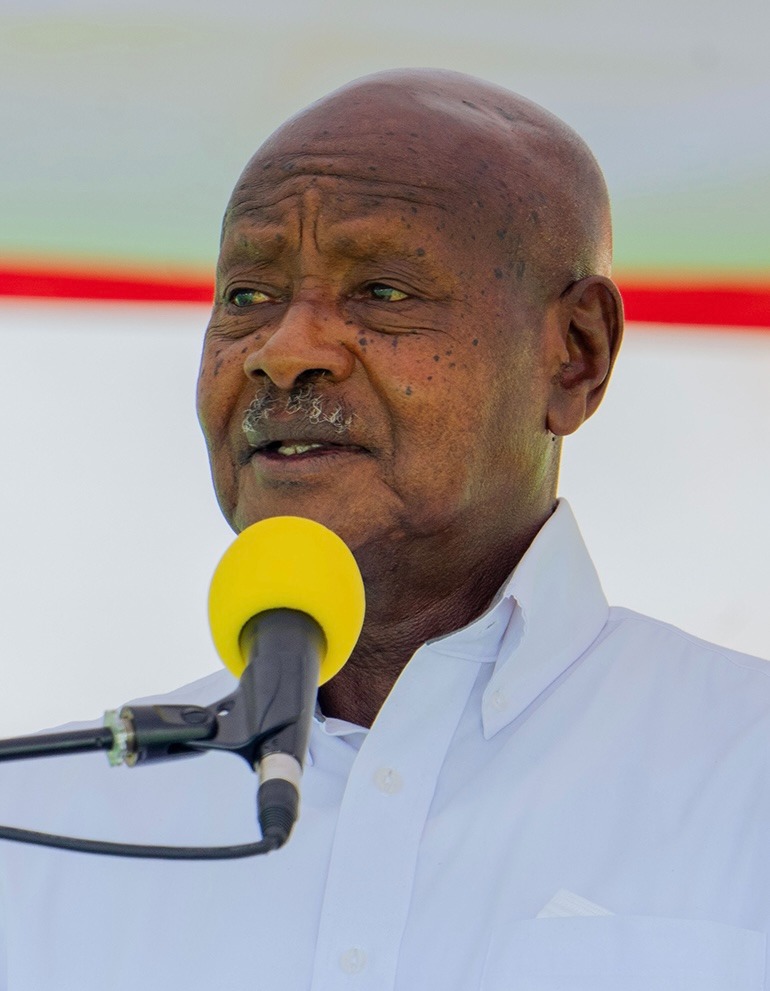
The confidential submission dated June 27, 2022 was addressed personally to President Museveni under the subject: “Massive Telecommunications Fraud Detected in MTN Uganda.”
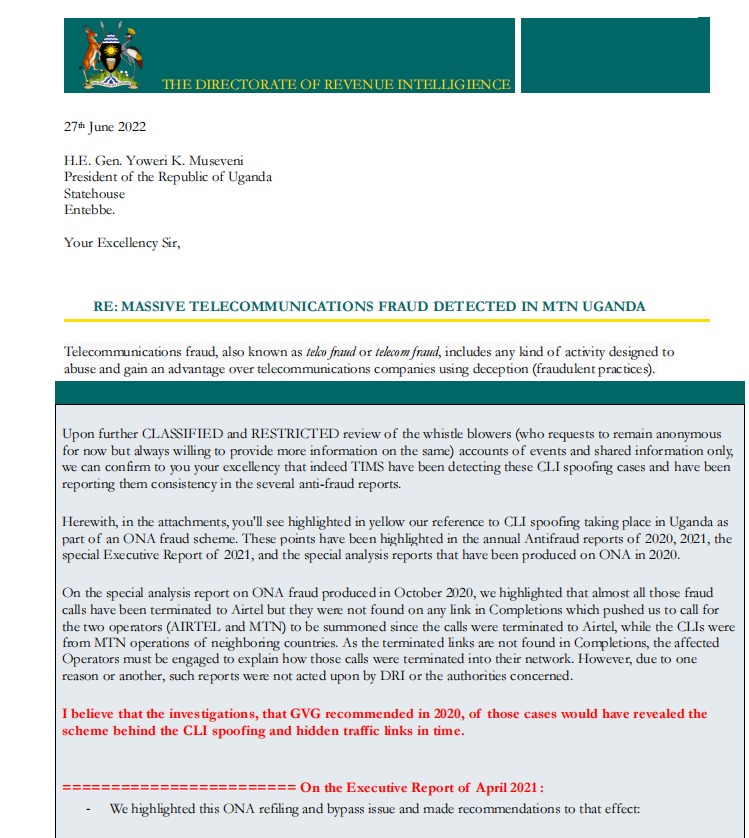
The letter explains that after reviewing whistleblower information together with existing TIMS reports, investigators concluded that suspected telecommunications fraud had indeed been repeatedly detected by government monitoring systems.
According to the letter, TIMS consistently detected Caller Line Identification (CLI) spoofing associated with One Network Area (ONA) fraud.The dossier states that these findings had already appeared in annual anti-fraud reports for 2020 and 2021, executive reports and special investigations. Yet despite repeated recommendations, officials allegedly failed to act.
“I believe that the investigations… recommended in 2020… would have revealed the scheme behind the CLI spoofing and hidden traffic links in time,” the author wrote to the President.
The technology Government already owned
The documents describe TIMS and the Data Monitoring System (DMS) as powerful platforms designed to monitor virtually every commercial telecommunications transaction occurring within Uganda.
According to the report, the systems collect near real-time data on:
voice traffic
SMS traffic
mobile money transactions
telecom revenues
fraud indicators
equipment identification
international gateway traffic
The report argues that the platforms were designed to strengthen tax collection, combat fraud and improve regulatory oversight while enhancing national security capabilities.
Officials behind the report insist the technology itself was never the problem.Instead, they argue the challenge was that government institutions failed to use the information the systems continuously generated.
Five years of missed opportunities
GVG’s assessment claims the company fully implemented every contractual obligation after signing its agreement with Government in 2016.
Among the completed systems listed are:
Telecom Traffic Monitoring System
Automated Revenue Monitoring System
Mobile Money Monitoring System
Device Detection and Control System
Fraud Control Management System
According to the report, all installations were officially accepted in November 2018 and Government made all contractual payments, signalling satisfaction with implementation.
The company further claims it invested additional infrastructure beyond contractual obligations, including fibre optic networks, network operations centres, analysis rooms and enhanced monitoring tools.
Where the money allegedly disappeared
One of the dossier’s most explosive claims concerns discrepancies between telecommunications traffic captured by TIMS and figures declared by mobile network operators.
According to reconciliation exercises conducted using TIMS data, investigators reported: more than UGX 3.58 trillion in airtime values monitored during 2021; over 2.18 billion verified local call minutes; more than 101 million international incoming minutes; international call revenue discrepancies exceeding 10 percent for one operator and more than 30 percent for another; suspected uncollected liabilities exceeding US$2.3 million from international traffic alone; approximately US$2.6 million additional revenue opportunity from One Network Area bypass fraud; nearly US$2 million linked to SIM box fraud detected between 2018 and 2022.
These figures, if independently verified, would represent substantial losses to the national treasury.The documents, however, present these as findings from reconciliation exercises rather than judicially established facts.
MTN and Airtel named in recommendations
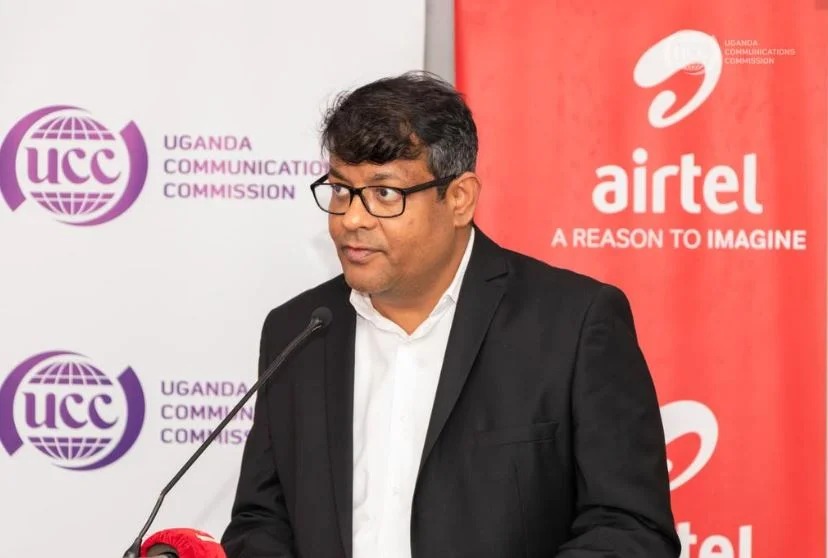
The confidential correspondence repeatedly refers to suspected fraud involving traffic terminating through the networks of Uganda’s largest telecom operators.Investigators claimed suspicious calls appeared to enter Uganda using identities associated with MTN operations in neighbouring countries before terminating on Airtel’s network.
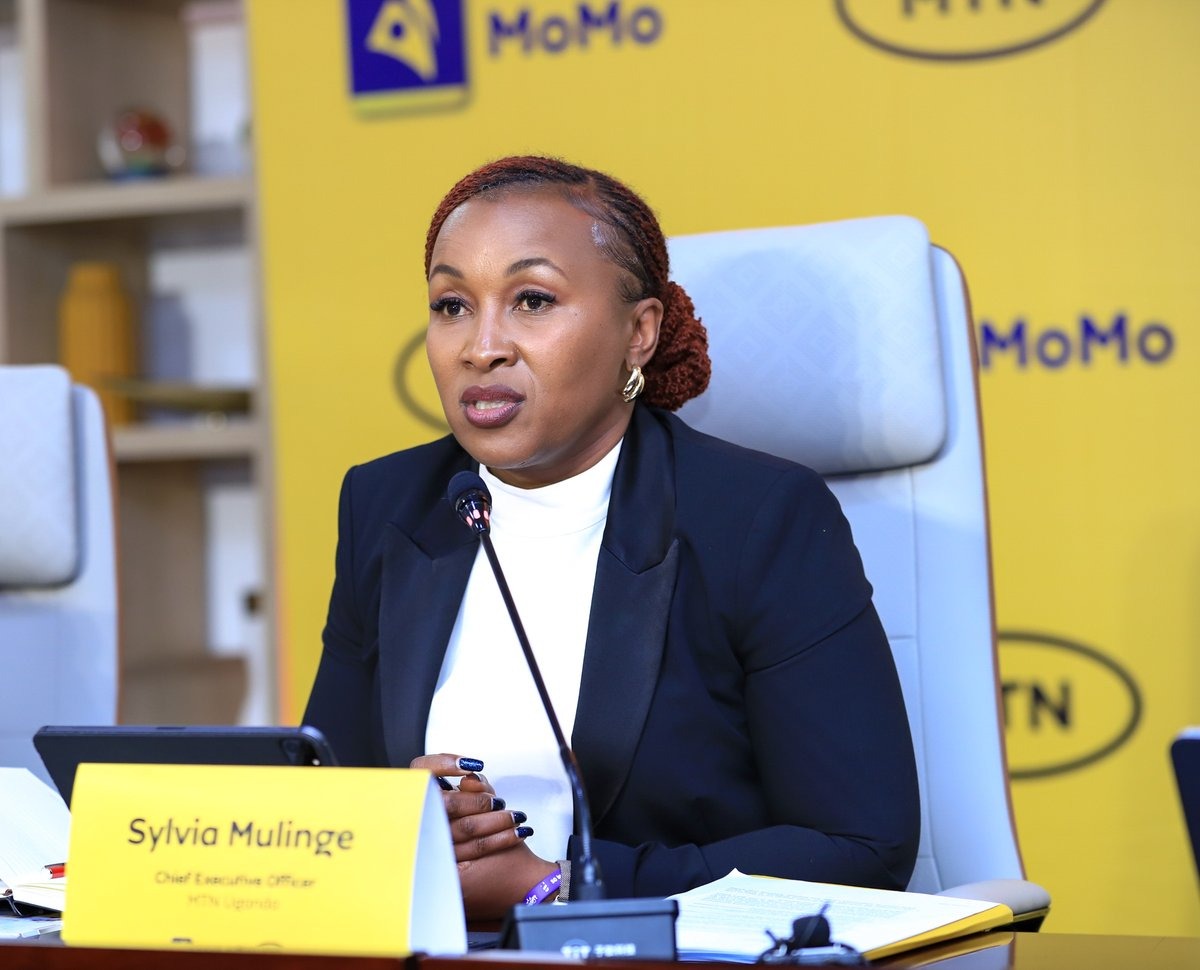
According to the report, those traffic patterns warranted urgent investigations.Recommendations included summoning Airtel Uganda to explain the links through which suspected ONA fraud calls entered its network.
The report also recommended summoning MTN to explain traffic allegedly terminated through caller identities originating from Rwanda and South Sudan.It further proposed billing operators at higher international rates if satisfactory explanations could not be provided.
The documents do not state whether the operators were ultimately found liable, and the allegations contained in the reports were recommendations for investigation rather than final determinations.
Years of reports allegedly ignored
Perhaps the most troubling revelation is the suggestion that the fraud indicators were not newly discovered. Instead, investigators argue they repeatedly documented them.
According to the June 2022 submission, anti-fraud reports issued in 2020, 2021 and several special reports consistently warned about:
CLI spoofing
ONA bypass
SIM box fraud
hidden international routes
suspicious carrier behaviour
Despite these warnings, the report states that little meaningful enforcement followed.It suggests that had authorities acted earlier, significant revenue losses might have been prevented.
A government working in silos
Rather than blaming technology, the broader assessment identifies institutional fragmentation as the principal obstacle.According to the report, several agencies held pieces of the puzzle but lacked authority or information to complete it. The Directorate of Revenue Intelligence possessed system outputs.
The Uganda Revenue Authority had legal powers to assess taxes but reportedly lacked direct access to system data.The Uganda Communications Commission had regulatory authority over telecom operators but similarly lacked operational access to TIMS information.
As a result, investigators argue, billions of records accumulated without triggering timely enforcement.The report concludes that the lack of coordination among DRI, URA and UCC significantly weakened revenue collection and fraud enforcement.
The national security dimension
Beyond taxation, the dossier highlights the wider intelligence potential of TIMS and DMS.
According to the report, the systems can analyse telecommunications metadata to identify:
money laundering networks;
cross-border financial transfers;
organised fraud;
suspected criminal relationships;
handset movements;
telecommunications fraud syndicates.
The report stresses that the technology cannot listen to phone conversations or read message content.
Instead, it analyses transactional information, enabling investigators to map relationships between individuals using advanced analytical software.
Officials argued this capability could significantly strengthen criminal investigations if properly integrated with police systems.
Calls for Police integration
One recommendation proposed creating a dedicated police operations centre connected directly to TIMS and DMS.
The proposal envisaged integrating:
CCTV systems;
criminal databases;
motor vehicle records;
gambling monitoring;
SIM registration systems;
cross-border payment analysis.
According to the report, these integrations would improve both revenue assurance and law enforcement.It also argued that such capabilities could help detect money laundering, cybercrime and organised telecommunications fraud more effectively.
Extending the contract
The report also makes a case for extending GVG’s contract beyond its original five-year term.It argues that the extension would allow Government to:
recover outstanding tax liabilities;
strengthen revenue assurance;
introduce online gambling monitoring;
monitor electronic levies;
expand tourism tracking;
improve handset monitoring;
enhance SMS monitoring.
The authors contend that Government had not yet developed sufficient internal technical capacity to independently manage the sophisticated systems.
Recommendations sent to the President
The dossier concludes with sweeping recommendations intended to overhaul Uganda’s telecom monitoring framework.
Among them were:
granting DRI stronger operational authority;
defining institutional responsibilities more clearly;
conducting extensive staff evaluations and training;
performing monthly revenue reconciliations between TIMS and URA;
reviewing telecommunications laws;
establishing a disaster recovery site;
approving sustainable operational funding.
The authors argue that implementing these reforms would transform TIMS from a passive monitoring platform into an active revenue protection and national security asset.
Questions that remain
The confidential documents leave several important questions unanswered.Were the recommended investigations against telecom operators ever completed?
Did Government recover any of the alleged lost revenues?Were any officials disciplined for failing to act on repeated anti-fraud reports?
Were the discrepancies independently verified through audits or court proceedings?The documents available provide detailed allegations and recommendations but do not include subsequent government findings or final enforcement outcomes.
What is clear from the dossier is that senior officials believed Uganda possessed advanced technology capable of detecting telecommunications fraud years before the June 2022 submission reached President Museveni’s desk.
The central claim running through the confidential reports is not merely that fraud existed, but that warning signs had been repeatedly identified, documented and communicated. According to the authors, the real failure lay in translating intelligence into enforcement.
Whether those allegations ultimately resulted in prosecutions, tax recoveries or regulatory reforms remains a matter that would require examination of subsequent government action beyond the documents reviewed.
Author Profile

- Charles Gazza Kodili is a seasoned journalist with over 20 years of experience in the media industry. He holds a Bachelor of Arts degree in Mass Communication. He’s currently the Chief Editor at the Investigator.
Charles can also be reached via; Tel: +256 774 108978
Email: [email protected]
Latest entries
 NewsSeptember 5, 2026THE INSIDE STORY: TOORO THRONE IN TURMOIL! Who Is Kamurasi? What Happened To Oyo’s Reported Son? Why Did Mwenda Announce The Decision? What Does the Custom Say About Succession?
 NewsSeptember 4, 2026MUSEVENI REVEALS OYO’S CANCER BATTLE: President Says Queen Mother Best Kemigisa Told Him About The King’s Aggressive Cancer In November 2025 As Oyo’s Body Returns Home
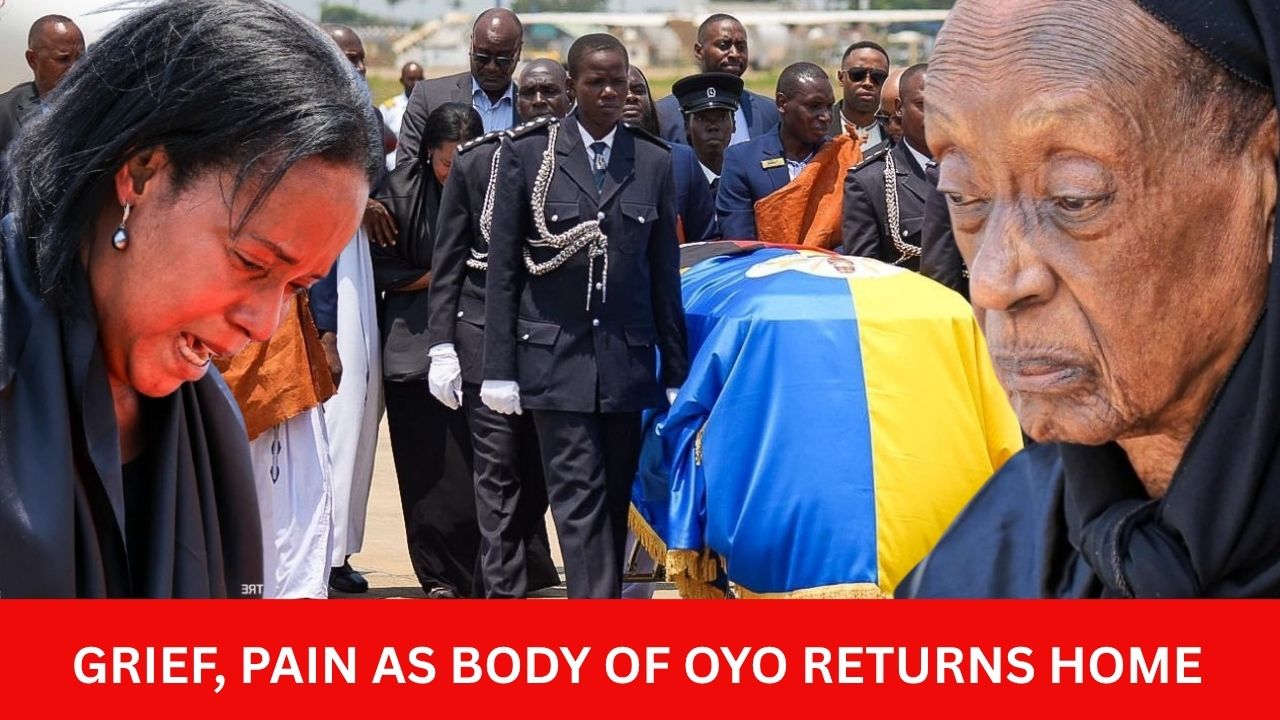 NewsSeptember 4, 2026KING OYO’S BODY BACK HOME: President Museveni Receives The Remains Of King Oyo At Entebbe As Queen Mother Best Kemigisa And Royal Family Members Begin The Monarch’s Final Journey Home
 NewsSeptember 3, 2026TOORO UNITY PLEA AS KING OYO RETURNS: Prime Minister Rwomiire Tells Batooro to Reject Division, Silence Speculation and Give Their Fallen King a Dignified Farewell