






















By Osbert R Biryomumaiso and Twiine Mansio Charles
The rising heat across our shared planet is exposing a harsh and unyielding reality: nature does not negotiate with human pride. For generations, we lived under the false belief that we could endlessly exploit the earth, pollute the atmosphere, and clear vast forests without triggering catastrophic consequences.
Today, as record breaking temperatures shatter historical norms month after month, that comfortable illusion is completely breaking down. The extreme heat is not simply altering everyday weather patterns; it is actively tearing at the structural foundations of our societies. When we disrupt the delicate balance of the global environment, physical laws eventually enforce themselves with unrelenting fury. The terrifying disaster now unfolding across Southwestern Europe is the direct and brutal consequence of that long standing neglect.
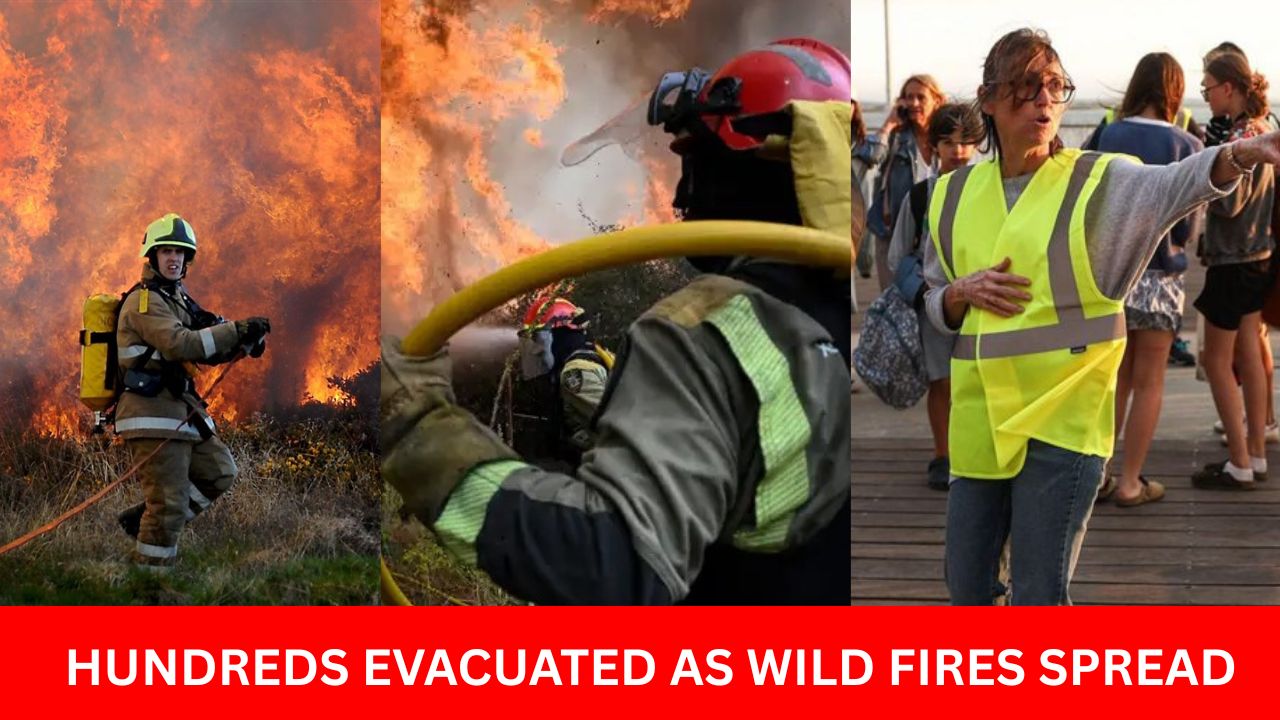
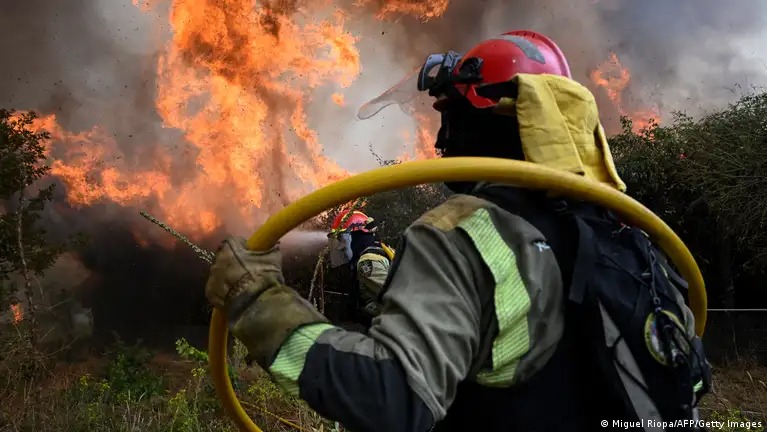
A sudden, catastrophic firestorm has swept through large regions of France and Spain, bringing entire provinces to a complete standstill and turning vibrant landscapes into charred, toxic graveyards. In a matter of days, massive walls of flame have swallowed whole rural communities, causing tragic loss of life, destroying thousands of family homes, and forcing over 250,000 traumatized people to flee into exile.
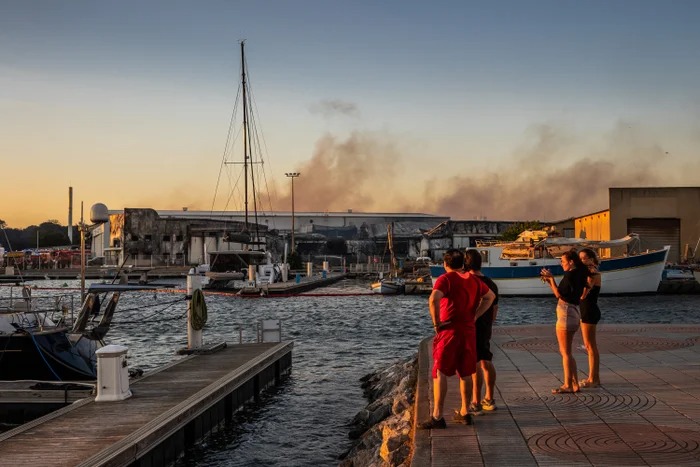
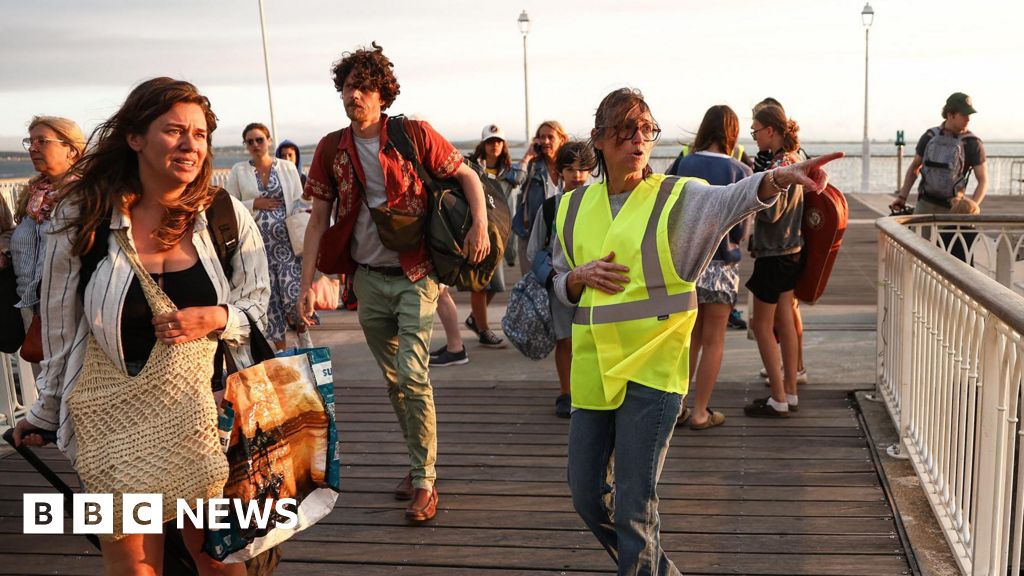 Across the Cap Ferret peninsula and the broader Gironde territory in France, entire communities were evacuated in an atmosphere of absolute panic as thick clouds of black smoke erased the sun. With primary escape roads severed by advancing flames, hundreds of desperate tourists and local residents were forced to flee directly toward the Atlantic Ocean, rescued from burning beaches by emergency water taxis, fishing trawlers, and private boats while falling ash rained down around them.
In Spain, several gargantuan infernos merged west of Madrid in the Sierra Oeste region, prompting national emergency declarations as burning embers showered empty city streets and veteran emergency managers admitted that the sheer speed and intensity of the fire made direct ground defense impossible.
For anyone studying the field of International Relations, this sudden breakdown of order is far more than a localized environmental tragedy. It is a profound, systemic security crisis that strikes directly at the core capacity of sovereign states to protect their people and maintain public stability.
To understand why these firestorms threaten global stability, we must examine how national defense has traditionally been understood. For centuries, classical political theory defined security through a strict state centered lens.
Sovereignty was defended by standing armies, naval fleets, armored divisions, and military alliances built to deter aggressive human rivals. However, the catastrophic fires currently raging across Western Europe expose the severe limits of that traditional mindset. The most dangerous force facing modern nations today is non-human, transboundary, and completely immune to military hardware.
Climate change functions as the ultimate threat multiplier. It takes preexisting social stresses, economic inequalities, energy demands, and resource limits, and accelerates them until government institutions begin to crack under the severe strain. When extreme heatwaves dry out ancient pine forests until they become explosive fuel beds, the resulting infernos do far more than burn trees and wildlife.
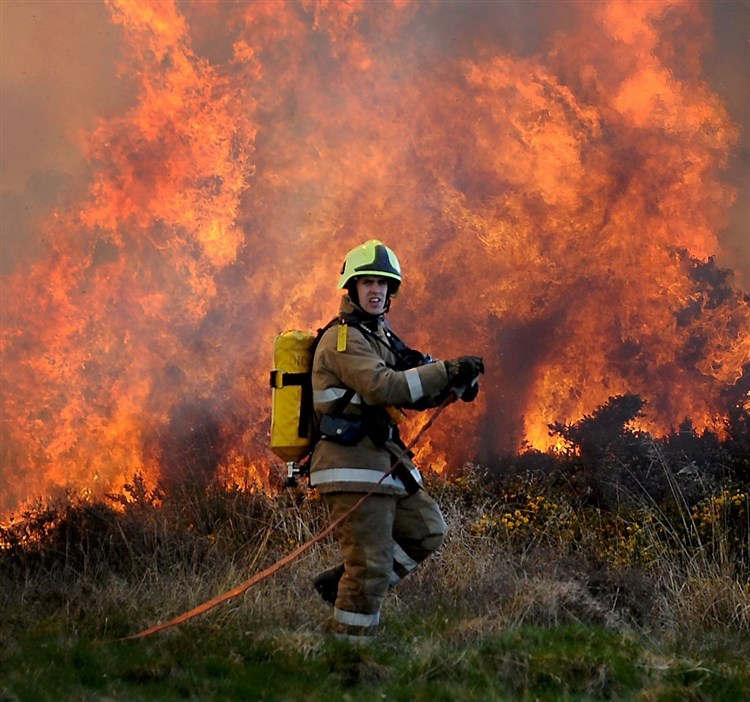
They force governments to mobilize specialized military units such as Spain’s Military Emergency Unit to preserve basic public order. They severely strain diplomatic relationships as neighboring countries compete for scarce shared firefighting aircraft and aerial water bombers. They destroy critical transport networks, power lines, and agricultural farms, while generating massive waves of internally displaced citizens who suddenly require emergency shelter, medical care, and financial relief.
Deeper tragedy
The deeper tragedy of this ongoing calamity lies in the fact that world renowned scientific bodies warned political leaders about this exact outcome for several decades. The Intergovernmental Panel on Climate Change, created in 1988 by the United Nations Environment Programme and the World Meteorological Organization, issued a continuous series of rigorous scientific evaluations detailing how human carbon emissions were warming the planet at an unsafe rate. In its landmark Sixth Assessment Report published in 2021, hundreds of leading international scientists declared unequivocally that human activities had warmed the atmosphere, oceans, and land at an unprecedented pace. United Nations Secretary General António Guterres highlighted these findings at UN headquarters, famously declaring the report a code red for humanity and warning international delegates at the COP26 summit in Glasgow and the COP27 conference in Sharm El Sheikh that global society was driving down a highway to climate hell with its foot firmly on the accelerator. Despite these urgent scientific warnings delivered in the highest diplomatic fora, many national leaders, fossil fuel lobbies, and political commentators dismissed atmospheric science as exaggerated rhetoric, choosing short term corporate profits over long term planetary survival.
Institutional evasion
This long history of political delay and institutional evasion was made far worse by the repeated withdrawal of the United States, the world leading historical carbon emitter, from fundamental international climate treaties. A critical moment in environmental diplomacy occurred with the 1997 Kyoto Protocol, an agreement negotiated under the United Nations Framework Convention on Climate Change. The Kyoto Protocol was designed to set legally binding targets for industrialized countries to reduce their overall greenhouse gas emissions by an average of 5 percent below 1990 levels during the first commitment period between 2008 and 2012. Although the Clinton administration signed the treaty in 1998, the United States Senate signaled its deep hostility by unanimously passing the Byrd Hagel Resolution in July 1997 by a vote of 95 to 0. The resolution declared that the United States should not join any treaty that imposed mandatory emission limits on developed nations without requiring similar commitments from developing countries, claiming such rules would cause serious economic harm. Consequently, in March 2001, President George W Bush officially abandoned the Kyoto Protocol, crippling global mitigation efforts and establishing a dangerous precedent for international noncompliance.
2015 Paris Agreement
A remarkably similar pattern of diplomatic retreat repeated itself with the 2015 Paris Agreement, which sought to keep the increase in global average temperature well below 2 degrees Celsius above pre industrial levels, while actively pursuing efforts to limit the increase to 1.5 degrees Celsius. In June 2017, President Donald Trump announced his intent to withdraw the United States from the Paris Accord, a decision that formally took effect in November 2020 before being temporarily reversed by President Joe Biden in February 2021. However, this cycle of diplomatic uncertainty returned when the second Trump administration issued an executive order in early 2025 to withdraw from the Paris Agreement, a move taking full effect in early 2026 alongside an announcement to pull out from the foundational 1992 United Nations Framework Convention on Climate Change itself.
This persistent refusal to remain bound by international environmental law extends into broader global resource governance. The United States has also failed for more than four decades to ratify the 1982 United Nations Convention on the Law of the Sea. Known as UNCLOS and signed by over 160 nations, this comprehensive treaty was established to regulate international maritime space, protect marine ecosystems, and prevent dangerous conflicts over deep seabed resources. Citing national sovereignty concerns and objections over deep seabed mining provisions, the United States Senate has consistently withheld its advice and consent, leaving the premier economic and military power outside the formal legal framework meant to govern the global oceanic commons.
Political neglect
That legacy of political neglect and international isolationism has now matured into an unavoidable, existential security crisis. The physical laws of atmospheric science do not care about election cycles, corporate stock values, or national borders. Europe is currently warming at roughly twice the global average rate, with regional surface temperatures standing more than 2.3 degrees Celsius above pre industrial baselines and global atmospheric carbon dioxide levels surpassing 420 parts per million. Denying or ignoring these empirical measurements out of political convenience was not merely a flaw in policy making; it represented a monumental failure of national security planning.
This stark reality brings us to the most urgent lesson facing global politics today: when a threat becomes truly universal, it must be treated like a global pandemic rather than a partisan debate. The devastating consequences of a warming atmosphere or a deadly infectious pathogen are completely non selective. A severe heat dome, a plume of toxic smoke, or an airborne virus does not inspect passports, respect state boundaries, or align with political ideologies. Extreme atmospheric heat strikes wealthy, highly developed democracies with the exact same physical force that it hits vulnerable, developing nations. Because these hazards operate without geographical or political discrimination, relying on national isolationism or border walls guarantees collective ruin.
Global governance theory
In the analytical framework of Liberal Institutionalism and global governance theory, essential public goods such as a stable atmospheric climate, clean air, healthy oceans, and predictable weather systems require absolute, unyielding international cooperation. Much like a fast moving pandemic, an atmospheric heat wave or a massive transboundary firestorm cannot be contained by increasing defense budgets or issuing isolationist political rhetoric. If a powerful state continues to dump massive quantities of carbon into the global commons under the pretext of defending national economic growth, it directly undermines the physical security and economic stability of every other country on earth.
Treating environmental collapse with national self-interest or policy procrastination creates a fatal collective action problem. When individual nations attempt to free ride off the carbon reduction efforts of others while expanding their own fossil fuel extraction, the entire international framework collapses under the weight of shared destruction. The fires currently ravaging towns across France and Spain offer a vivid, terrifying preview of what that structural breakdown looks like on the ground. When a deadly biological pandemic emerges, rational governments do not attempt to stop the virus with infantry or political slogans. They rely on transparent scientific data, pooled medical resources, joint policy measures, and absolute respect for empirical facts. The exact same rigorous discipline must be applied to the global climate crisis. The belief that any nation can insulate itself from planetary destruction through accumulated wealth or strict border enforcement is a dangerous delusion. A crisis that threatens all human beings universally requires a truly universal response, one where individual states subordinate narrow national interest to the overriding cause of collective human survival.
Desperate refugees
Furthermore, the cascading geopolitical consequences of these climate disasters will inevitably ripple across the entire international system. As unbearable heatwaves and severe water shortages render large regions of the Global South increasingly uninhabitable, widespread agricultural failures will drive unprecedented levels of human displacement. Millions of desperate climate refugees will be forced to migrate across international frontiers in search of basic security, creating intense political friction along major migration corridors. Tragically, the very political movements that historically opposed proactive climate policies are often the first to weaponize climate driven migration, using human suffering to promote xenophobia and border militarization, thereby creating a self-reinforcing cycle of political instability and human tragedy.
At the same time, the physical degradation of vital trade routes and economic infrastructure threatens global financial stability. Lower river levels across major European river basins like the Rhine, the Rhone, and the Ebro severely disrupt commercial river transport, reduce hydroelectric power generation, and force nuclear power stations to reduce energy output because river waters become too warm to safely cool reactors. When key agricultural heartlands suffer compound heatwaves and droughts, governments frequently impose agricultural export bans to protect domestic food supplies, triggering international food price spikes and severe geopolitical tension. Even in the far north, the rapid melting of Arctic sea ice, which ought to serve as a stark warning of planetary fever, has instead sparked a tense geopolitical struggle among major powers competing for control over newly opened shipping lanes and untapped subsea fossil fuel deposits, demonstrating how short sighted competitive habits persist even during a planetary emergency.
To grasp the full weight of this crisis we must examine the tools and methods victim countries are now forced to deploy, and what those emergency measures mean for their economies. Traditional municipal fire brigades are designed for urban structure fires, not for wildfires that move faster than vehicles on a highway. In France and Spain authorities have had to reassign Canadair water bombers, heavy helicopters, and military transport planes to continuous aerial drops. Each sortie burns thousands of liters of fuel, degrades engines, and requires maintenance that grounds the fleet for days. Because demand far exceeds supply, governments are leasing aircraft from Morocco, Italy, Greece, and Canada at emergency rates. That leasing market has become a bidding war, and the cost per flight hour has tripled in two weeks.
On the ground the response is equally strained. Bulldozers and excavators are pulled from infrastructure projects to cut firebreaks, delaying road repairs and housing construction for months. Thermal imaging drones originally purchased for border surveillance are now flying 18 hour shifts to map fire fronts. Incident commanders report that radio networks are overloaded, forcing them to patch together civilian mobile towers and satellite phones, creating dangerous gaps in coordination. Hospitals near fire zones are running out of burn beds, oxygen, and respiratory masks. Pharmacies cannot restock because supply trucks cannot pass through closed highways.
The economic consequences are immediate and compounding. Tourism in Gironde and Sierra Oeste has collapsed. Hotels, vineyards, and campsites that depend on summer revenue have lost their entire season. Insurance companies are announcing they will not renew policies in high risk zones, which means banks will not issue mortgages. That freezes real estate and removes a major pillar of local tax revenue. Agriculture is suffering twin shocks. Olive groves and cork forests that take decades to mature have been incinerated, wiping out generational wealth. At the same time, smoke and ash have contaminated water sources, forcing municipalities to import bottled water and to run expensive filtration at treatment plants.
Energy systems are under severe stress. Power lines have melted. Substations have been evacuated. To keep hospitals running, governments are deploying diesel generators, which increases fuel imports and pushes up national energy bills. Meanwhile, reduced river flow has cut hydroelectric output, and warm river water has forced nuclear plants to reduce output, creating electricity shortages that drive up prices for manufacturers. Logistics firms report delays of up to 72 hours because key motorways are closed, raising the cost of food and medicine across the region.
Then there is the human capital cost. Firefighters are working 24 hour rotations for weeks. Medical staff are treating smoke inhalation, trauma, and exhaustion. Schools are closed and used as shelters, disrupting education. Businesses cannot get insurance payouts quickly, so they lay off workers. Local governments must divert budgets from schools and social programs to debris removal and emergency housing. The fiscal hole grows every day the fire burns. Multiply these pressures across provinces and you see a macroeconomic shock. Growth forecasts for the affected regions have been cut. Consumer confidence has dropped. Investment is pausing because no one can price climate risk anymore. The state ends up borrowing more, at higher interest rates, to cover reconstruction, while tax revenue falls. This is not a one time expense. It is a permanent increase in the cost of governing.
Now pause and imagine this tragedy befalling our developing nations, countries with little or no means of firefighting equipment capable of confronting a fire of this magnitude. Imagine a rural district with one aging fire truck, no aerial support, and volunteer brigades armed with rakes and backpack pumps. Imagine a national budget where the entire annual allocation for disaster response is less than the cost of leasing one water bomber for a week. Imagine hospitals with no burn units, pharmacies with no stock of inhalers, and roads that turn to dust when heavy vehicles pass.
In that scenario, evacuation is not orderly. It is families walking at night with children on their backs. It is communities losing not just homes but seed stocks, livestock, and the small businesses that sustain the local market. It is a crop failure that becomes hunger within a month. It is a health crisis that becomes a regional epidemic because clinics are overwhelmed. The economic impact would be catastrophic and irreversible. A single firestorm could erase years of development gains. Foreign investment would flee. Debt would rise. And the people who contributed least to global emissions would pay the highest price. That thought should keep every leader awake. It is not hypothetical. The same heat, the same winds, and the same dry fuels exist on every continent. The only difference is capacity.
Which brings us to a choice that governments can no longer avoid. For too long we have measured strength by the number of drones purchased, missiles stockpiled, and defense contracts signed. Those tools have their place. But they cannot put out a fire. They cannot cool a river. They cannot restore a forest. We must start now building capacities that match the threats we actually face. That means investing in national and regional firefighting fleets, including water bombers, heavy lift helicopters, and rapid response ground crews trained for wildland fire. It means early warning systems with satellite monitoring, weather stations, and community alert networks that reach the last village. It means firebreak planning, controlled burns, forest management, and watershed restoration done at scale.
It also means resilient infrastructure. We need power grids that do not fail in heat, hospitals with surge capacity, transport networks with alternative routes, and water systems that can function when rivers run low. It means insurance reform, so that risk is priced honestly and recovery funds are available quickly. It means regional cooperation agreements to share aircraft, personnel, and equipment before a crisis, not during one.
Crucially, it means budget choices. Every dollar spent on a missile that will never be fired is a dollar not spent on a helicopter that could save a town. Every procurement cycle that prioritizes advanced weapons over civil protection is a gamble that the next disaster will be merciful. It will not be. To finance ministries, to parliaments, and to development partners: reallocate. Create a dedicated climate resilience fund. Train engineers, foresters, and emergency managers with the same seriousness we train soldiers. Partner with universities to build local research on heat, drought, and fire behavior. Support small businesses to adapt, so that when disaster comes, they can rebuild instead of close.
To international institutions: stop treating adaptation as charity and start treating it as security. The same way we pool resources for peacekeeping, we must pool resources for firefighting, for drought response, and for early warning. Create a global reserve of aircraft and equipment that can be deployed within 48 hours anywhere. Fund it, staff it, and practice with it.
The disaster currently unfolding across Southwestern Europe demonstrates beyond all doubt that the era of comfortable political delays and superficial policy promises has come to an end. National security can no longer be measured strictly by the number of fighter jets, armored tanks, and border fences a country possesses. If the international community fails to face this warming world with the same speed, structural seriousness, and shared commitment used during world wars or health emergencies, our political systems will continue to fracture under the strain of environmental chaos.
In the final assessment, we stand at a profound historical crossroads where the smoldering ruins of Southern Europe serve as a quiet, unrelenting mirror reflecting our own collective choices. For centuries, humanity has busied itself building thick fortress walls, counting arsenals of destruction, and playing zero sum political games, completely forgetting that the grand vessel of human civilization floats upon the delicate grace of a balanced biosphere. To imagine that we can outwit or out negotiate the fundamental laws of nature is to build a high castle upon shifting sand; when the tide inevitably turns, the towering walls we constructed for our protection will offer no shelter from the rising storm. True wisdom in statecraft lies in recognizing that our ultimate safety is bound up in our shared vulnerability, for nature does not bend its knee to political power, corporate wealth, or national pride. If we continue to let short sighted hubris rule our decisions, we will learn the hardest lesson of all, that when the roof over our heads catches fire, no one gets to sleep safely in their own room, and a house divided against its own environment simply cannot stand. The time to act is not after the next firestorm. It is now. Build the tools. Train the people. Fund the systems. Choose resilience over rhetoric, capacity over spectacle, and survival over vanity.
Author Profile

Latest entries
 FeaturedSeptember 10, 2026QUEEN MOTHER: I AM UNDER ARREST: Best Kemigisha Tells Reporters Karuziika Has Been Taken Over, Sparking Fresh Alarm Inside The Royal Establishment. Land Forces Commander Gen Kayanja Muhanga Seen Directing Troops As Soldiers Tighten Control
 BusinessSeptember 10, 2026‘GIVE ME 50% OR CLOSE!’ — URA OFFICIAL SHARIFA NAKALEMA ACCUSED: Chinese Investors Claim URA Enforcement Followed Refusal To Make Official A Partner In Multibillion-Shilling Trade
 FeaturedSeptember 8, 2026MWENDA, KEMIGISA AND THE KASANGO SHADOW OVER TOORO SUCCESSION: How An Old Legal Battle Involving Queen Best Kemigisa And Her Late Lawyer Bob Kasango Has Resurfaced Amid The Bitter Dispute Over King Oyo Successor Bid
 BusinessSeptember 8, 2026WHAT CUSTODIAL SERVICES MEAN FOR UGANDANS AND WHY THEY MATTER: Centenary Bank is entering the custody market with solutions aimed at improving access, transparency, and confidence for investors.