



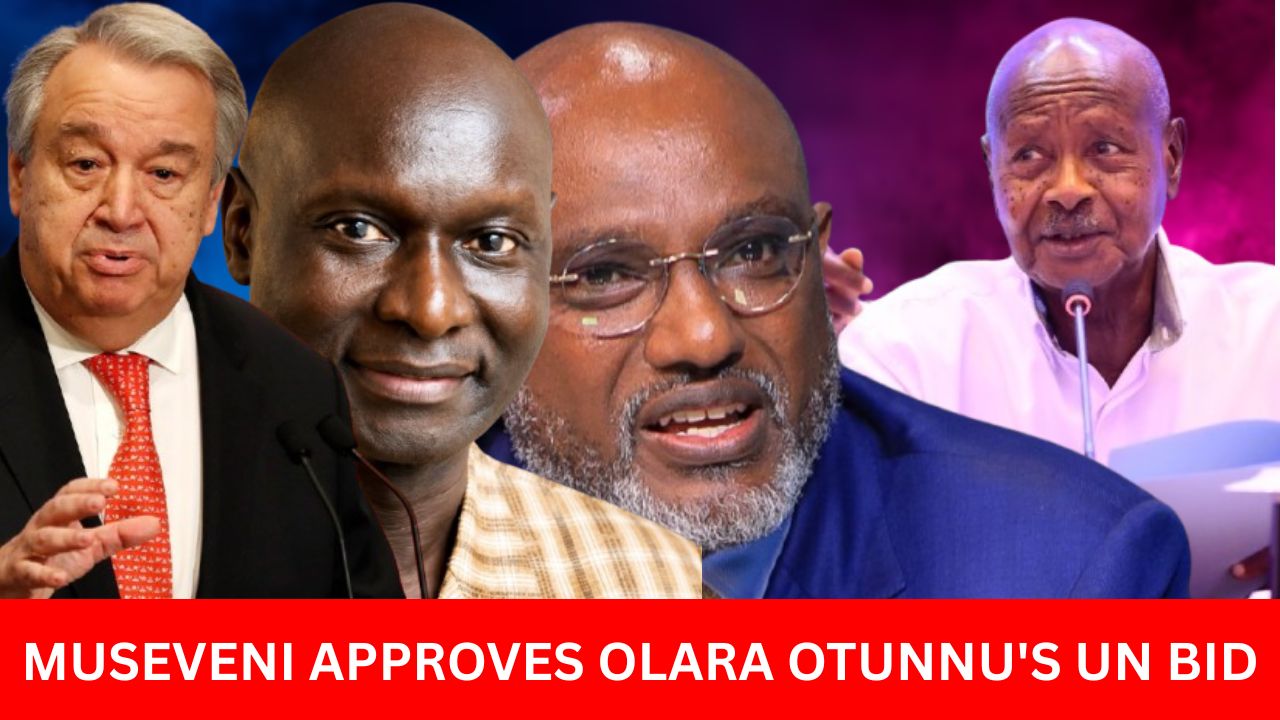
Uganda’s decision to nominate veteran diplomat and former United Nations Under-Secretary-General Olara Otunnu for the world’s top diplomatic job has rekindled national pride and generated excitement among many Ugandans. Yet, despite his distinguished international career spanning more than four decades, political analysts believe the former foreign affairs minister enters one of the world’s most competitive elections facing significant hurdles.
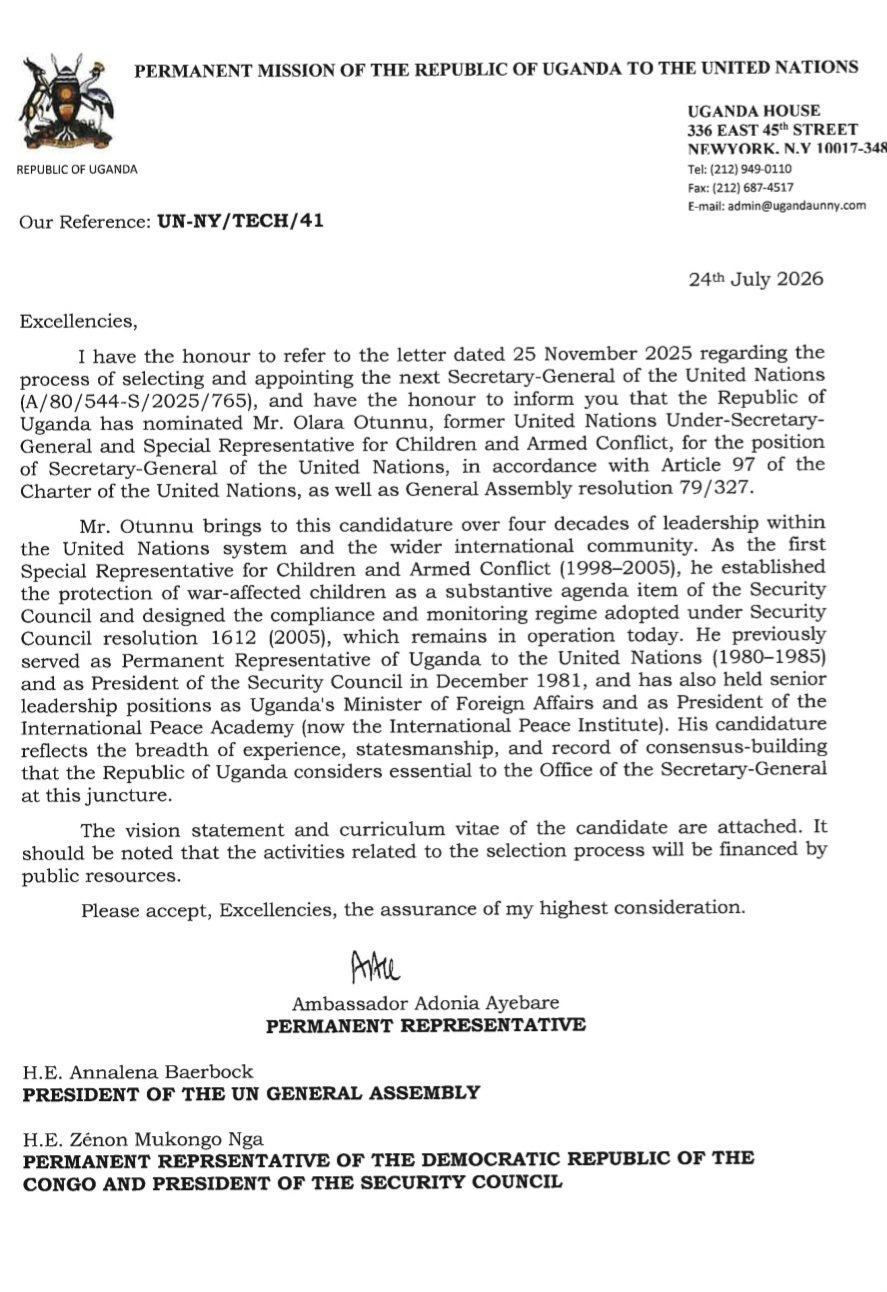
Otunnu was formally nominated by the Government of Uganda through the country’s Permanent Representative to the United Nations, Ambassador Adonia Ayebare, in a letter addressed on July 24 to the Presidents of the UN General Assembly and the UN Security Council.
The nomination raises the number of candidates seeking to succeed UN Secretary-General António Guterres to seven, but it also places the Ugandan diplomat in an unusually difficult position.
Unlike the other contenders who have spent months lobbying member states and participating in public engagements, Otunnu has joined the race at the eleventh hour, just days before the first crucial United Nations Security Council straw poll scheduled for July 30, 2026.
The late entry means he has little time to build momentum, secure endorsements and convince the five permanent members of the Security Council and the wider UN membership that he is the right person to lead the 193-member organization.
A distinguished international career
Few would question Otunnu’s credentials. The veteran diplomat has built one of the most accomplished international careers by any Ugandan.
 He served as Uganda’s Minister of Foreign Affairs between 1985 and 1986, playing a central role in the Nairobi Peace Agreement negotiations between the Tito Okello government and Yoweri Museveni’s National Resistance Army.
Earlier, he represented Uganda at the United Nations, where he also served as President of the UN Security Council during Uganda’s rotating presidency.
His international profile expanded further when he became President of the International Peace Academy before serving as the first United Nations Under-Secretary-General and Special Representative for Children and Armed Conflict from 1998 to 2005.
During that period, he championed the protection of children trapped in conflicts across Africa, Asia and the Middle East, earning global recognition for placing children’s rights at the center of international peace and security discussions.
The Ugandan government says his extensive experience in diplomacy, peacebuilding, governance and academia makes him exceptionally qualified to lead the United Nations at a time of multiple global crises.
Timing may prove costly
However, credentials alone rarely determine who becomes UN Secretary-General. Diplomatic timing often matters just as much.
Otunnu’s nomination comes after the official UN General Assembly Town Hall meeting with candidates, held on July 23, where other contenders presented their visions before diplomats, civil society organizations and the international media.
That public forum offered candidates a rare opportunity to showcase their leadership style and policy priorities.As a late entrant, Otunnu missed one of the most visible campaign platforms in the selection process.
He must now rely almost entirely on private diplomatic lobbying during the final days before Security Council members begin evaluating candidates.That compressed timeline leaves little room for building the broad international consensus usually required for success.
Regional rotation complicates the race
Another challenge stems from the unwritten but influential principle of regional rotation. Although the UN Charter does not require regional succession, member states have traditionally respected an informal understanding that leadership rotates among geographical groups.
This election cycle has generally been viewed as the turn of the Latin American and Caribbean Group to present the next Secretary-General.
Yet Otunnu becomes the second African candidate after former Senegalese President Macky Sall. The presence of two African contenders has prompted renewed debate about whether African governments are moving away from the long-standing principle they have historically defended.
Diplomatic observers note that Africa has traditionally argued strongly for respecting regional rotation whenever senior UN positions become vacant.
Now, with two African candidates in the field despite expectations that the position would go to another region, some member states may question whether supporting another African nominee aligns with that informal arrangement.
The decisive role of the Security Council
Perhaps Otunnu’s biggest obstacle lies in the structure of the election itself. While all 193 member states eventually participate through the General Assembly, the real contest begins inside the 15-member United Nations Security Council.
The Council conducts several secret straw polls designed to measure support for each candidate. These informal ballots often eliminate weaker candidates long before a formal recommendation reaches the General Assembly.
Even more importantly, any of the five permanent members—China, France, Russia, the United Kingdom and the United States—can effectively block a candidate by casting a veto during the final selection.
Political analysts frequently describe the position of Secretary-General as “the most impossible job on earth” because success depends on simultaneously satisfying competing global powers with sharply different geopolitical interests.
For Otunnu, entering the race just days before the first straw poll means he has considerably less time than his rivals to secure crucial diplomatic assurances.
Domestic politics cast a long shadow
Although the election is international, Uganda’s domestic politics continue to shape perceptions of Otunnu.After years of distinguished service abroad, he returned to Ugandan politics and became one of President Yoweri Museveni’s most outspoken critics.
He later led the Uganda People’s Congress and contested presidential elections before largely stepping away from active partisan politics.Some observers believe his political history could complicate diplomatic calculations among countries seeking continuity and broad consensus.
Others argue that his previous disagreements with Kampala make the government’s decision to nominate him even more remarkable, demonstrating that Uganda is placing national interest above domestic political differences.
The nomination has therefore been interpreted by some analysts as a significant gesture of reconciliation.
Ugandans rally behind Otunnu
Despite the challenges, many Ugandans have welcomed the nomination with enthusiasm. Journalist and commentator Benson Ongom revealed that he had spoken to Otunnu shortly after learning of the nomination.
“Huge progress,” Ongom posted on X. “Just spoke to our elder brother and mentor Ambassador Olara Otunnu minutes ago, a huge congratulations to him. Government unveiling will happen on Wednesday next week.” Seasoned journalist Angelo Izama described Otunnu as the race’s potential surprise contender.
“Report says Olara Otunnu is the dark horse candidate for UN Secretary-General,” Izama wrote, adding that this would be Otunnu’s second attempt at securing the world’s top diplomatic position after a distinguished UN career that was later overshadowed by Uganda’s domestic politics.
The description of Otunnu as a “dark horse” reflects the belief that while he may not currently rank among the favourites, his vast international experience could still appeal to diplomats seeking an experienced consensus builder.
Across social media, many Ugandans congratulated the veteran diplomat, describing his nomination as recognition of Uganda’s contribution to international diplomacy.Others expressed hope that his candidacy would elevate Uganda’s standing on the global stage regardless of the final outcome.
Uganda’s diplomatic gamble
For Kampala, nominating Otunnu represents more than supporting an individual candidate. It is also an opportunity to showcase Uganda’s diplomatic credentials and reaffirm its role in international peace and security discussions.
Uganda has become increasingly active in regional peacekeeping, mediation and security operations across East and Central Africa.Supporting one of its most accomplished diplomats for the UN’s highest office aligns with that broader foreign policy objective.
If successful, Otunnu would become the first Ugandan—and one of the few Africans—to lead the United Nations.Even if unsuccessful, the campaign itself provides Uganda with an opportunity to deepen diplomatic engagement with member states around the world.
Can experience overcome timing?
Ultimately, Otunnu’s greatest strength remains the same quality that makes many Ugandans believe he deserves the position: experience.
His decades at the United Nations have given him intimate knowledge of the institution’s bureaucracy, peacekeeping operations, humanitarian work and diplomatic processes.
Few candidates possess comparable experience across diplomacy, conflict resolution, children’s rights and multilateral negotiations. Yet the realities of UN politics mean experience alone rarely guarantees victory.
Campaign timing, regional calculations, geopolitical alliances and the preferences of the Security Council’s permanent members often prove decisive. For Otunnu, every remaining day before the first straw poll will matter.
He enters the contest with immense credibility but limited campaign time, making him one of the race’s most intriguing candidates.
Whether his distinguished international record can overcome the disadvantages of a late start will become clearer when Security Council members cast their first informal votes.
Until then, Uganda’s veteran diplomat remains exactly what many analysts are calling him—a respected statesman, an experienced international civil servant and perhaps the election’s most fascinating dark horse.
Author Profile
- Charles Gazza Kodili is a seasoned journalist with over 20 years of experience in the media industry. He holds a Bachelor of Arts degree in Mass Communication. He’s currently the Chief Editor at the Investigator.
Charles can also be reached via; Tel: +256 774 108978
Email: [email protected]
Latest entries
 FeaturedSeptember 25, 2026SAIL WELL MOSES MATOVU: Thousands Of Mourners Gather In Kyanja to Honour Afrigo Band Surviving Founder, Prince Kassim Nakibinge Calls for Justice as Gen. Muhoozi Contributes UGX15m
 FeaturedSeptember 24, 2026NSSF SAVERS HIT JACKPOT: Government Declares Record 22.53% Interest As Fund Revenue Soars To Sh6.51 Trillion, Triggering Celebrations Among Millions Of Members
 FeaturedSeptember 24, 2026OYO’S TEXAS SON BLOCKED! MUSUUGA: WE WON’T ACCEPT HIM: Tooro Throne War Explodes Over Baby Oyo As Kamurasi Rejects Secret Return, Demands Royal Regalia Back
 crime NewSeptember 24, 2026MATOVU’S LOVE-NEST DEATH! Afrigo Boss Allegedly Killed by Rival at Girlfriend’s One-Room House, He Had Just Dropped Beauty Queen Rose Tumusiime Before the Deadly Encounter