
















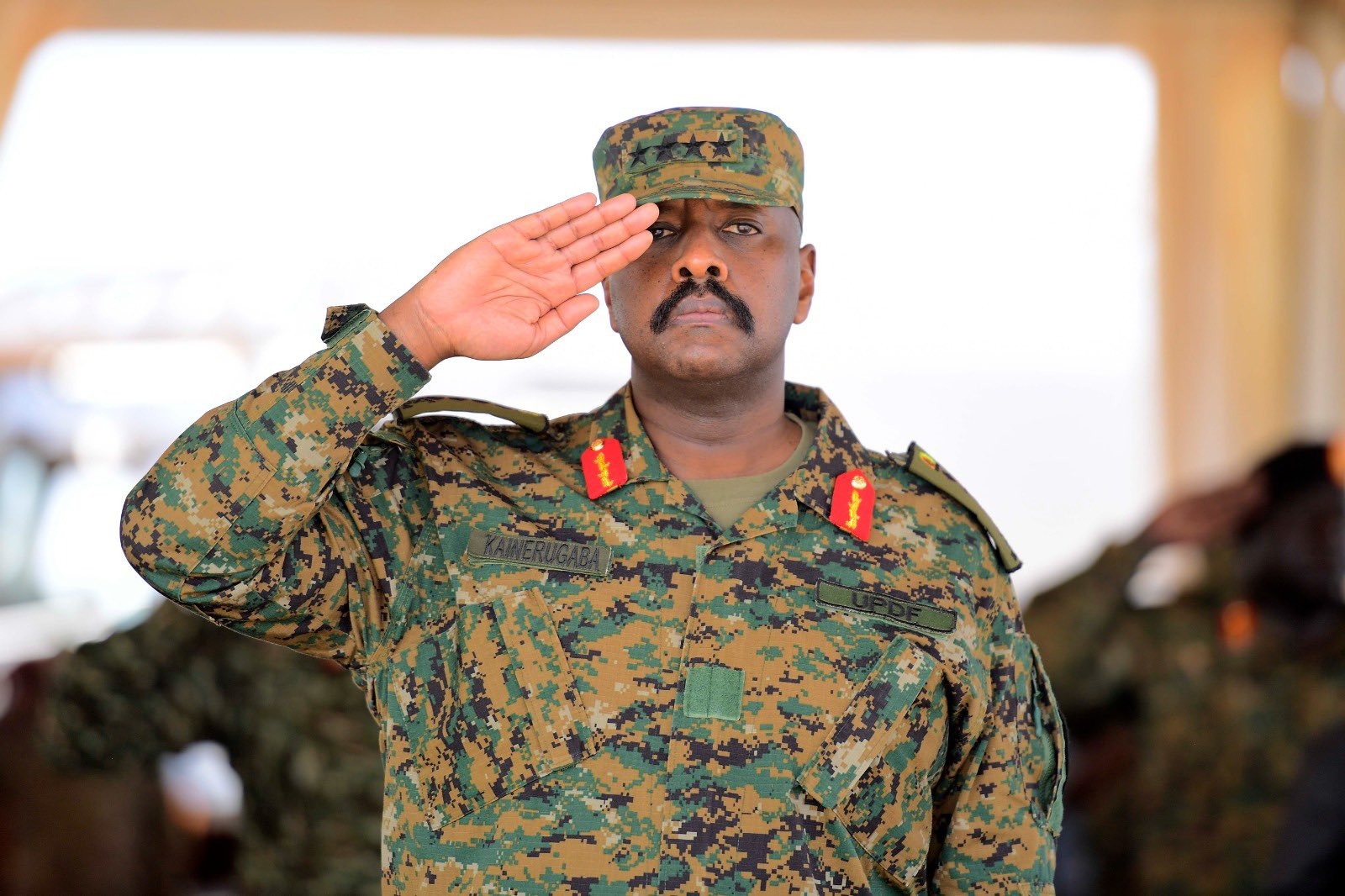
The public fallout between Chief of Defence Forces (CDF) Gen Muhoozi Kainerugaba and Vice President Jessica Alupo has opened a fresh front in Uganda’s increasingly complicated succession politics, with the army chief openly demanding that the country’s second-highest political office be handed over to him.
In an extraordinary series of posts on X on Monday, November 9, Gen Muhoozi turned his guns on Ms Alupo, questioning her loyalty to President Museveni, threatening her removal from government and suggesting that he would make a better Vice President.
The military chief went further, declaring that Uganda’s so-called “gynocracy” was coming to an end, in remarks that appeared to challenge not only Ms Alupo’s continued stay in office but also the place of women in the country’s political leadership.
His statements, delivered through his personal X account, @mkainerugaba, have generated intense debate about the increasingly blurred boundaries between the military establishment, the ruling National Resistance Movement (NRM) and the political ambitions of the President’s son.
The controversy took another dramatic turn on Tuesday morning when the CDF’s X account became inaccessible, displaying a message indicating that the account did not exist.
Reports by several media outlets indicated that the account had been deactivated shortly after the controversial posts. There was, however, no official confirmation that X had suspended it or that the military chief had permanently abandoned the platform.
The disappearance of the account has done little to contain the controversy, with screenshots of the posts continuing to circulate and Ugandans dissecting what they perceive as an extraordinary attempt by a serving military commander to publicly position himself for a constitutional political office.
The demand to replace Alupo
Gen Muhoozi’s latest confrontation with the Vice President followed a series of cryptic posts in which he referred to a woman named Jessica, saying she had occupied a position he considered his for too long.
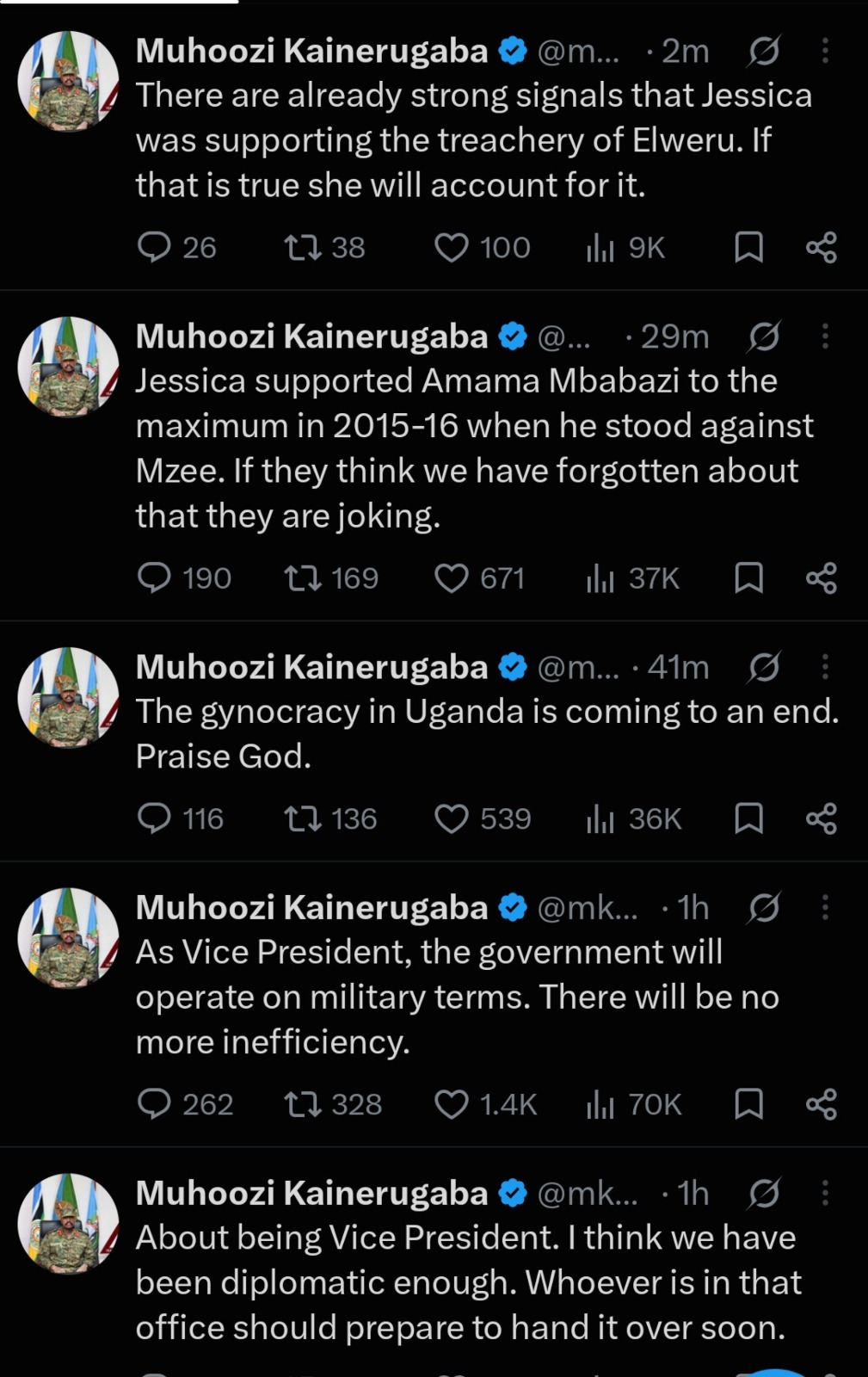
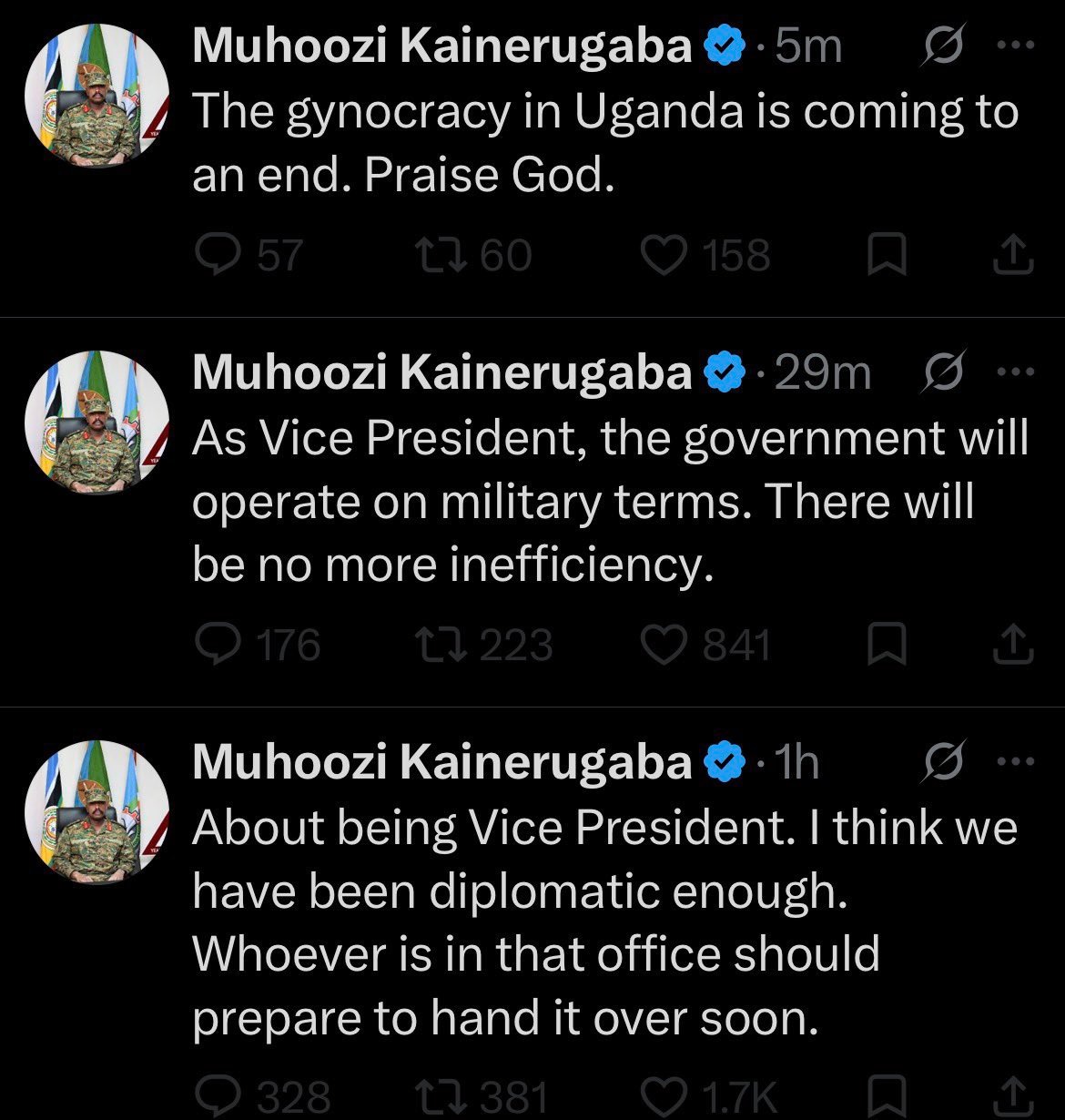
He subsequently removed any ambiguity about the office he was referring to. “About being Vice President. I think we have been diplomatic enough. Whoever is in that office should prepare to hand it over soon,” he wrote.
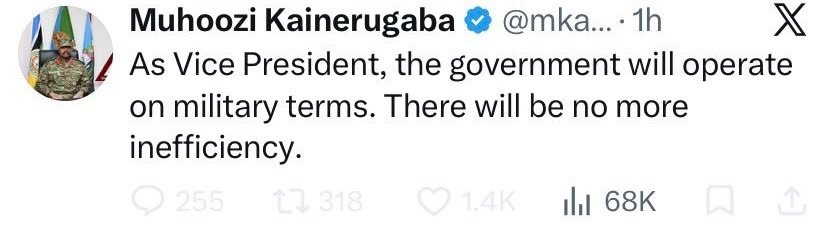
In another post, he offered an indication of how he intended to govern if appointed to the position. “As Vice President, the government will operate on military terms. There will be no more inefficiency,” he declared.
He then directly targeted Ms Alupo, saying: “As Deputy Commander-in-Chief, Jessica will be dismissed from our government soon. We have very many supporters in Teso. We don’t have to rely on traitors.”
The CDF also invoked the 2015–2016 political contest involving former Prime Minister Amama Mbabazi, who challenged President Museveni in the 2016 presidential election.
“Jessica supported Amama Mbabazi to the maximum in 2015-16 when he stood against Mzee. If they think we have forgotten about that they are joking,” he posted.
In another particularly provocative statement, Gen Muhoozi appeared to suggest that Ms Alupo had overstayed in an office he expected to occupy.
The remarks were not merely a criticism of the Vice President’s performance. They amounted to an explicit declaration of interest in her position, accompanied by a threat of political consequences. For a serving CDF, whose responsibilities include commanding the Uganda People’s Defence Forces (UPDF), the intervention raised fundamental questions about the relationship between military command and civilian constitutional authority. Ms Alupo had not publicly responded to the latest accusations at the time of writing.
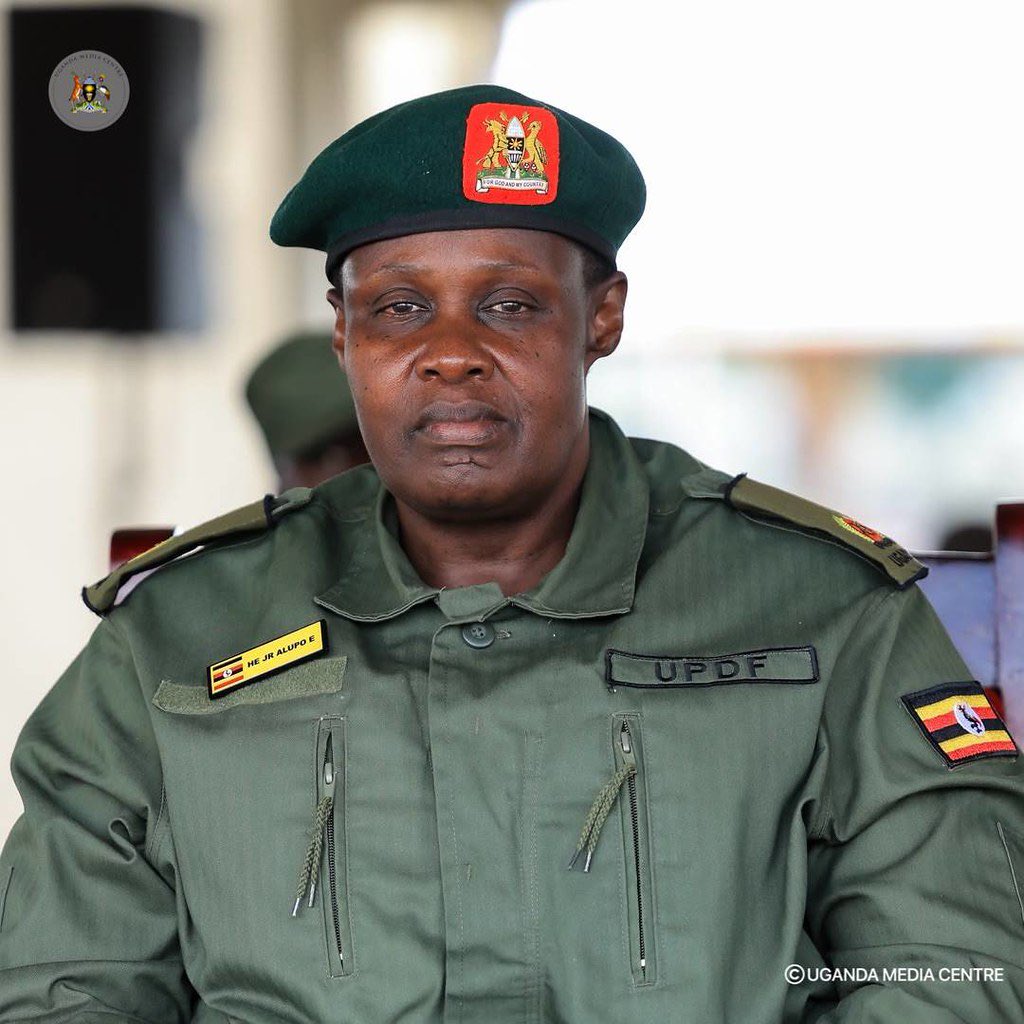
The ‘gynocracy’ declaration and the politics of women in government
Perhaps the most politically loaded statement in the series was Gen Muhoozi’s declaration that the country’s alleged female-dominated political order was coming to an end. “The gynocracy in Uganda is coming to an end. Praise God,” he wrote.
Gynocracy refers to a system of government or political order in which women exercise dominant authority. The statement immediately attracted criticism, with commentators questioning what the CDF meant by suggesting that Uganda was being governed by women.
It also raised questions about whether his proposed political changes were limited to Ms Alupo’s position or reflected a broader hostility towards women’s representation in government. One of the most detailed reactions came from social media commentator Godwin Toko, who dismissed the CDF’s description of Uganda as a gynocracy.
In a post on X, Toko argued that the country’s political system was better understood as a family-centred political establishment than one dominated by women.
“That women call the major shots here, & run the state. That’s blatantly false, a mockery of women even! Uganda is a familiocracy, a literal family business,” Toko wrote.
He questioned the assumption that women occupying prominent government positions necessarily translated into meaningful political power.
According to him, some women held senior positions, but their presence should not be confused with having control over the country’s most consequential political decisions.
Toko’s reaction captured a wider debate about the distinction between political representation and actual power, particularly in a political establishment where President Museveni’s family connections have become an increasingly prominent subject of public discussion.
His argument was that the concentration of political influence around the first family, rather than women as a collective, better explained Uganda’s political arrangements.
He also questioned the logic behind Gen Muhoozi’s suggestion that military leadership would solve Uganda’s governance problems.
“Uganda today is one of the MOST MILITARISED countries anywhere in the world,” he wrote, arguing that the growing involvement of the military in civilian institutions had coincided with worsening administrative inefficiencies.
He cited the military’s involvement in areas including education, healthcare, traffic management and road construction, arguing that Uganda’s problems could not be solved simply by extending military authority into government administration.
“For Uganda to be efficient, send military men back to their primary role of securing our borders,” he argued.
Toko’s criticism was significant because it challenged two central elements of the CDF’s intervention: his description of Uganda as a gynocracy and his proposal to introduce military-style administration through the Vice Presidency.
Why Alupo became the target
The immediate question is why Ms Alupo, who has served as Vice President since 2021 and was retained following the 2026 elections, suddenly became the subject of such an aggressive public campaign.
Her political journey has been closely associated with the NRM establishment. A retired army major, Ms Alupo previously served in Parliament and held several ministerial responsibilities, including the Ministry of Education and Sports, before President Museveni appointed her Vice President in May 2021.
She replaced Edward Kiwanuka Ssekandi, becoming Uganda’s second female Vice President after Specioza Kazibwe.
Her appointment was widely interpreted as a strategic political decision, with considerations of regional representation, gender balance and the ruling party’s political interests.
She also became one of the senior political figures expected to represent the President at official engagements, national functions and international meetings.
However, Gen Muhoozi’s latest accusations have revived questions about the circumstances surrounding her rise and the political relationships that may have influenced her appointment.
His reference to Amama Mbabazi is particularly interesting. Mbabazi, who served as Prime Minister between 2011 and 2014, fell out with President Museveni after declaring his presidential ambitions ahead of the 2016 elections.
His departure exposed divisions within the NRM establishment, with several political figures suspected of supporting his presidential bid facing political consequences.
Gen Muhoozi now appears to be using that historical episode to question Ms Alupo’s political loyalty.
But the allegations remain his own assertions. No evidence was presented in the posts to establish that the Vice President engaged in wrongdoing or that her appointment was obtained through Mbabazi’s influence.
The political significance is that a serving military commander has publicly resurrected an old political grievance to challenge the continued suitability of a sitting Vice President.
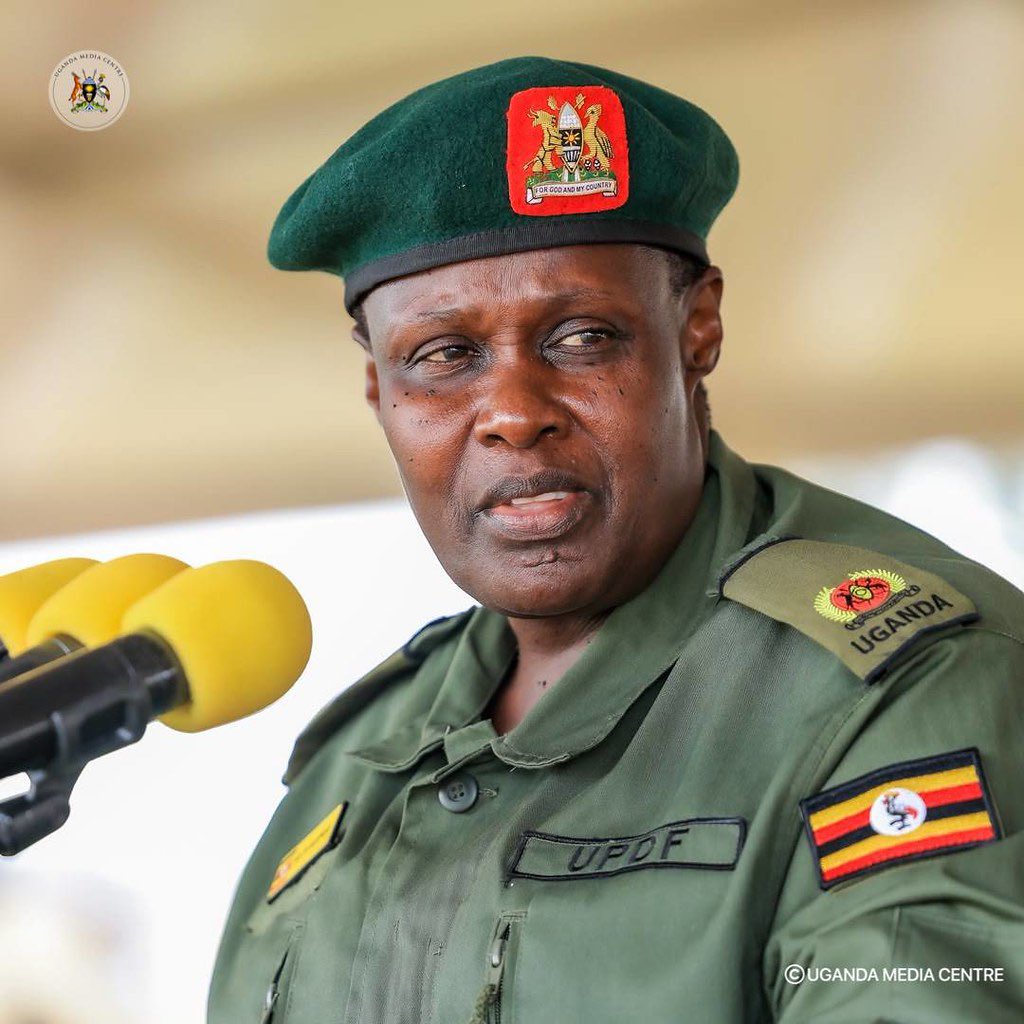
The succession battle behind the Alupo confrontation
The Alupo controversy cannot be separated from the wider debate about the political future of President Museveni and the growing prominence of his son.
Gen Muhoozi occupies several influential positions. He is the Chief of Defence Forces, Senior Presidential Advisor for Special Operations and chairman of the Patriotic League of Uganda (PLU), a political movement whose activities have increasingly attracted attention in the succession debate.
His supporters have openly presented him as a future national leader, while his critics question the growing intersection between his military responsibilities and political ambitions.
The CDF’s latest declaration about the Vice Presidency therefore carries significance beyond the personal disagreement with Ms Alupo. It is a public statement about where he sees himself in the country’s political hierarchy.
The timing is also noteworthy because Gen Muhoozi recently announced that he intended to leave the position of CDF in the coming months and dedicate himself to Christianity after handing over command to another qualified officer.
He subsequently indicated that he would remain in the position for at least another year. His latest remarks about replacing Ms Alupo introduce another dimension to that uncertainty: whether his political ambitions are being pursued independently of his military career or whether the two are becoming increasingly intertwined.
For the NRM establishment, the development creates an uncomfortable political question.
The President remains the appointing authority for the Vice President, subject to parliamentary approval. Under Article 108 of the Constitution, the Vice President is appointed by the President and approved by Parliament. The office is therefore not a position that can be claimed or transferred through a military commander’s public declaration.
Gen Muhoozi’s father, President Museveni, appointed both him to the military’s top command and Ms Alupo to the Vice Presidency.
Consequently, the CDF’s public demand puts the President in an unusual position: his son is openly challenging the continued tenure of a senior official serving in his government.
Whether the remarks reflect an independently held political position or a wider disagreement within the ruling establishment remains unclear.
Social media asks: Who is running government?
The reaction to the CDF’s posts went beyond the question of whether Ms Alupo should remain Vice President.
A second lengthy social media commentary, circulated amid the controversy, framed the developments as evidence of a deeper succession struggle within the first family and the NRM.
The writer argued that the country’s political establishment had become increasingly divided between individuals seeking to preserve President Museveni’s authority and those perceived to be advancing Gen Muhoozi’s succession ambitions.
The post suggested that some senior NRM figures had failed to organise a coherent response to the growing political influence of the PLU camp.
It also questioned the silence of established party figures who had previously criticised some of President Museveni’s political decisions but continued to support his presidency.
The writer cited politicians including Kahinda Otafiire, Chris Baryomunsi, Theodore Ssekikubo, Barnabas Tinkasiimire and Wilfred Niwagaba, arguing that their failure to take a decisive position had left them spectators in a succession debate increasingly dominated by Gen Muhoozi’s political allies.
The commentary also revisited the political history of Mbabazi and the failed succession manoeuvres associated with other members of the first family.
Its central argument was that the current political establishment had underestimated the organisational and political ambitions of the Muhoozi camp.
Although the writer’s claims about internal family disagreements and alleged succession manoeuvres remain unverified, the commentary illustrates the level of suspicion surrounding the relationship between State House, the military and the PLU.
Another particularly provocative part of the post questioned President Museveni’s political decision-making, suggesting that some individuals around him were exploiting his age and the uncertainties surrounding succession.
These are allegations and political interpretations, not established facts. Nevertheless, their circulation demonstrates how Gen Muhoozi’s latest statements have provided fresh ammunition for speculation about the future of the NRM government.
Why the disappearance of @mkainerugaba matters
The disappearance of Gen Muhoozi’s X account added another layer of intrigue to an already explosive political episode.
By Tuesday morning, November 10, attempts to access @mkainerugaba returned a message indicating that the account did not exist.
Media reports attributed the disappearance to deactivation rather than a confirmed suspension by X. No explanation had been issued by the CDF, the UPDF or State House regarding the decision.
The development raised questions about whether the military chief had voluntarily withdrawn from the platform following the backlash or whether there had been pressure to stop the public confrontation.
It is not the first time Gen Muhoozi has abandoned X following controversial political statements.
In 2022, his remarks about the possibility of capturing Nairobi within two weeks triggered a diplomatic dispute between Uganda and Kenya, forcing President Museveni to publicly apologise to Kenya.
In January 2025, he also announced his departure from the platform, saying he wanted to concentrate on his military responsibilities. He returned six days later with a brief message declaring: “I’m back!”
His latest disappearance therefore fits a pattern of dramatic social media exits followed by eventual returns.
However, the circumstances surrounding the latest episode are particularly sensitive because his posts directly targeted a serving Vice President and appeared to suggest that he could take over her constitutional office.
The constitutional question: Can a CDF demand the Vice Presidency?
Beyond the personal attacks, Gen Muhoozi’s statements have revived an important constitutional debate about the limits of military authority in Uganda’s political system. The Vice Presidency is a constitutional office established under Article 108 of the Constitution.
The President appoints the Vice President, subject to approval by Parliament. If the position becomes vacant, the President is required to appoint a replacement within 14 days, again subject to parliamentary approval.
There is no constitutional provision granting the Chief of Defence Forces an entitlement to the Vice Presidency or authority to remove its occupant.
Gen Muhoozi’s declaration that the government would operate on military terms if he became Vice President therefore raises questions about the relationship between military command and civilian political leadership.
The CDF is responsible for the command and administration of the armed forces, while the country’s political administration is governed by constitutional institutions.
The suggestion that military-style administration would automatically eliminate inefficiency also attracted criticism from commentators who argued that Uganda’s governance challenges are rooted in institutional weaknesses, accountability and political decision-making rather than the absence of military leadership.
Toko’s argument that Uganda is already heavily militarised reflects this concern. The controversy is particularly significant because Gen Muhoozi is not an ordinary political commentator. He is a serving four-star general occupying the country’s highest military command position.
His statements therefore carry institutional weight beyond the usual political exchanges on social media.
Alupo’s silence and Museveni’s difficult balancing act
For now, Ms Alupo’s response remains one of the biggest unanswered questions. The Vice President has not publicly engaged the CDF over the accusations, including the allegation that she supported Mbabazi during the 2016 presidential contest.
Her silence could reflect a decision to avoid escalating a confrontation involving the President’s son and the country’s most senior military officer.
But the absence of a public response does not diminish the political significance of the accusations. President Museveni also faces an uncomfortable balancing act.
On one hand, he appointed Ms Alupo to the Vice Presidency and retained her after the 2026 elections. On the other, his son has publicly declared that the office should be handed over and threatened the incumbent with dismissal.
The President’s response, or lack of one, could become an important indicator of how the succession question is being managed within the ruling establishment.
It would also be significant to see whether the NRM leadership, Cabinet and parliamentary caucus address the growing controversy.
For years, Gen Muhoozi’s social media interventions have frequently generated political storms, with senior government officials and ruling party supporters sometimes rushing to interpret or defend his statements.
The latest confrontation, however, is different because it involves a sitting constitutional officeholder and an explicit expression of interest in replacing her.
It also places the military institution at the centre of a political debate that should ordinarily be resolved through civilian constitutional processes.
A new chapter in the succession debate
The Alupo confrontation has exposed the increasingly complicated relationship between the first family, the military establishment and the NRM political structure.
It has also revived the debate about whether Gen Muhoozi’s political ambitions are moving beyond the 2031 presidential conversation to include immediate changes in the country’s executive leadership.
His declaration that Uganda’s gynocracy is coming to an end, coupled with his demand that Ms Alupo vacate the Vice Presidency, has transformed what might have been another social media outburst into a significant political controversy.
For Ms Alupo, the confrontation presents a challenge to her political standing after years of service within the NRM establishment.
For Gen Muhoozi, it raises questions about the boundaries between his military responsibilities and his publicly expressed political ambitions.
And for President Museveni, it creates another test of his ability to maintain political cohesion within a government increasingly confronted by questions about succession. The most intriguing question is no longer simply whether @mkainerugaba will return to X.
It is whether the President will publicly address his son’s demand to replace the Vice President, whether the NRM will defend the constitutional position of its second-highest officeholder, and whether the latest confrontation signals a deeper struggle over who controls the political future of Uganda.
For now, the CDF’s account may have disappeared from X, but the political questions raised by his posts are unlikely to disappear with it.
Author Profile

- Charles Gazza Kodili is a seasoned journalist with over 20 years of experience in the media industry. He holds a Bachelor of Arts degree in Mass Communication. He’s currently the Chief Editor at the Investigator.
Charles can also be reached via; Tel: +256 774 108978
Email: [email protected]
Latest entries
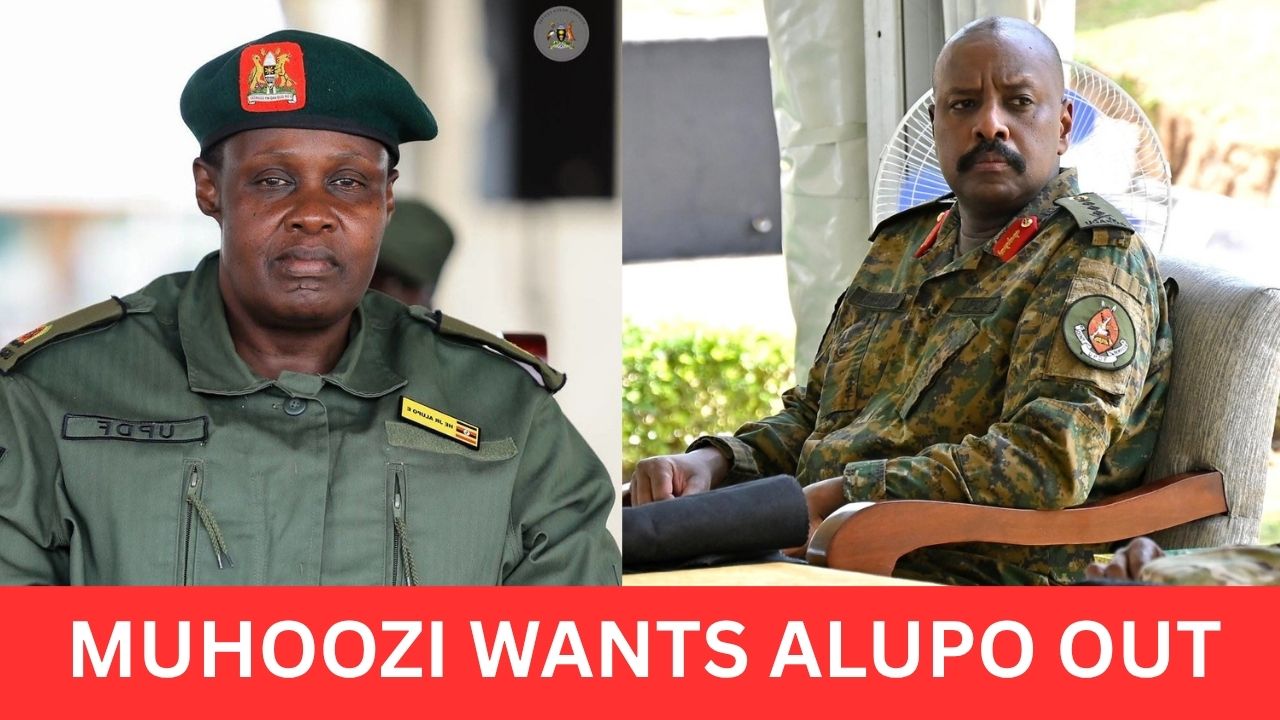 FeaturedNovember 10, 2026MUHOOZI DECLARES WAR ON JESSICA ALUPO: The CDF’s Explosive Tweets Demanding The Vice President’s Removal, Accusing Her Of Backing Mbabazi And Declaring An End To Uganda’s Alleged Gynocracy Have Exposed Fresh Tensions Within The Museveni Establishment
 FeaturedNovember 10, 2026HOW STATE HOUSE OFFICIAL TURNED KYENDIRA’S CHILDREN INTO VICTIMS OF THEIR OWN INHERITANCE: She Was Entrusted With Powers Of Attorney To Recover Their Late Father’s Estate And Agreed To Take 10 Acres As Payment. But The Family Now Accuses Naomi Ruth Nakatude Tasumba Of Forging Their Signatures And Plotting To Transfer The Entire 78-Acre Property To Herself And Her Children
 FeaturedNovember 10, 2026WHY BIGIRIMANA, OKIDI AND OKALANY WERE SHOWN THE EXIT: What Triggered The Departures Of Bigirimana, Okidi, Okalany And Other Long-Serving Permanent Secretaries? Inside The Succession Battle, Performance Questions And Changing Priorities Behind The Biggest Civil Service Shake-Up In Years
 BusinessNovember 9, 2026EQUITY BANK vs DEI PHARMACEUTICALS: Inside the Muwema-Equity Bank Showdown Over Magoola’s Impending Property Auction