











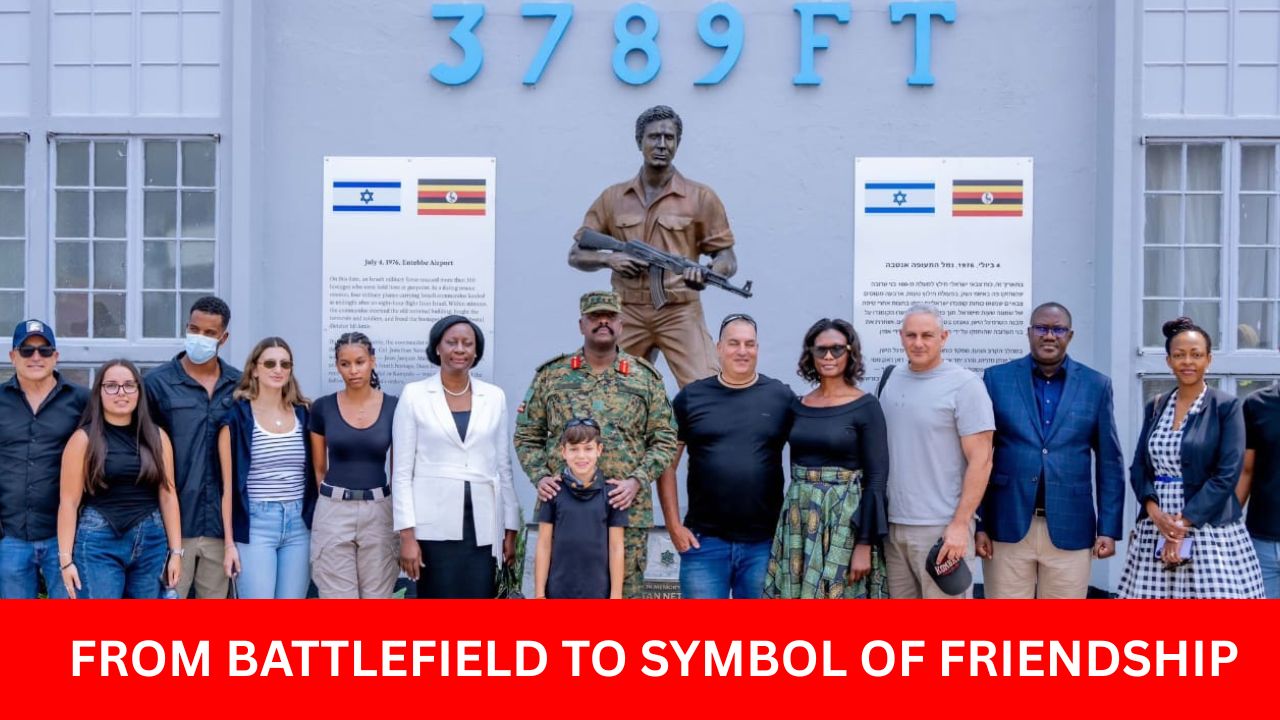
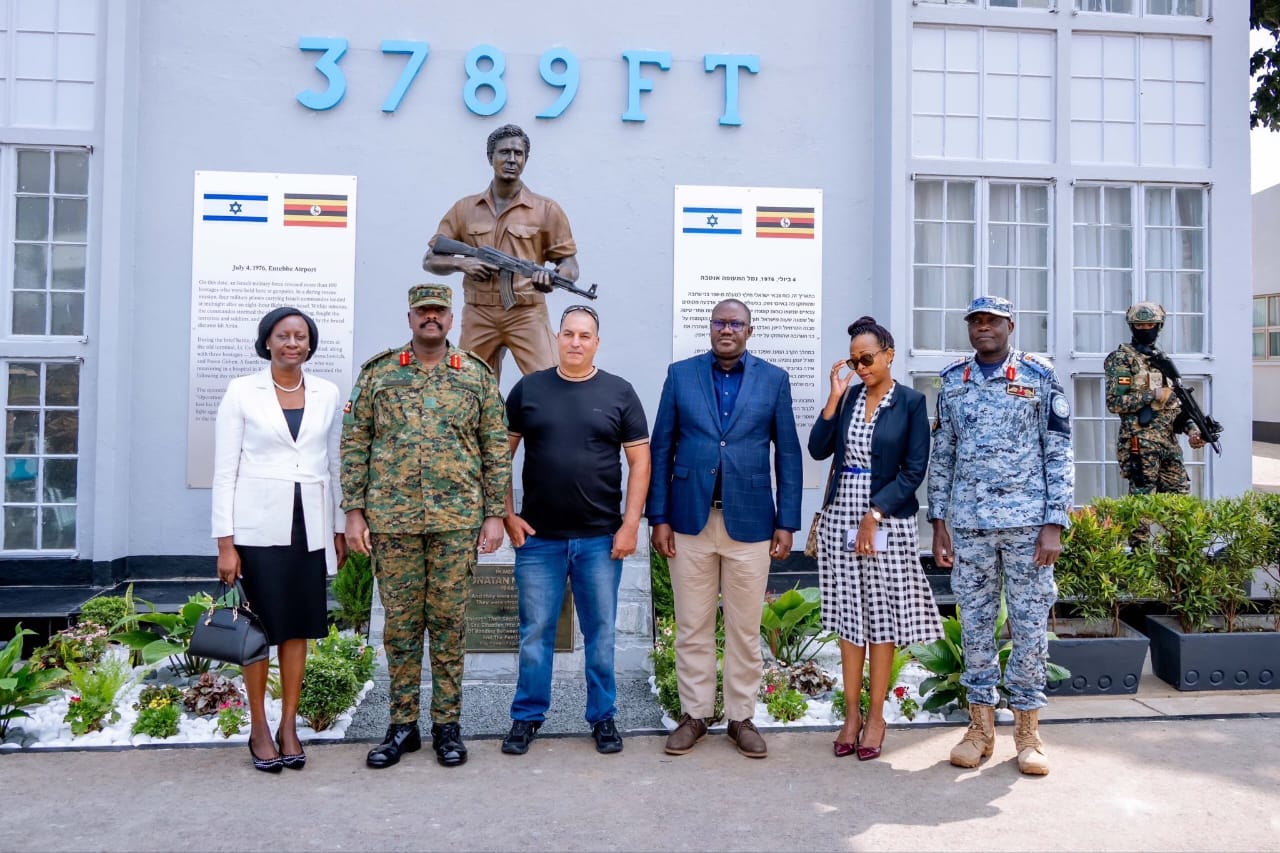
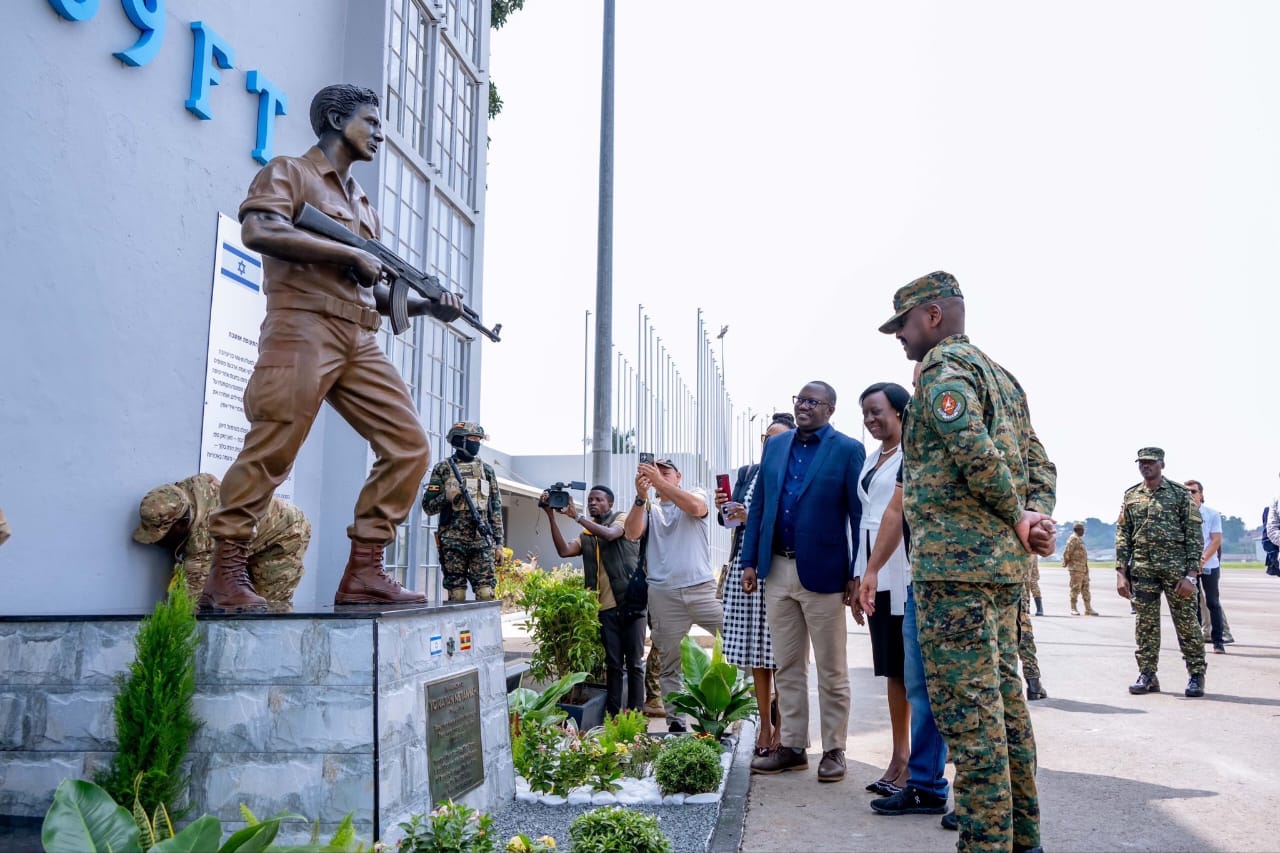
Exactly fifty years after one of the world’s most daring military rescue operations reshaped modern counter-terrorism, Uganda on Saturday took another symbolic step in rebuilding its historical relationship with Israel as Chief of Defence Forces Gen Muhoozi Kainerugaba unveiled a monument in honour of Lieutenant Colonel Yonatan “Yoni” Netanyahu at the Old Entebbe Airport Terminal.
The monument stands at the very place where the elite Israeli commander was fatally shot while leading Operation Entebbe—also known as Operation Thunderbolt—on July 4, 1976. Netanyahu, the elder brother of Israeli Prime Minister Benjamin Netanyahu, remains the only Israeli soldier killed during the dramatic rescue mission that freed more than 100 hostages from hijackers under the protection of Idi Amin’s regime.
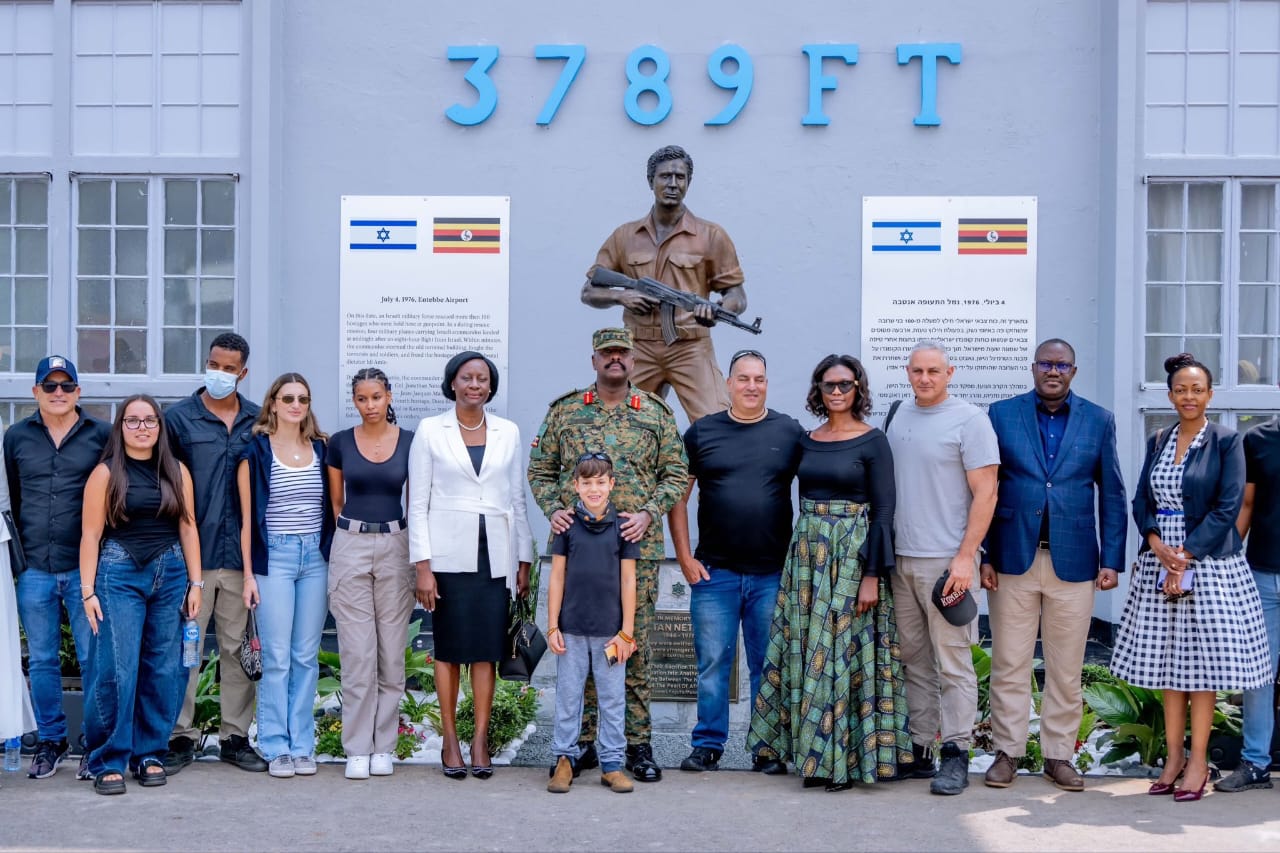
Saturday’s ceremony was attended by senior military officers, government officials, diplomats and representatives of the Israeli community, marking what Gen Kainerugaba described as a new chapter in the friendship between Uganda and Israel.
Remembering a Soldier Who Became a Symbol
Addressing guests at the historic site, Gen Kainerugaba said it was both an honour and privilege to commemorate a soldier whose courage has inspired military professionals across the world for five decades.
“It is a great honor and privilege to join you at this historic site as we unveil this monument to Lieutenant Colonel Yonatan ‘Yoni’ Netanyahu, the courageous commander of the Israeli rescue force whose leadership and ultimate sacrifice during the Entebbe raid of 4th July 1976 has become an enduring symbol of courage, duty, and selfless service,” Gen Kainerugaba said.
He noted that the monument was not merely about remembering one military officer but about preserving values that transcend generations.
“Today, this memorial stands not only in remembrance of a distinguished soldier, but also as a tribute to the enduring values he embodied: courage in the face of danger, unwavering commitment to protecting innocent lives, and steadfast devotion to duty,” he said.
“Monuments are more than stone and bronze. They preserve memory, teach history, and inspire future generations. This monument, therefore, carries significance far beyond commemorating one brave individual.”
The Hijacking That Shocked the World
The story behind the monument dates back to June 27, 1976, when Air France Flight 139 departed Tel Aviv for Paris with a scheduled stopover in Athens.
Shortly after leaving Greece, the aircraft carrying 248 passengers and 12 crew members was hijacked by two members of the Popular Front for the Liberation of Palestine (PFLP) and two German militants belonging to the Revolutionary Cells.
The hijackers diverted the Airbus first to Benghazi in Libya before flying it to Entebbe Airport in Uganda, where President Idi Amin welcomed them and publicly presented himself as a mediator while, in reality, offering protection and logistical support.
The passengers were held inside the Old Entebbe Airport Terminal under armed guard. Over the following days, most non-Israeli and non-Jewish passengers were released, while Israeli citizens and Jewish passengers remained captive.
The hijackers demanded the release of dozens of Palestinian and other militants imprisoned in Israel and several foreign countries, threatening to execute the hostages if their demands were not met.
Operation Thunderbolt
Faced with an impossible deadline, Israel launched one of the most audacious special forces missions in military history.
On the night of July 3, 1976, four Israeli C-130 Hercules transport aircraft flew more than 4,000 kilometres to Uganda in complete secrecy, crossing multiple African airspaces before landing at Entebbe shortly before midnight.
The rescue force included commandos from the elite Sayeret Matkal unit under Lt Col Yoni Netanyahu.
To confuse Ugandan troops guarding the airport, the Israelis famously drove a black Mercedes-Benz and Land Rovers resembling the convoy often used by Idi Amin.
Within minutes of arriving at the terminal, Israeli commandos stormed the building, killing the hijackers and securing the hostages before fierce gun battles erupted with Ugandan soldiers.
The rescue operation lasted roughly 90 minutes.
Of the more than 100 hostages rescued, only three died during the assault, while dozens of Ugandan soldiers were killed in the fighting.
The commandos also destroyed numerous Ugandan Air Force MiG fighter jets stationed at Entebbe to prevent pursuit after take-off.
Lt Col Netanyahu was struck by enemy fire outside the terminal and later succumbed to his wounds, becoming the sole Israeli military casualty.
His death transformed him into one of Israel’s most celebrated military heroes, and the mission was later renamed Operation Yonatan in his honour.
Remembering All Victims
Gen Kainerugaba used Saturday’s ceremony to remember not only the Israeli commander but also innocent civilians who lost their lives during the crisis.
“As we gather here, we also respectfully remember the innocent hostages who lost their lives during those tragic events,” he said.
He specifically named Jean-Jacques Maimoni, Pasco Cohen, Ida Borochovitch and Dora Bloch.
Dora Bloch, an elderly British-Israeli passenger, had been admitted to Mulago Hospital before the raid after falling ill. Following the successful rescue mission, she was murdered on the orders of Idi Amin’s security operatives, an act that drew widespread international condemnation.
Acknowledging Uganda’s Painful Past
In one of the ceremony’s most significant moments, Gen Kainerugaba acknowledged that Ugandan soldiers who confronted the Israeli commandos were acting under the orders of the government they served.
“We also recognize today the Ugandan soldiers who fought valiantly that day in what they believed was a justified cause,” he said.
“Of course, today we know that the government of Idi Amin, which they served, was a brutal dictatorship which did not represent the Ugandan people in any way.”
The remarks reflected an effort to separate Uganda’s present-day government and armed forces from the actions of Amin’s military regime.
“The events that unfolded here in July 1976 remain one of the most significant episodes in modern history,” Gen Kainerugaba observed.
“They occurred during one of the darkest periods in our country’s history. Today, however, Uganda is a constitutional democracy committed to peaceful coexistence and constructive engagement with the international community.”
A Renewed Uganda-Israel Partnership
Relations between Uganda and Israel have undergone a remarkable transformation since President Yoweri Museveni assumed power in 1986.
The two countries now cooperate in security, intelligence sharing, agriculture, technology, health, infrastructure development and counter-terrorism.
Military cooperation has also expanded significantly, with both nations exchanging expertise in special operations and strategic defence.
Gen Kainerugaba said the unveiling of the monument symbolised more than remembrance; it reflected the strength of a relationship built on mutual respect and shared interests.
“The friendship between Uganda and Israel extends well beyond the events of 1976,” he said.
“Our two countries have enjoyed good relations for a long time now, founded on mutual respect and practical cooperation.”
He pledged continued collaboration in addressing emerging global threats.
“As we look to the future, we remain committed to deepening our cooperation across all areas of mutual interest while working together to advance peace, security, innovation, and sustainable development,” he concluded.
History Preserved
The Old Entebbe Airport Terminal has increasingly become both a historical landmark and a symbol of reconciliation between Uganda and Israel.
The unveiling of Yoni Netanyahu’s monument comes as both countries seek to preserve the lessons of one of the twentieth century’s defining counter-terrorism operations while strengthening diplomatic and military ties for the future.
For Israel, Yoni Netanyahu remains the embodiment of sacrifice and military excellence. For Uganda, the monument acknowledges a painful chapter in the country’s history while demonstrating how former adversaries can forge lasting partnerships based on peace, mutual respect and shared security interests.
Half a century after gunfire echoed through the Old Entebbe Terminal, the site now hosts a monument dedicated not to conflict, but to remembrance, reconciliation and the enduring hope that history’s darkest moments can ultimately give rise to stronger international friendships.
Author Profile
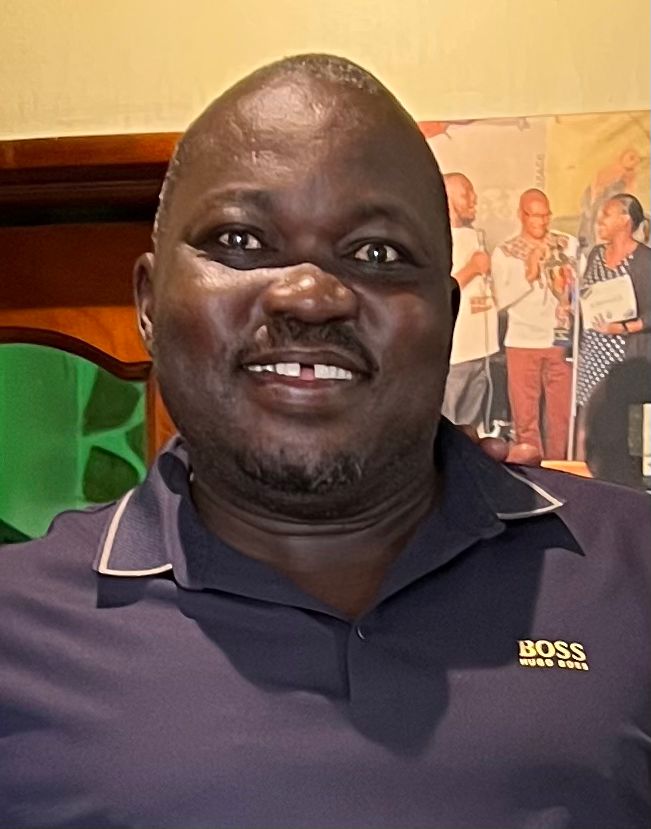
- Charles Gazza Kodili is a seasoned journalist with over 20 years of experience in the media industry. He holds a Bachelor of Arts degree in Mass Communication. He’s currently the Chief Editor at the Investigator.
Charles can also be reached via; Tel: +256 774 108978
Email: [email protected]
Latest entries
 FeaturedSeptember 18, 2026MONEY HAS BEEN WIRED ON CLUBS ACCOUNTS: Each Uganda Premier League Club Is Allocated Sh305.5m Annually, With Sh152.7m Due In The First Quarter As Government Releases 50% Of The Subsidy
 FeaturedSeptember 18, 2026STATE HOUSE FALLOUT: Bishop Patience Museveni Warns Her Big Brother CDF Gen Muhoozi Kainerugaba As The Council of Elders From Ankole Move To Mend Family Rift
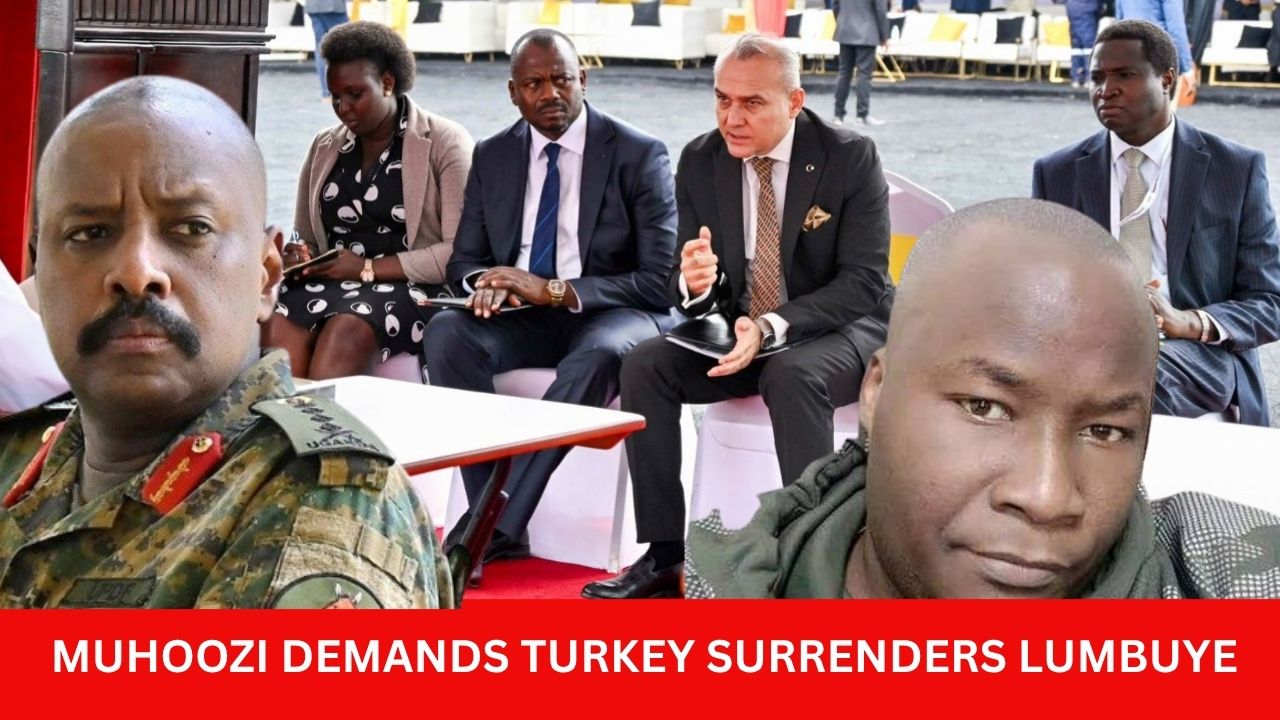 FeaturedSeptember 18, 2026PLU MARCHES TO TURKISH EMBASSY AS MUSEVENI MEETS ENVOY: PLU Supporters Demand Extradition Of Uganda Blogger As President Holds Talks With Turkish Ambassador Mehmet Fatih Ak
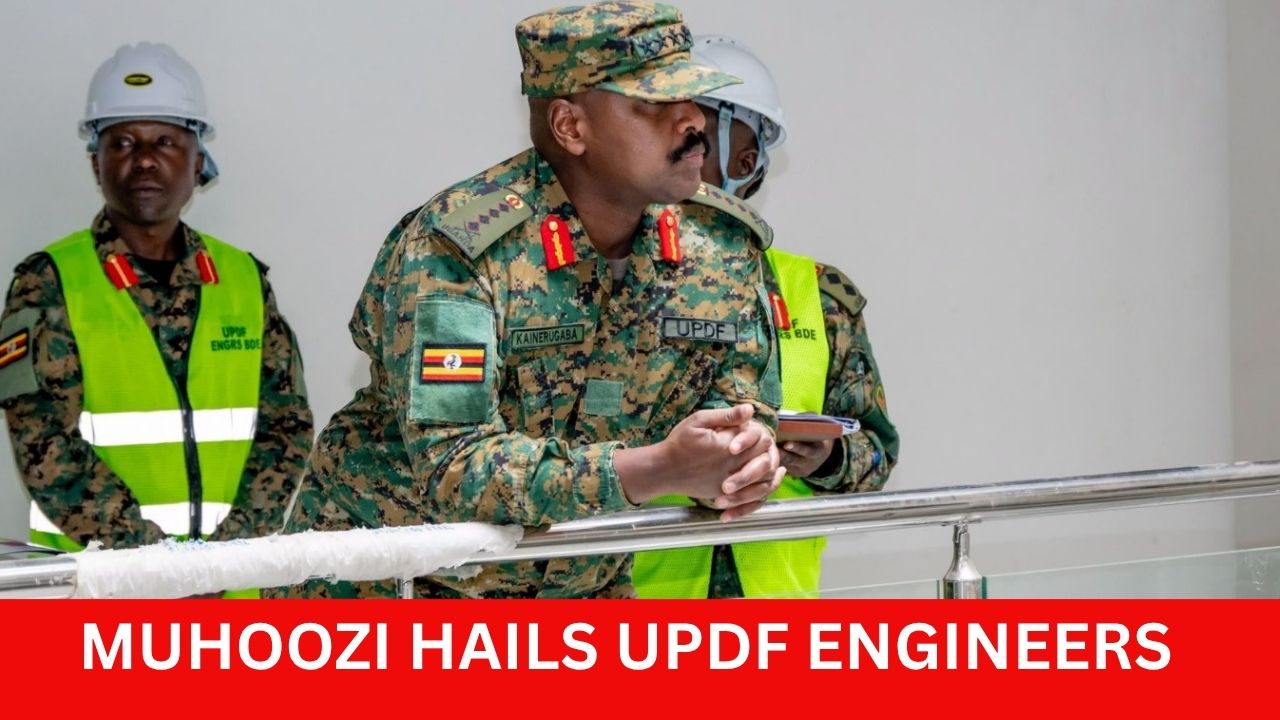 FeaturedSeptember 14, 2026WELL DONE UPDF ENGINEERS: 87% New Defence Headquarters Complete, Gen Muhoozi Kainerugaba Commends Engineers For Speeding Up The Modern Twin-Tower Complex At Mbuya