

















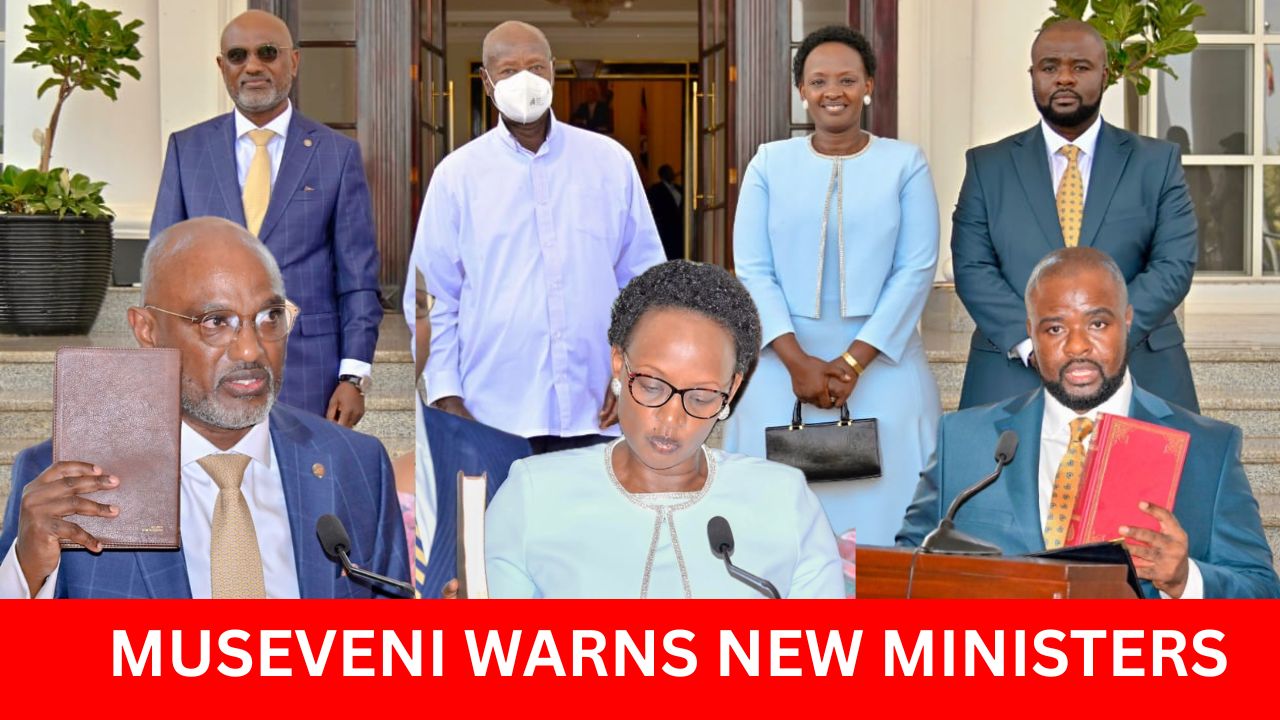
President Yoweri Museveni has sworn in Ambassador Adonia Ayebare as Minister of Foreign Affairs, Shartsi Kutesa Musherure as Minister of State for Finance, Planning and Economic Development in charge of Micro-Finance, and Juma Witonze as Minister of State for Internal Affairs.
The three ministers took their oaths at State House Entebbe, bringing to an end a prolonged wait that had surrounded some of the appointments and adding fresh leadership to three ministries considered central to Uganda’s diplomatic, economic and internal security agenda.
President Museveni, who presided over the ceremony, congratulated the ministers and challenged them to concentrate on improving the performance of government institutions rather than treating their appointments merely as political positions.
In a message following the ceremony, Museveni said the ministers must make the fight against corruption and inefficiency a priority.
“I congratulate them and urge them to focus on eliminating corruption and inefficiency in Government through proper supervision and accountability.”
The President’s warning places the new ministers under pressure to demonstrate results in ministries that have significant responsibilities in Uganda’s national administration.
Ambassador Ayebare takes charge of the Ministry of Foreign Affairs at a time when Uganda continues to deepen its engagement with neighbouring countries, the wider East African region, Africa and international partners.
His diplomatic experience is expected to be central to his new assignment, particularly as Uganda continues to pursue regional integration, economic diplomacy and strategic international partnerships.
Musherure, meanwhile, assumes responsibility for the Micro-Finance portfolio under the Ministry of Finance, Planning and Economic Development. Her assignment comes as government continues to push financial inclusion, access to affordable credit and programmes intended to expand economic opportunities for households and small businesses.
Witonze joins the Ministry of Internal Affairs, a portfolio responsible for several institutions dealing directly with citizens and national security, including immigration, citizenship, national identification and internal security.
His appointment follows the rejection of the nomination of Dr Lawrence Muganga, who had initially been designated for the same position. Parliament’s Appointments Committee rejected Muganga’s nomination amid questions surrounding his citizenship status. Witonze was subsequently nominated and approved by Parliament’s Appointments Committee in July.
Why the swearing-in took so long
The delayed swearing-in of Ayebare and Musherure was largely linked to Uganda’s dual-citizenship requirements.
When President Museveni’s new Cabinet was announced earlier this year, several nominees did not take the oath alongside the rest of the Cabinet because questions had emerged over their citizenship status.
Ayebare, Musherure, David Calvin Echodu and Dr Lawrence Muganga were among those affected. Government officials explained that the issue had to be resolved before the affected nominees could formally assume ministerial office.
The controversy centred on Uganda’s constitutional provisions governing public office and citizenship. While Uganda allows qualifying citizens to hold dual citizenship, the constitutional framework imposes restrictions on dual or multiple citizens holding certain offices, including ministerial positions, unless the relevant foreign citizenship has been lawfully renounced.
Reports at the time indicated that Ayebare and Musherure had been required to complete the process of renouncing their United States citizenship before taking the ministerial oath.
The delay was therefore not simply an administrative scheduling issue. It involved questions of constitutional eligibility and the legal validity of their appointments.
President Museveni had sought legal guidance on the matter, with the Head of Public Service and Secretary to Cabinet, Lucy Nakyobe, and government lawyers involved in reviewing the citizenship questions.
Government lawyers reportedly advised that the affected ministers should not be sworn in until the citizenship issues had been resolved, because proceeding before completion of the renunciation process could expose the appointments to legal challenges.
By July, however, Ayebare and Musherure had completed the required renunciation process, clearing the way for them to take office. President Museveni subsequently directed the Head of Public Service to arrange their swearing-in.
The issue has now become part of a wider conversation about the place of dual citizens in Uganda’s public service.
Museveni revisits dual citizenship
Interestingly, Museveni returned to the citizenship question during the swearing-in ceremony itself. The President said Uganda’s dual-citizenship arrangement had emerged from the country’s difficult history, but cautioned citizens who hold more than one nationality to be clear about their ultimate loyalty.
“On dual citizenship, I stressed that while the arrangement was introduced to address Uganda’s difficult history, people must be clear about where their loyalty lies.”
Museveni linked the debate to his long-standing argument for deeper East African integration.
“Ultimately, the East African Federation remains the long-term solution to questions of identity and integration in our region.”
His remarks suggest that the citizenship debate should not be viewed only through the narrow question of whether an individual holds a foreign passport. For Museveni, the broader challenge is how Uganda and the East African Community can manage questions of identity, mobility, citizenship and political belonging as regional integration advances.
The issue is particularly significant given the increasing movement of East Africans across national borders for work, business, education and investment.
A second chance for a delayed Cabinet
The swearing-in also represents the completion of a process that began with the formation of Museveni’s new Cabinet.
The initial Cabinet swearing-in ceremony at State House Entebbe was attended by most of the appointed ministers, but several nominees were left out because of unresolved questions. Reports at the time indicated that government had been advised to postpone the oath-taking of those affected until their citizenship matters were conclusively handled.
For Ayebare and Musherure, the eventual ceremony therefore represents the conclusion of a legal and administrative process that lasted several weeks.
For Witonze, the journey was different. His appointment followed the rejection of Muganga’s nomination and subsequent parliamentary approval of his own nomination. Parliament’s Appointments Committee approved Witonze after vetting him in late July, paving the way for his formal appointment and swearing-in.
The three ministers now face the more important test: performance. Museveni’s warning about corruption and inefficiency suggests that the President expects them to move quickly from ceremony to execution.
At Foreign Affairs, Ayebare will be expected to advance Uganda’s diplomatic interests and strengthen the country’s international relationships.
At Micro-Finance, Musherure will have to help translate government financial-inclusion programmes into practical benefits for ordinary Ugandans and small enterprises.
At Internal Affairs, Witonze enters a ministry whose work affects some of the most visible government services, including national identification, immigration, citizenship and internal security. For all three, Museveni’s message was clear: the oath is only the beginning.
The President wants ministers who supervise government agencies effectively, demand accountability and confront corruption and inefficiency.
As the ministers begin their assignments, their ability to turn those presidential directives into measurable improvements will ultimately determine how their delayed arrival in government is remembered—not as a controversy over citizenship, but as the beginning of a new phase of public service.
Author Profile
- Charles Gazza Kodili is a seasoned journalist with over 20 years of experience in the media industry. He holds a Bachelor of Arts degree in Mass Communication. He’s currently the Chief Editor at the Investigator.
Charles can also be reached via; Tel: +256 774 108978
Email: [email protected]
Latest entries
 FeaturedSeptember 25, 2026SAIL WELL MOSES MATOVU: Thousands Of Mourners Gather In Kyanja to Honour Afrigo Band Surviving Founder, Prince Kassim Nakibinge Calls for Justice as Gen. Muhoozi Contributes UGX15m
 FeaturedSeptember 24, 2026NSSF SAVERS HIT JACKPOT: Government Declares Record 22.53% Interest As Fund Revenue Soars To Sh6.51 Trillion, Triggering Celebrations Among Millions Of Members
 FeaturedSeptember 24, 2026OYO’S TEXAS SON BLOCKED! MUSUUGA: WE WON’T ACCEPT HIM: Tooro Throne War Explodes Over Baby Oyo As Kamurasi Rejects Secret Return, Demands Royal Regalia Back
 crime NewSeptember 24, 2026MATOVU’S LOVE-NEST DEATH! Afrigo Boss Allegedly Killed by Rival at Girlfriend’s One-Room House, He Had Just Dropped Beauty Queen Rose Tumusiime Before the Deadly Encounter