






















From the kickboxing ring to the home of a battle-hardened general, Patricia “Black Pearl” Apolot Elwelu has lived a life that combines sporting ambition, personal choices and proximity to Uganda’s military establishment.
 Now, reports that she was among those arrested during a raid on her husband’s home have brought renewed attention to the world champion whose rise was built on determination and discipline.
For years, Apolot made her name by taking on opponents in the ring, exchanging punches and kicks with fighters who stood between her and championship titles. Her career took her from the modest surroundings of Ngora District in eastern Uganda to international competitions, where she won recognition as one of the country’s leading female kickboxers.
But this week, the spotlight shifted from her sporting achievements to her private life after Chief of Defence Forces Gen Muhoozi Kainerugaba reportedly announced that security personnel had captured about 20 escorts attached to retired Lt Gen Peter Elwelu, including Apolot, during a raid on the former general’s home.
The reported arrest has raised questions about the circumstances surrounding the operation and the position of a celebrated sportswoman married to a senior military officer whose career has become associated with some of Uganda’s most controversial security operations.
The circumstances of Apolot’s reported detention, the allegations against those arrested and whether she faces any charges require clarification from the relevant authorities. Her reported presence at the residence does not, by itself, establish wrongdoing.
For a woman whose public identity was built around sporting excellence, the development has placed her in an unfamiliar kind of contest: one fought not under the lights of a sporting arena, but amid the uncertainty surrounding her husband’s military troubles.

From Ngora to the international stage
Born on November 6, 1990, to Josephine Aujo and Emmanuel Mukula, Apolot grew up in Ngora, in the Teso sub-region of eastern Uganda. She spent much of her childhood under the care of her maternal great-grandmother, an upbringing that preceded her eventual emergence as an internationally recognised martial artist.
Her early life was not a straightforward journey towards professional sport. Like many young Ugandans trying to identify a career path, she explored different opportunities before finding a discipline in which she could distinguish herself.
Apolot attended St Aloysius Primary School from 1996 to 2002 before joining Teso Integrated Secondary School. She completed her Ordinary Level studies in 2006 and her Advanced Level education in 2008.

After completing school, she relocated to Kampala to live with her mother. The move exposed her to a wider range of opportunities, but it also marked the beginning of a period of experimentation as she searched for a profession that suited her ambitions.
She explored vocational pursuits and considered different careers, including police training. Football became one of her serious interests, and she played for Proline Football Academy for nearly two years.
Her involvement in football reportedly took her to a high competitive level, including appearances in matches involving Uganda’s national team. It was a promising route, but it was not the one that would ultimately make her famous.
In 2010, Apolot turned to boxing. Three years later, she moved into kickboxing, a combat sport that combines punching techniques with kicks and demands considerable physical conditioning, timing, balance and tactical awareness. By 2014, she had turned professional.
The transition required more than physical strength. Professional combat sports demand a willingness to train repeatedly, absorb setbacks and return to competition against opponents who are equally determined to win. For Apolot, the ring became a platform on which she could build a name beyond her home district.
Her nickname, the “Black Pearl”, would become associated with her identity as a Ugandan female fighter competing for national and international honours.

The making of the Black Pearl
Apolot’s rise gathered momentum in 2014 when she successfully defended her national kickboxing title against Jackie Nassimbwa. The victory helped establish her as a leading contender in Uganda’s female combat-sports scene.
Her defining breakthrough came on June 27, 2015, in Dunaújváros, Hungary, where she defeated Serbia’s Ivana Mirkov to win the World Kickboxing Federation international lightweight title.
The achievement placed Apolot among the Ugandan women who had demonstrated that local athletes could compete successfully on the international stage. She was no longer simply a promising fighter from Teso; she was a champion with a title to defend.
Later that year, she returned to Hungary to defend her international standing against Anita Nagy, then a Hungarian champion. Apolot won by technical knockout in November 2015, reinforcing her reputation as a determined and effective competitor.
These victories formed the foundation of the “Black Pearl” identity. Her career was built around preparation, aggression within the rules of the sport and the ability to maintain composure under pressure.
Kickboxing is an unusual career choice in a society where women in competitive sport can face pressure to pursue more conventional paths. Apolot’s decision to enter the ring, and then turn professional, required her to establish herself in an environment where physical toughness and confidence are central to success.
Her experience also offered a different image of a young woman from eastern Uganda: not merely someone seeking opportunities in Kampala, but an athlete capable of representing her country abroad.

Recognition at State House
Apolot’s sporting accomplishments eventually brought her into contact with Uganda’s highest political office.
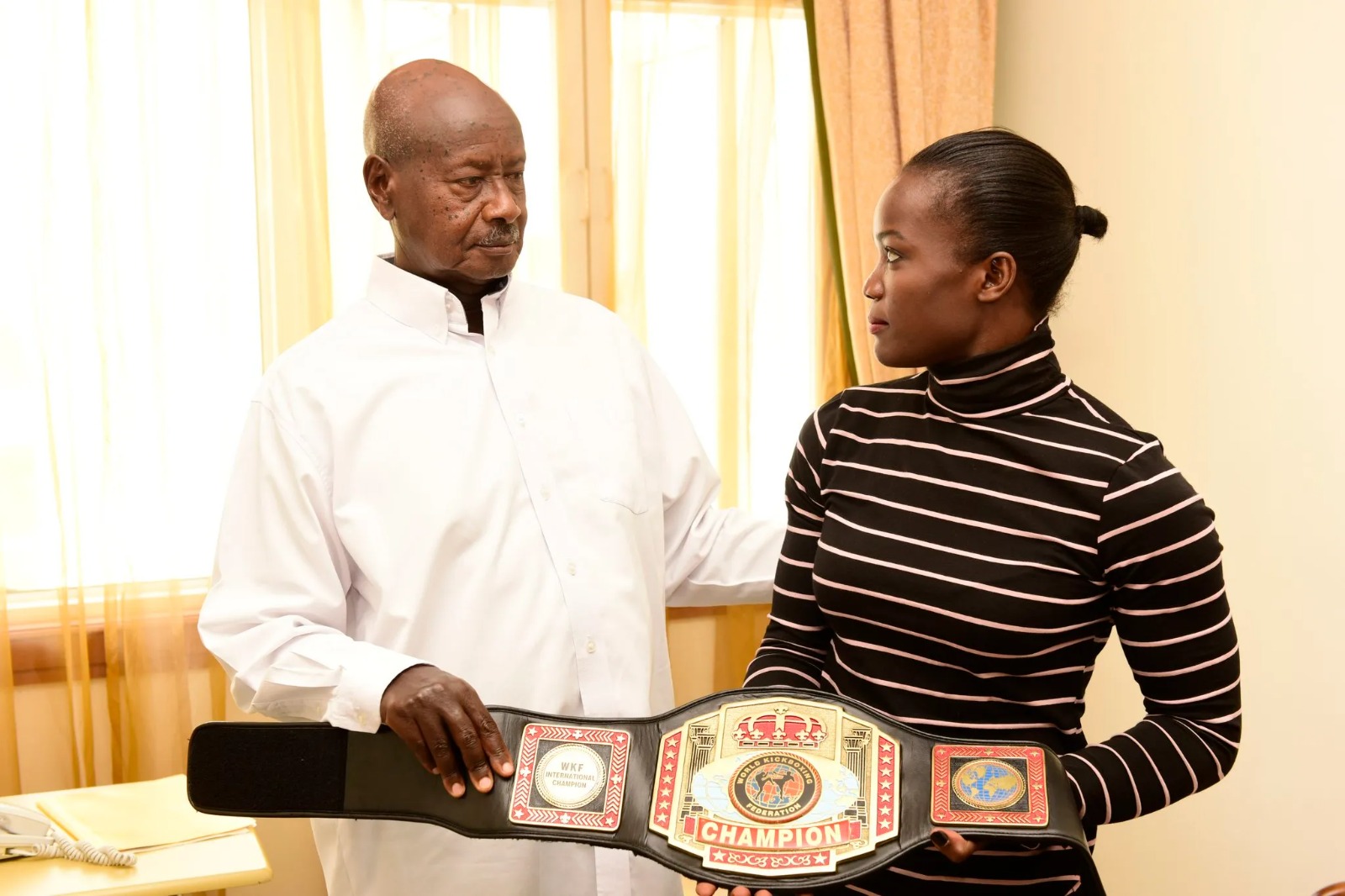
On a reported courtesy visit to President Yoweri Museveni at State House, Entebbe, she presented some of the championship belts she had won during her career. Dressed in a black-and-white striped outfit, she discussed the progress and promotion of kickboxing with the President.
The visit reflected the public recognition she had earned through her achievements. For an athlete whose career had begun after experimenting with football and other pursuits, presenting her belts to the Head of State represented a significant moment.
It also highlighted the potential of combat sports to provide opportunities for young Ugandans beyond conventional employment.
Yet sporting recognition does not necessarily translate into sustained institutional support. Athletes need training facilities, qualified coaches, sponsorship, international competition opportunities and reliable funding to maintain their careers.
Apolot’s meeting with Museveni brought attention to those issues, although the available account does not establish what specific commitments, if any, followed the discussion.
Her championship record nevertheless remains an important part of her public identity. Before the current controversy surrounding her marriage, she was known principally as a fighter who had carried Uganda’s flag into international competition.

The marriage that drew attention
Apolot’s personal life attracted a different kind of interest when she married Elwelu, a senior UPDF officer whose career had taken him through some of the most consequential military operations in Uganda’s recent history.
The supplied biographical account places their marriage at about 2016, when Apolot was in her mid-twenties and Elwelu was already an established military commander.
Their reported age difference of 24 years has become a talking point following the events at Elwelu’s home. But the age gap alone cannot explain the relationship or establish what drew the two together.
How does a successful young athlete decide to marry a man who belongs to a markedly different generation and whose professional life has been shaped by military command?
It is a compelling question, but one that cannot responsibly be answered by assuming that Apolot was attracted to his rank, wealth, authority or reputation
What can be said is that Apolot had established an independent public identity before becoming widely discussed as Elwelu’s wife. Her sporting career involved its own ambitions, achievements and challenges.
Her marriage subsequently connected her to a man whose name was already associated with Uganda’s military establishment, bringing a different dimension to her public profile.

For a woman in her twenties marrying a man with decades of military experience, the relationship would naturally attract public curiosity. But the more important question is how the couple navigated their private life away from public attention.
That question has become particularly pertinent following Gen Muhoozi’s allegations about the relationship.
The Elwelu controversy: A marriage under the shadow of Kasese
To understand why Apolot’s marriage has attracted renewed public interest, it is necessary to examine the military career of her husband and the controversies that have followed him.
Elwelu rose through the ranks of the Uganda People’s Defence Forces (UPDF), eventually serving as Deputy Chief of Defence Forces between 2021 and 2024. He was also appointed a senior presidential adviser on Teso and Karamoja affairs and represented the army in Parliament.
 His name, however, is particularly associated with the November 2016 security operation in Kasese, where the army and police raided the offices and palace of the Rwenzururu Kingdom, led by King Charles Wesley Mumbere.
At the time, Elwelu was a brigadier general commanding the army’s Second Division. He was among the senior commanders associated with the operation, which followed prolonged tensions between the government and the kingdom over its royal guards and security incidents in the region. The operation left scores dead and resulted in the arrest of Mumbere and many of his subjects.
The International Criminal Court’s Office of the Prosecutor later reported credible information that multiple killings had been committed by Ugandan security forces during the events of November 26 and 27, 2016. Human Rights Watch has also called for an independent investigation into the killings.
In May 2024, the United States announced travel sanctions against Elwelu, citing extrajudicial killings committed by members of the UPDF under his command. The sanctions did not amount to a criminal conviction, but they added an international dimension to the controversy surrounding his military record.
For Apolot, who was a young professional athlete around the time of the Kasese operation, marriage to a man with such a public profile meant becoming connected to a military career that carried both senior institutional responsibilities and considerable controversy.

Muhoozi’s allegations and the reported arrest
The immediate trigger for renewed scrutiny of Apolot came on Monday, when Gen Muhoozi announced on X that security personnel had arrested Elwelu’s wife alongside more than 20 former soldiers associated with the retired general.
In his post, the CDF alleged that Apolot had been physically abusing her husband for eight years. He described the allegation as domestic abuse. The claim was reported by Pulse Uganda, which noted that the allegations had not been independently verified.
The allegation introduced a startling new dimension to the public story of the couple. Elwelu, a former senior military commander whose career was built around authority and command, was now being portrayed by the army chief as a victim of alleged abuse within his marriage.
However, a social media statement is not a substitute for independently established facts. The circumstances of the alleged abuse, the evidence supporting the accusation and the legal basis for Apolot’s reported detention were not established in the reports available at the time.
It is also necessary to distinguish between an arrest and a finding of guilt. Apolot is entitled to due process, and any allegation against her should be examined through the appropriate legal procedures.
The CDF’s public remarks also raise questions about how sensitive military matters and allegations involving family relationships should be handled. Those questions are especially significant because the people involved include a serving army chief and a retired officer who once held one of the military’s highest positions.
The reported arrest also occurred amid a broader confrontation over Elwelu’s whereabouts and military status.

A champion whose story is bigger than the controversy
Before her name became associated with the troubles surrounding Elwelu, Apolot had established a record that deserves to be considered on its own terms.
Her journey from Ngora to international kickboxing competitions demonstrated the possibilities available to a young Ugandan woman willing to pursue an unconventional sporting career.
Her early experiences were not without obstacles. In a 2015 media interview, Apolot discussed the challenges faced by female fighters, including limited sponsorship, inadequate institutional support and the difficulties of training in environments dominated by men. Those challenges are central to understanding her career. Success in combat sports requires physical conditioning, technical ability and sustained investment in training. For women, the challenge can be compounded by limited access to funding and recognition.
Apolot nevertheless persevered, won national honours and secured an international title in Hungary. Her achievements provided a source of pride for Ugandan sport and helped demonstrate that female athletes could compete beyond the continent.
The contrast between that career and the current controversy is stark. A woman once recognised for presenting championship belts at State House is now in the headlines because of allegations involving her marriage and a military dispute.
But neither her sporting accomplishments nor the allegations against her should predetermine how the public understands her.
If authorities have credible evidence of wrongdoing, the matter should be investigated fairly. If the allegations cannot be substantiated, that too should become clear through an appropriate process. Until then, speculation about her motives, character or role in her husband’s troubles risks obscuring the facts.
The same principle applies to Elwelu. His military record, including the unresolved questions surrounding the Kasese killings, should be assessed through evidence and accountable institutions rather than through personal attacks or social media declarations.
 For Apolot, the immediate questions are practical: Where is she being held, what are the grounds for her reported arrest, has she been formally charged, and has she been given access to legal representation?
Ultimately, Patricia “Black Pearl” Apolot’s life contains two distinct stories. The first is that of a young woman from Ngora who found her calling in a demanding sport and rose to international recognition. The second is that of a champion whose private life has become entangled in a highly public military controversy.
Author Profile
- Mr. Stephen Kasozi Muwambi is a seasoned crime investigative writer, majoring in judicial-based stories. His two decades’ experience as a senior investigative journalist has made him one of the best to reckon on in Uganda. He can also be reached via [email protected]
Latest entries
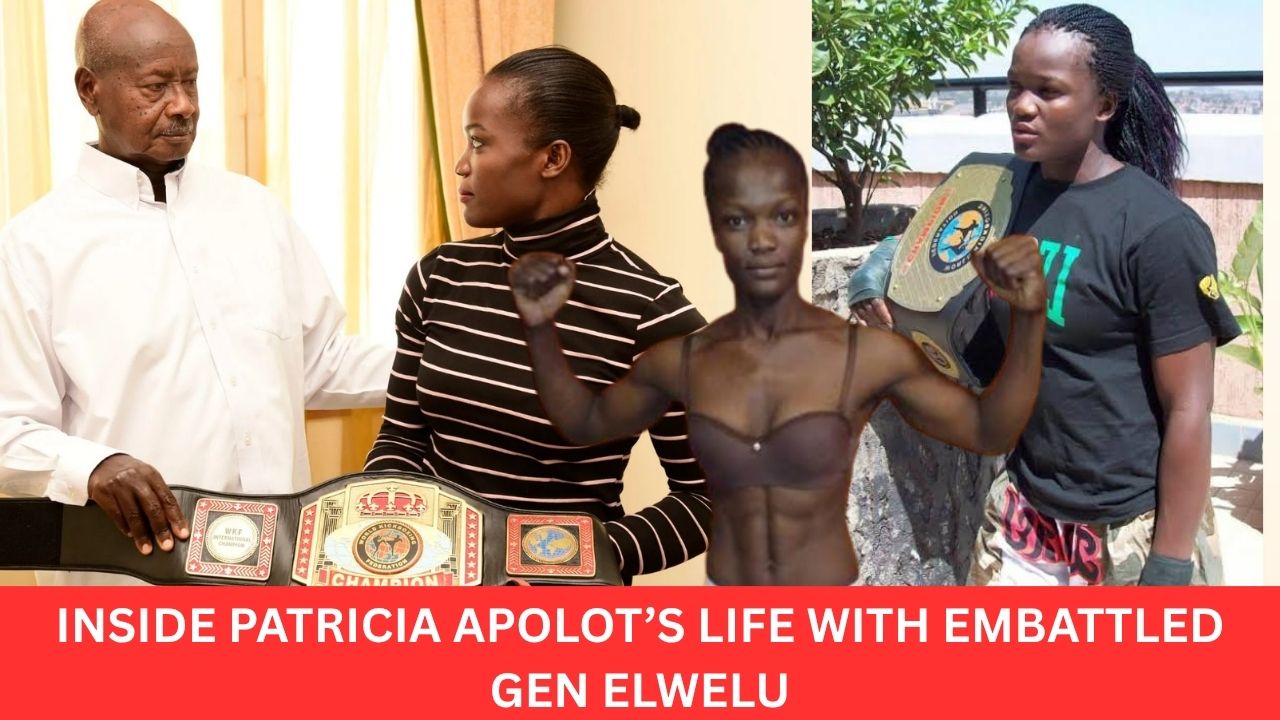 FeaturedOctober 29, 2026WHY KICKBOXING CHAMPION APOLOT MARRIED GEN ELWELU: The 24-year Age Gap Between Patricia Apolot And Retired Lt Gen Peter Elwelu Has Drawn Renewed Attention As Allegations Surrounding Their Marriage Emerge Amid A Military Standoff
 FeaturedOctober 21, 2026NAMEERE RETAINS MASAKA CITY SEAT: High Court Dismisses Nalubowa’s Election Petition, Ruling That Recount Irregularities Did Not Substantially Alter The Final Result
 FeaturedOctober 20, 2026VETERAN JOURNALIST KASYATE JOINS OPM: Simon Kasyate Moves Back Into Government Communications After Years In Journalism, Corporate Affairs And Public Relations, Including A Senior Role At KCCA
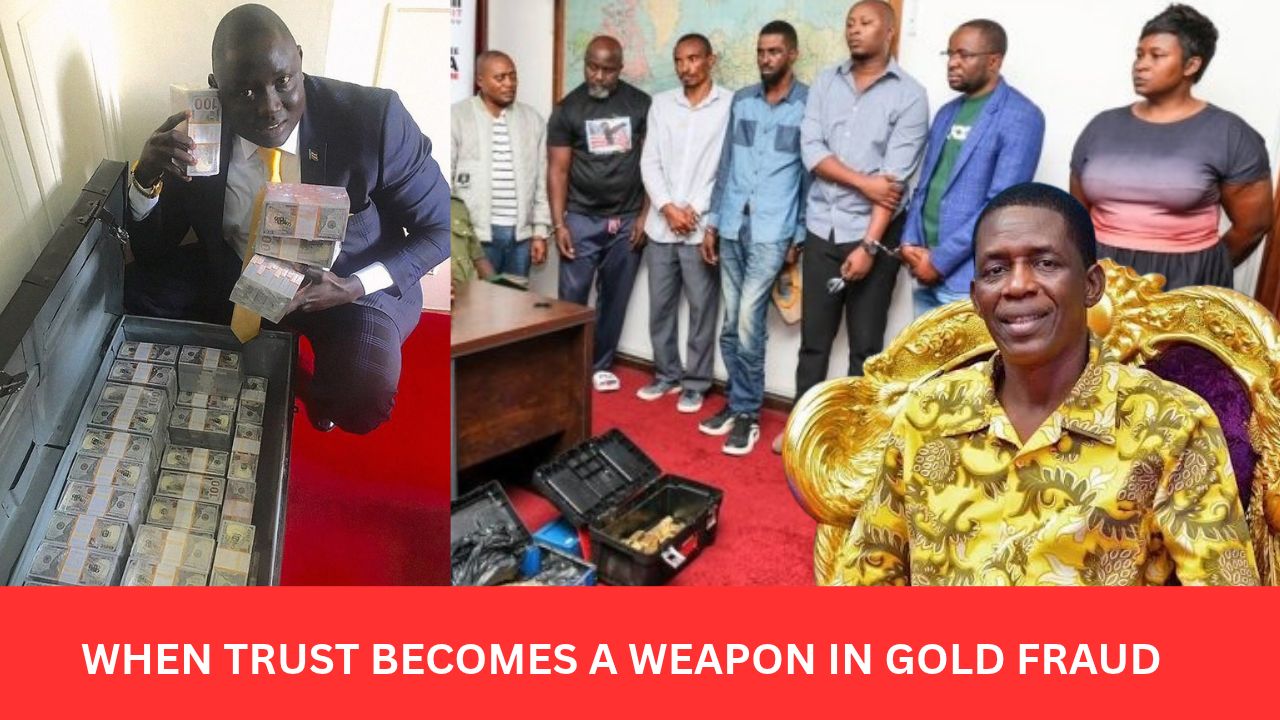 FeaturedOctober 19, 2026BILLIONS LOST, INVESTORS DUPED, GOLD TRADE UNDER SCRUTINY: A City Pastor’s Arrest Over An Alleged Shs2.9b Fraud Involving American Investors Adds To A String Of High-Profile Gold Scams Threatening Uganda’s Investment Reputation