















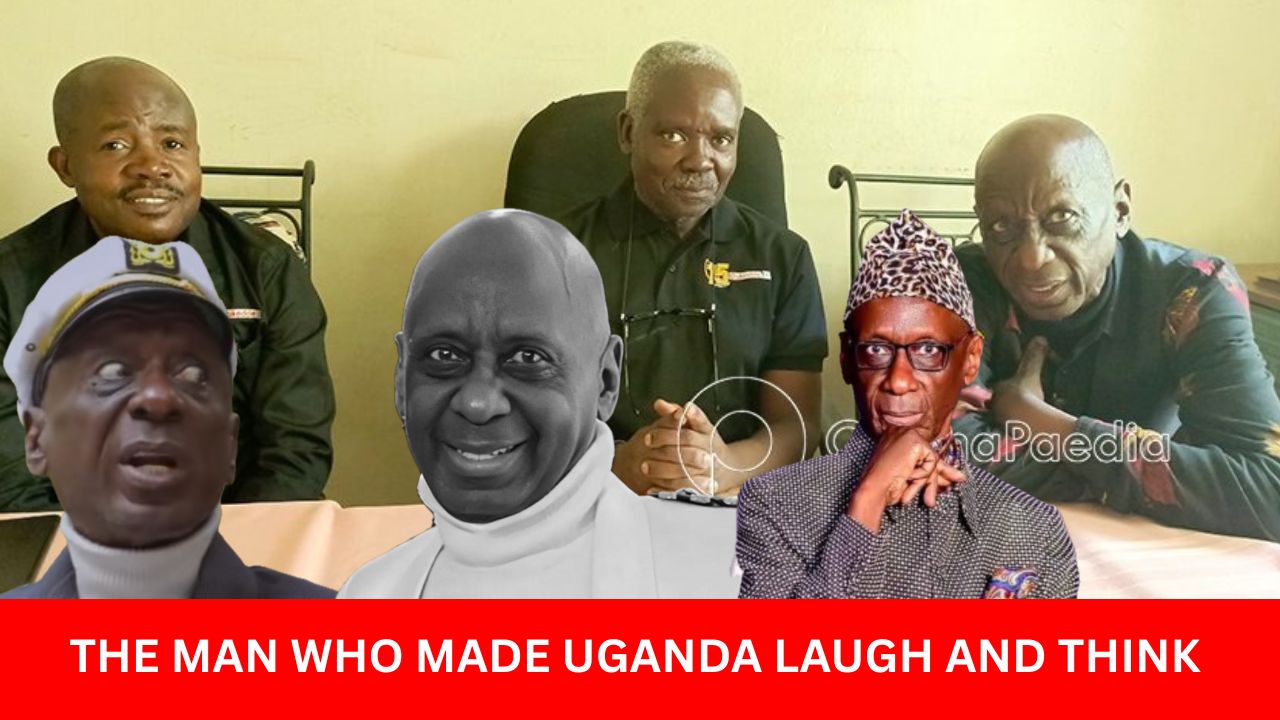
Uganda is mourning the death of veteran playwright, actor, musician and radio personality Alex Mukulu, a creative giant whose unconventional style, sharp satire and fearless storytelling left an enduring mark on the country’s cultural landscape.
Mukulu died over the weekend aged 72, bringing to an end a career that stretched across theatre, music, broadcasting and cultural activism.
News of his death triggered an outpouring of grief from artists, politicians, cultural leaders and ordinary Ugandans who remembered him not only as a gifted performer, but as an eccentric, independent-minded and often provocative voice who refused to conform.
Among those paying tribute was writer and social commentator Jim Spire Ssentongo, who described Mukulu as one of the rare creative geniuses whose brilliance was not always immediately understood.
“Rest in peace. You were one of those creative geniuses that only appear in small numbers once every so many years – and usually hardly understood,” Spire wrote on X on August 15.
The tribute captured the complicated genius that defined Mukulu: a man who could entertain audiences while simultaneously forcing them to confront uncomfortable questions about Uganda, its politics, culture and society.
A life built around theatre
Born in 1954 in Misebe in present-day Mityana District, Mukulu grew up in Buganda and later attended Namilyango College and Kololo Secondary School. He subsequently studied Film and Drama at Makerere University.
His artistic journey had begun even earlier, with his exposure to drama and mentorship at Namasagali College, where his abilities as a performer were nurtured.
His first play, Muzukulu wa Kabangala, was produced in 1977, marking the beginning of a career in which he would eventually write and stage dozens of productions.
Mukulu was not merely a playwright. He frequently wrote, directed and acted in his own productions, often taking the leading role.
A 2012 profile of Uganda’s theatre industry described him as determined, self-sufficient, humorous and unconventional, noting that his three decades in theatre had established him as a central figure in Uganda’s performing arts, particularly during the 1980s, 1990s and early 2000s.
His theatre became a vehicle for examining Uganda’s history and the contradictions of everyday life. Among his best-known works were Wounds of Africa, The Journey of Realization, The People’s President, I Killed the Archbishop, The Guest of Honor, Dances with Poverty, Excuse Me Mzungu, Radio Mambo Bado, The Peasants’ Song and, most famously, 30 Years of Bananas.
The bananas that challenged Uganda
If one production came to define Mukulu’s reputation, it was 30 Years of Bananas. First staged in the early 1990s, the play used humour, caricature and satire to examine Uganda’s political history since independence in 1962.
Mukulu portrayed successive political regimes and presidents through theatrical caricature, challenging audiences to reflect on what had happened to the country during its first three decades of independence. The production was daring for its time.
Mukulu himself explained that the political environment following the 1986 change of government created a brief period in which artists felt able to address subjects that had previously been difficult to discuss publicly.
He said the play was intended to use Uganda’s political history to make a broader argument about the country’s development.
The play subsequently became one of Uganda’s most celebrated political theatre productions and was even published by Oxford University Press in 1993. More than three decades later, 30 Years of Bananas continued to resonate.
When the production returned to the stage in 2025, critics observed that its themes about Uganda’s political journey remained remarkably relevant.
That endurance demonstrated Mukulu’s strength as a playwright. He did not simply write for the moment. His work often contained questions that survived the circumstances that inspired them.
From stage to radio
Mukulu’s influence was not confined to the theatre. He was among a generation of theatre personalities who crossed into Uganda’s rapidly expanding radio industry in the 1990s, becoming associated with Radio Simba.
The station, launched in 1998, helped transform the relationship between theatre, vernacular broadcasting and popular entertainment.
Mukulu became a familiar voice to radio listeners, using his theatrical instincts to make broadcasting entertaining, humorous and accessible.
He is also remembered by Ugandan football followers as one of the pioneering voices who helped bring English Premier League football to vernacular radio audiences, delivering the excitement of the game in a distinctly Ugandan style.
For many listeners, his sporting broadcasts became another demonstration of his ability to turn an ordinary microphone into a stage.
His radio career also demonstrated the breadth of his talent. He could move from political satire to theatre, music and football without losing the personality that made him distinctive.
Radio, like theatre, gave Mukulu a mass audience.
A cultural ambassador
Mukulu’s contribution extended beyond entertainment into the promotion of Ugandan and African culture. His productions regularly incorporated music, dance, history, politics and traditional storytelling.
In 2007, he performed Journey to Self-Realization at the opening ceremony of the Commonwealth Heads of Government Meeting in Kampala, an event attended by Queen Elizabeth II and then Prince Charles. His performance earned a standing ovation.
It was one of the international moments that demonstrated the capacity of Ugandan theatre to occupy prestigious global stages. Yet Mukulu remained rooted in Uganda’s social and cultural realities.
His work was often irreverent, humorous and uncomfortable. He could make audiences laugh while confronting them with political failures, social inequalities and contradictions in society.
The final return to the stage
In 2024, Mukulu surprised many Ugandans by returning to the stage after a 17-year absence. His production, Kulunkalu ne Kulumbisi, was an African adaptation of Shakespeare’s Romeo and Juliet, but Mukulu transformed the familiar story through Ugandan culture, music, dance, language and history. The production demonstrated that age had not diminished his appetite for experimentation.
Katikiro of Buganda Charles Peter Mayiga was among those who praised Mukulu’s contribution to theatre, describing his ability to use talent to portray the good, bad and ugly in society.
His final years therefore came full circle: the veteran who had helped define Uganda’s theatre returned to the stage to engage a new generation.
“Alex Mukulu has been a thorough obscene result-oriented playwright,” said Jaako David Waluluka a seasoned entertainment journalist.
A legacy larger than theatre
Mukulu’s death leaves Uganda with more than a collection of plays. It leaves a philosophy of creativity. He believed artists should question, provoke, educate and entertain. His career demonstrated that theatre could be both a mirror and a weapon—a mirror reflecting society and a weapon challenging complacency.
His passing is therefore being mourned not simply as the death of an actor or playwright, but as the departure of one of Uganda’s original creative voices.
For a generation that watched him perform on stage, listened to him on radio or encountered his political satire, Alex Mukulu was unmistakable. He was eccentric. He was humorous. He was fearless. He was sometimes difficult to understand.
But, as Jim Spire Ssentongo’s tribute suggested, perhaps that was precisely what made him exceptional. Uganda’s creative industry has lost a man who spent nearly half a century asking audiences to look at themselves, their country and their history differently.
The stage has gone dark on Alex Mukulu. But the characters, jokes, arguments, songs and uncomfortable questions he left behind will continue to speak.
And perhaps that is the greatest tribute a playwright can receive: that long after he has left the stage, his work refuses to leave the audience.
Author Profile

- Charles Gazza Kodili is a seasoned journalist with over 20 years of experience in the media industry. He holds a Bachelor of Arts degree in Mass Communication. He’s currently the Chief Editor at the Investigator.
Charles can also be reached via; Tel: +256 774 108978
Email: [email protected]
Latest entries
 FeaturedOctober 9, 2026UGANDA ECONOMY TO HIT $73.96B: President Museveni Cites Decades Of Economic Growth As He Receives A Top National Honour During The 64th Independence Anniversary Celebrations At State House, Entebbe
 FeaturedOctober 9, 2026KABALEGA: THE KING WHO FOUGHT THE BRITISH: From Battles Against Sir Samuel Baker To Uganda’s Independence In 1962, The Bunyoro King Became A Symbol Of Resistance Against Foreign Domination
 FeaturedOctober 8, 2026UGANDA AT 64: From Obote Receiving the Instruments of Power in 1962 to Museveni Receiving a National Medal in 2026, Uganda’s Independence Story Remains Unfinished. We Journey With You the Thorney 6+ Decades of Uhuru
 FeaturedOctober 8, 2026AFRICA MUST PREPARE FOR NEW WARS – MUSEVENI: The President Challenges Defence Chiefs to Link Military Strength With Economic Power, Political Stability and Regional Integration as African Armies Rethink Security Beyond Conventional Warfare