



Ofwono Opondo, one of the most recognisable voices in Uganda’s ruling National Resistance Movement (NRM), is facing an uncomfortable political moment after openly questioning the growing campaign around Chief of Defence Forces (CDF) Gen Muhoozi Kainerugaba’s potential 2031 presidential bid.
What began as a disagreement over the country’s political succession has now developed into a public confrontation involving the veteran journalist, Patriotic League of Uganda (PLU) activists and Kasambya County MP Daudi Kabanda, who has revived a controversial 2004 newspaper report concerning Opondo.
The latest developments have also raised questions about the space available for independent political commentary within the ruling establishment, particularly at a time when Gen Muhoozi’s political ambitions are increasingly being discussed by his supporters.
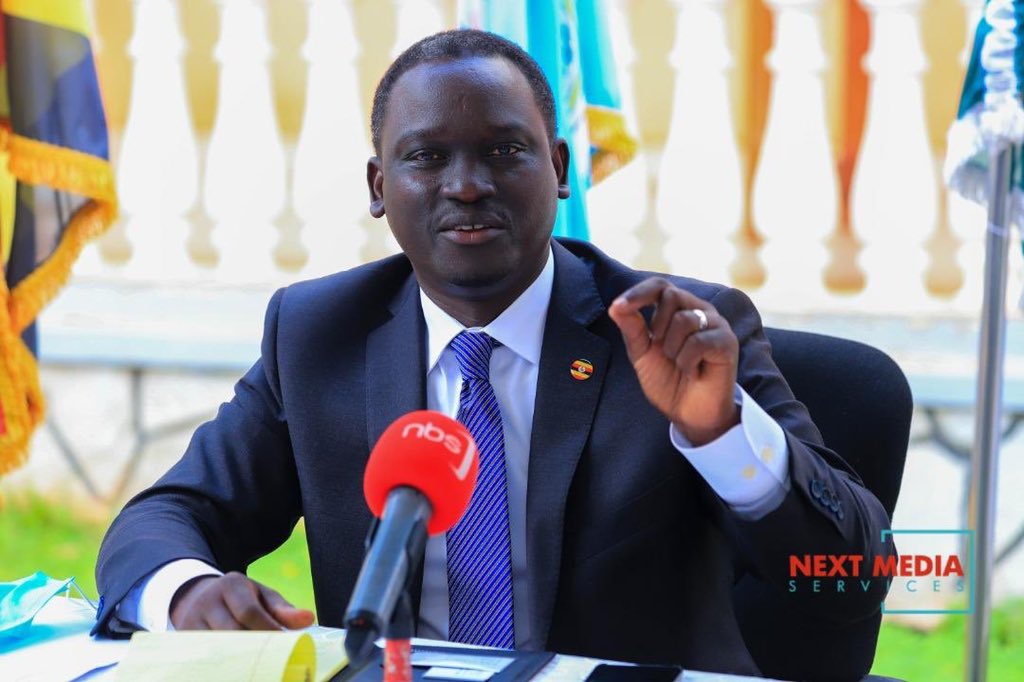
 Opondo, the MP representing Older Persons in the Eastern Region and former government spokesperson, has found himself at odds with sections of the political establishment after insisting that President Yoweri Museveni’s preferred successor should not automatically become Uganda’s next president. His position directly challenges the growing enthusiasm among Muhoozi’s supporters, who have been positioning the CDF as the country’s potential next leader in the 2031 general elections.
The controversy has been compounded by reports that Opondo has stopped contributing his weekly column to the state-owned New Vision newspaper following a disagreement with the publication’s editorial leadership. However, Opondo has disputed suggestions that he was dismissed or forced out because of his political opinions.
In a clarification, he said: “You’re not entirely accurate. The decision to not to write in the last two weekend is entirely my own after I disagreed with a fickle editorial slant.” His response introduces another dimension to the controversy: whether the veteran journalist voluntarily stepped aside over editorial differences or whether his increasingly outspoken political commentary has created tensions within the media establishment.
Kabanda Revives 2004 Shooting Controversy
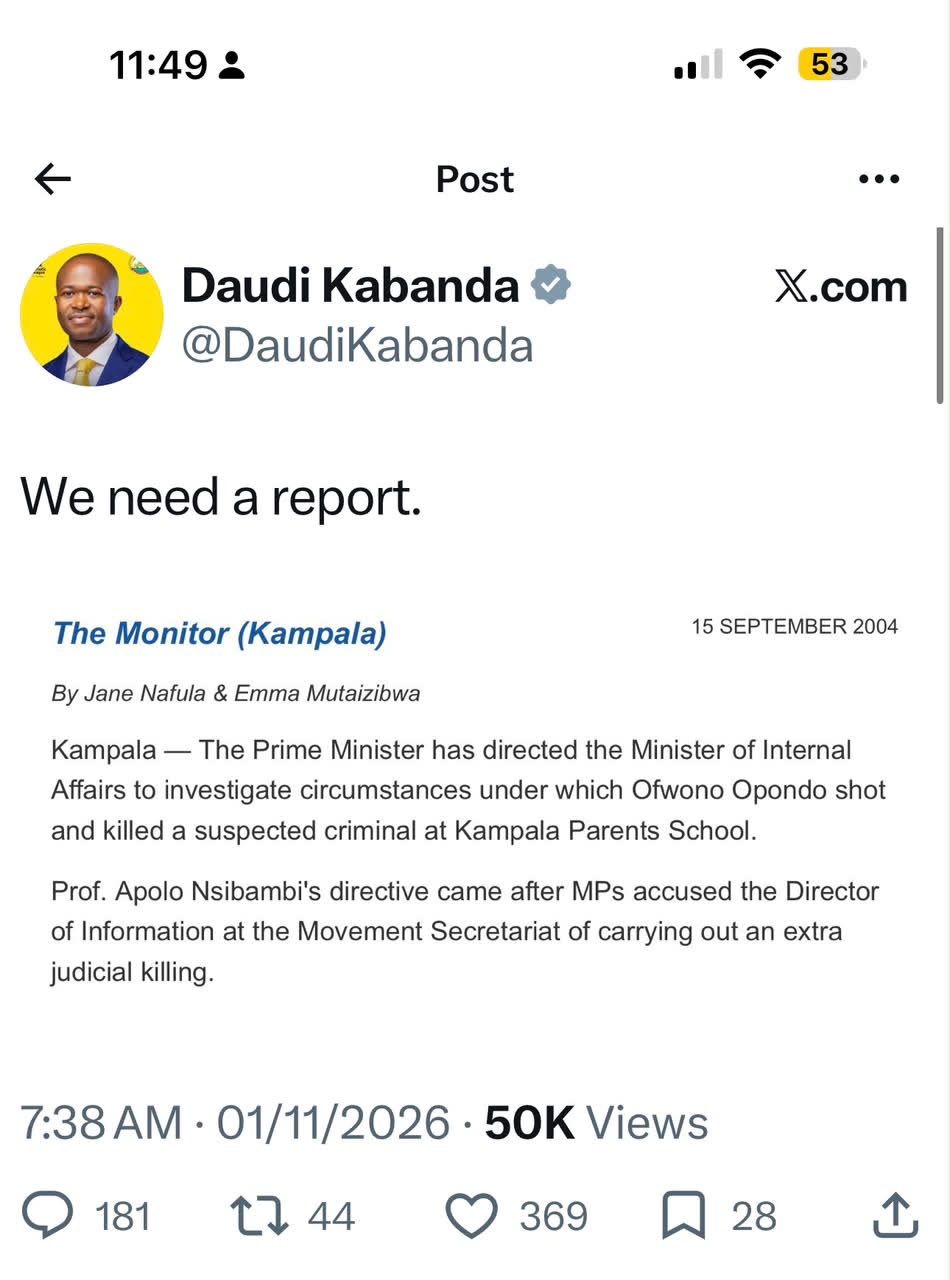
One of the most consequential developments in the unfolding confrontation has been Kabanda’s decision to bring back a 22-year-old controversy involving an alleged shooting incident near Kampala Parents School. Kabanda, who heads the Office of the PLU Chairman, Gen Muhoozi, shared an old newspaper clipping from the Daily Monitor detailing allegations that Opondo shot dead a suspected criminal in September 2004. His accompanying message was brief but politically loaded.
 “We need a report,” Kabanda wrote. The timing of the intervention has attracted attention because it came shortly after Opondo challenged the direction of the succession debate and questioned whether Museveni’s reported preference for his son should automatically determine Uganda’s political future.
The September 2004 newspaper report indicated that then Prime Minister Apolo Nsibambi had directed an investigation into the circumstances surrounding the shooting. According to the historical accounts, Opondo allegedly shot Geoffrey Lubega, a suspected car thief, during an incident near Kampala Parents School, where he had reportedly taken his daughter.
The incident was reported against the background of an alleged attempted vehicle robbery. Opondo was reported to have used his firearm during the confrontation. Subsequent accounts indicated that the government defended the shooting as an act of self-defense after suspects allegedly began firing, putting people at the scene in danger. However, the precise outcome of the investigation and whether a formal report was completed have become central to Kabanda’s renewed demand.
By sharing the old newspaper report, Kabanda has effectively shifted the political argument from Opondo’s criticism of the succession campaign to questions about his past conduct. It is not clear whether Kabanda intends to pursue a formal police investigation or was simply demanding that the findings of the original inquiry be made public. Neither does his post, by itself, establish wrongdoing by Opondo.
Nevertheless, the intervention has placed the veteran politician under renewed public scrutiny, with his critics likely to use the old controversy to challenge his credibility. The development also raises questions about whether the revival of historical allegations is becoming a political weapon in the increasingly heated contest surrounding Muhoozi’s ambitions.
 Daudi Kabanda’s intervention and the PLU connection
Kabanda’s intervention is particularly significant because of his position within the PLU political machinery. As head of the Office of the PLU Chairman, he occupies a strategic position in an organisation whose central political objective has increasingly revolved around mobilising support for Muhoozi’s proposed 2031 presidential bid. The PLU has been at the forefront of the campaign to secure endorsements from political leaders, legislators, businessmen and NRM supporters.
Its mobilisation has attracted several senior figures, including ministers and legislators who have publicly declared support for Muhoozi. The campaign has also gained prominence following reports that Museveni presented a succession discussion paper to the NRM Central Executive Committee, addressing the question of leadership beyond the current political term.
According to reports, Museveni’s paper discussed Muhoozi’s suitability for the presidency during the 2031–2036 period. However, accounts of the CEC meeting have differed, with some party officials disputing whether succession was formally discussed. For Opondo, the growing political mobilisation appears to be moving faster than the institutional debate about succession.
His argument is that Uganda’s future leadership should not be treated as an arrangement that can be settled through endorsements by influential individuals. That position puts him on a collision course with PLU activists who consider the campaign an important political undertaking. Kabanda’s intervention has therefore acquired significance beyond the old shooting controversy because it demonstrates how personal and historical issues can quickly become entangled with the current succession contest.
Opondo’s Warning: Museveni’s wish is not Necessarily Uganda’s Choice
Opondo’s strongest criticism of the Muhoozi project has been his insistence that the country’s political future must involve ordinary Ugandans rather than remain the preserve of powerful individuals within the NRM.
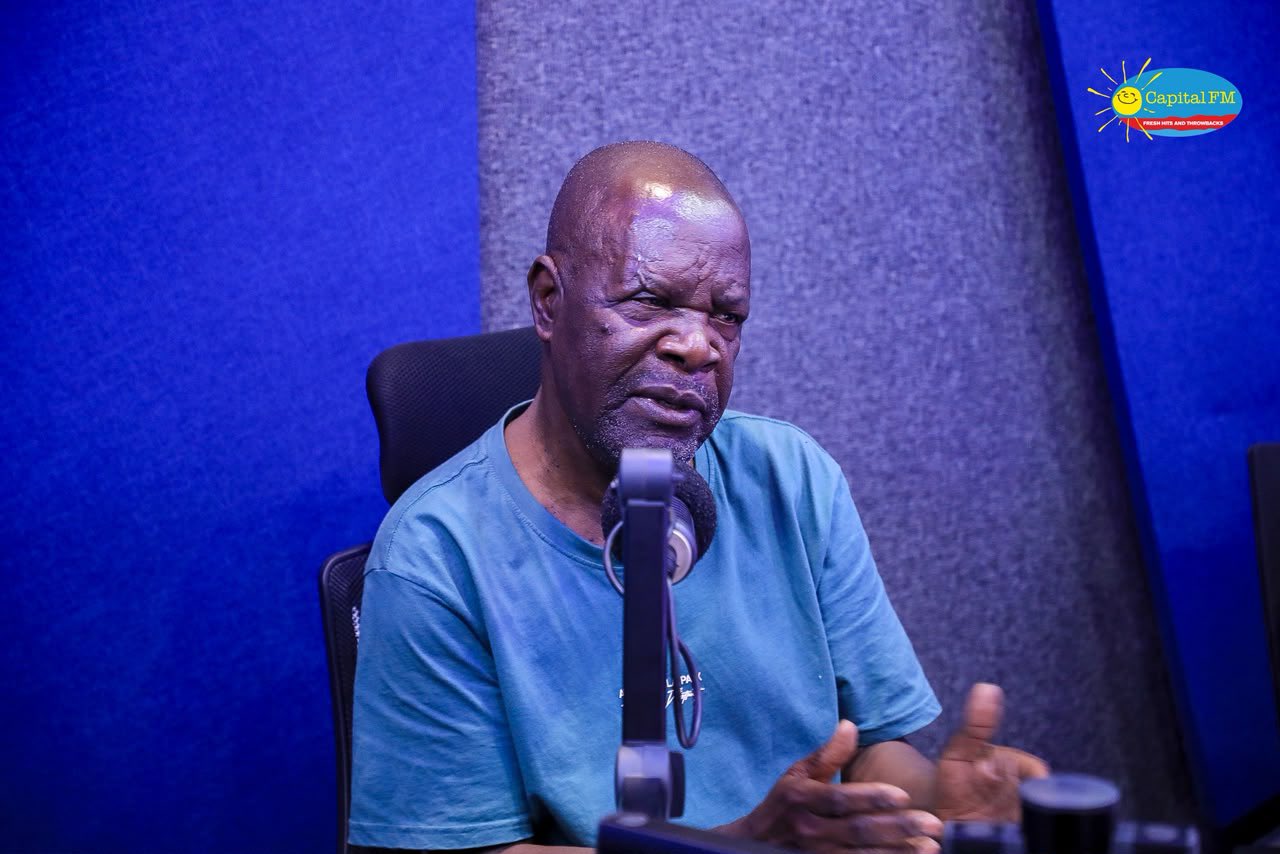 Appearing on Capital FM’s The Capital Gang, the veteran politician questioned whether Museveni’s preference should automatically become the country’s political decision. “The President together with NRM, brought us democracy. It is us who’re failing ourselves. The President can have his wish, but must his wish prevail? You, Ugandans, wake up! If he has brought the discussion on succession and transition, let us engage,” Opondo said.
The remarks were a direct challenge to the growing enthusiasm among Muhoozi’s supporters, particularly those who have presented the CDF as the natural successor to his father. Opondo’s argument was not necessarily that Muhoozi should be barred from contesting for the presidency, but that the process should be subjected to public discussion and democratic competition.
He has also questioned the timing of the endorsements, arguing that some NRM leaders appear to be abandoning the President’s current mandate by rushing to support a successor before the present term has run its course. On October 25, Opondo described the rush by ministers to endorse Muhoozi as a possible vote of no confidence in Museveni, who had only recently secured another presidential term.
He questioned why Cabinet ministers would immediately start campaigning for another candidate when the President had just received a fresh mandate. His criticism was also informed by concerns that the succession debate could undermine political stability and investor confidence if handled without regard to established institutions. In another intervention, Opondo argued that whoever seeks to replace Museveni should demonstrate greater political tolerance and commitment to dialogue.
He warned against a leadership style that relies on what he described as crude power instead of persuasion and engagement with political opponents. These remarks have resonated with critics of the PLU’s growing influence, particularly those concerned about the relationship between the military establishment and political mobilisation. For Muhoozi’s supporters, however, such criticism risks undermining a campaign they regard as a legitimate expression of political support for a potential presidential candidate.
 The Muhoozi Question and Opondo’s Criticism of Security Excesses
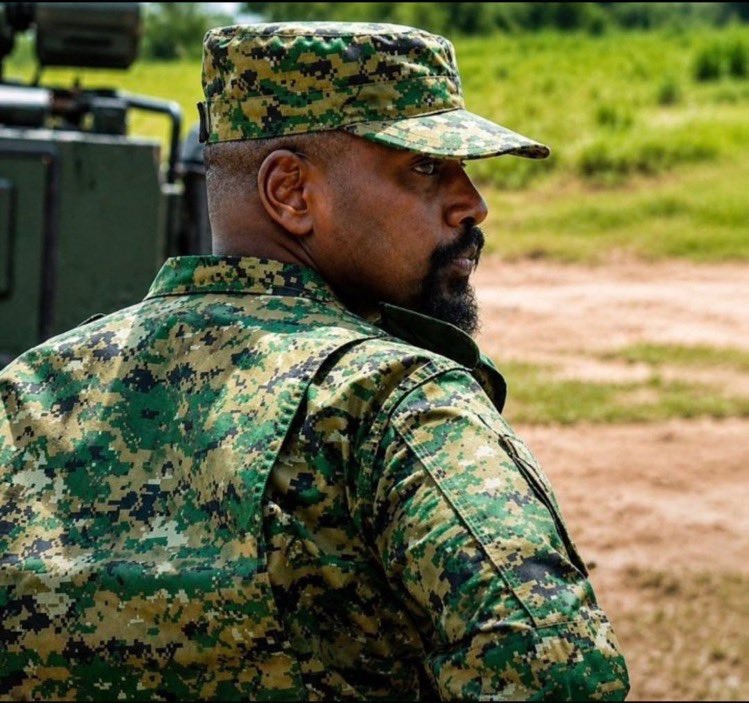
Opondo’s troubles have also been compounded by his criticism of security operations associated with Muhoozi, who serves as CDF. The former government spokesperson has increasingly questioned the treatment of opposition activists and other individuals arrested by security agencies. His concerns have brought him closer to some NRM historicals and senior figures who have expressed reservations about the manner in which security operations are being conducted.
Among those whose position has attracted attention is Minister for Energy and Mineral Development Maj Gen (Rtd) Kahinda Otafiire, who has previously questioned aspects of the security approach. Otafiire’s remarks before Parliament, in which he suggested that a general should be capable of winning a war without firing bullets, were interpreted by some observers as a criticism of the apparent preference for force over political engagement. Opondo has defended the importance of such dissent within the ruling establishment.
The debate has been fuelled by reports of arrests and alleged mistreatment involving opposition figures, including former presidential candidate Dr Kizza Besigye, former Kampala Lord Mayor Erias Lukwago and activist Sam Mugumya. Muhoozi has previously attracted controversy over social media statements concerning detained individuals and security operations.
In one particularly contentious episode, the CDF was accused of boasting that some opposition activists were being held in military basements. Such allegations have intensified demands for accountability and clarification from security authorities. Opondo’s position is that the ruling party should not ignore concerns about human rights and the rule of law simply because the individuals affected belong to the opposition.
His interventions have therefore exposed an uncomfortable debate within the NRM: whether loyalty to the government requires silence when security agencies are accused of excesses. The question is particularly sensitive because Muhoozi occupies both a senior military position and an increasingly prominent political role through the PLU. For Opondo, the distinction between the two responsibilities is important, especially when discussing a possible future presidency.
 New Vision column controversy adds to the pressure
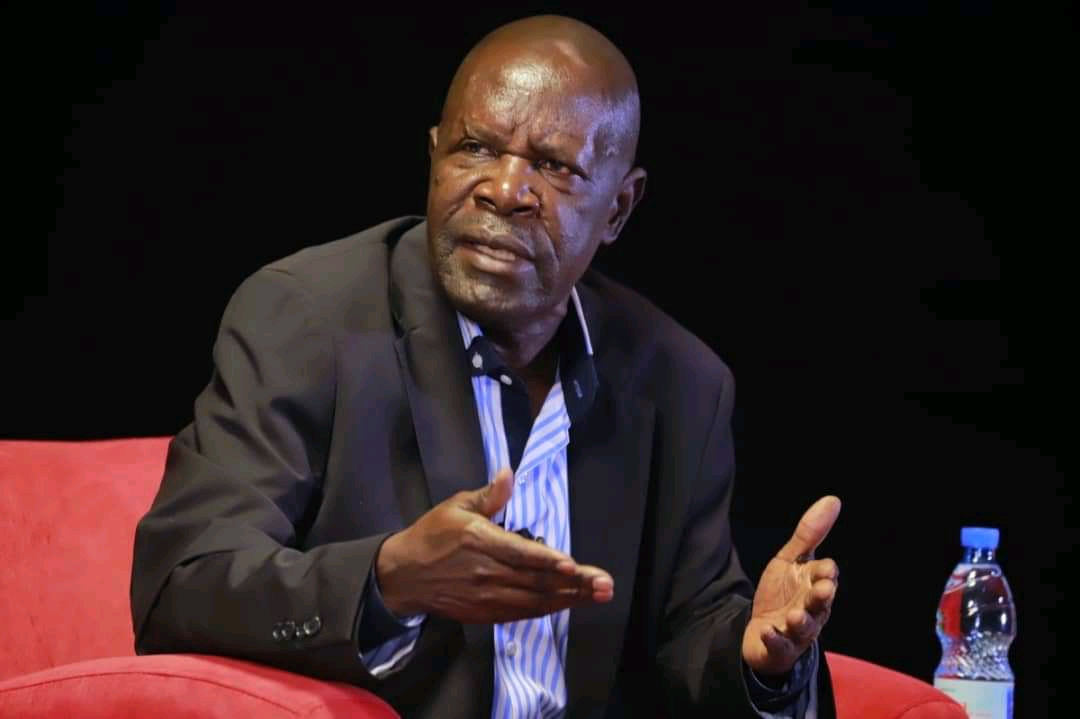
While the exchange with Kabanda has dominated the political conversation, Opondo is also facing uncertainty over his relationship with New Vision, where he has been a regular columnist for years. Opondo reportedly stopped writing his weekly column following a disagreement with the newspaper’s editorial leadership over the direction and treatment of his submissions.
He began his journalism career at New Vision in the early 1990s before rising through the ranks of the political establishment to become one of the country’s most prominent government communicators. His recent opinion pieces have increasingly focused on alleged corruption, accountability and the conduct of government officials.
His defence of Otafiire’s right to question security operations and his criticism of the growing Muhoozi succession campaign are among the interventions that have attracted attention. Social media commentator Kakwenza Rukirabashaija claimed that Opondo had been dropped by New Vision because of his criticism of PLU activists.
Kakwenza further alleged that New Vision chief executive Don Wanyama had made the decision to protect his position within the emerging political order. However, these allegations have not been independently established. Opondo has expressly rejected the suggestion that he was dismissed, maintaining that his decision not to publish during the previous two weekends followed a disagreement over what he described as a “fickle editorial slant”.
His clarification leaves open the possibility that he could return to the publication or make a formal decision about his future relationship with the newspaper. The controversy has nevertheless raised questions about editorial independence, particularly where journalists and commentators openly challenge influential political figures.
Will NBS and Capital FM also Become Uncomfortable Platforms?
There are also claims that Opondo could face pressure over his appearances on NBS Television and Capital FM. He is a regular participant on NBS Television’s Frontline programme and Capital FM’s The Capital Gang, where he has built a reputation as an outspoken political commentator. The two programmes provide him with platforms to interrogate government policy, challenge political leaders and participate in debates involving opposition and ruling party figures.
However, claims circulating among sources suggest that NBS chief executive Kin Karisa could also come under pressure over Opondo’s continued participation in the programmes. Those claims have not been independently confirmed, and there is no established evidence that Karisa has been directed to remove Opondo from either programme.
The Capital FM programme is particularly important because it was on this platform that Opondo made his latest remarks questioning Museveni’s succession preferences. The programme has traditionally provided a forum for political heavyweights to debate developments within government, Parliament and the opposition.
Opondo’s continued participation would therefore offer him an opportunity to defend his position and explain why he believes the succession debate should be opened up to the wider public. There is, however, a growing concern among sections of the political establishment that criticism of Muhoozi and the PLU could become increasingly difficult as the 2031 project gains momentum.
 A veteran of the NRM now questioning its political direction
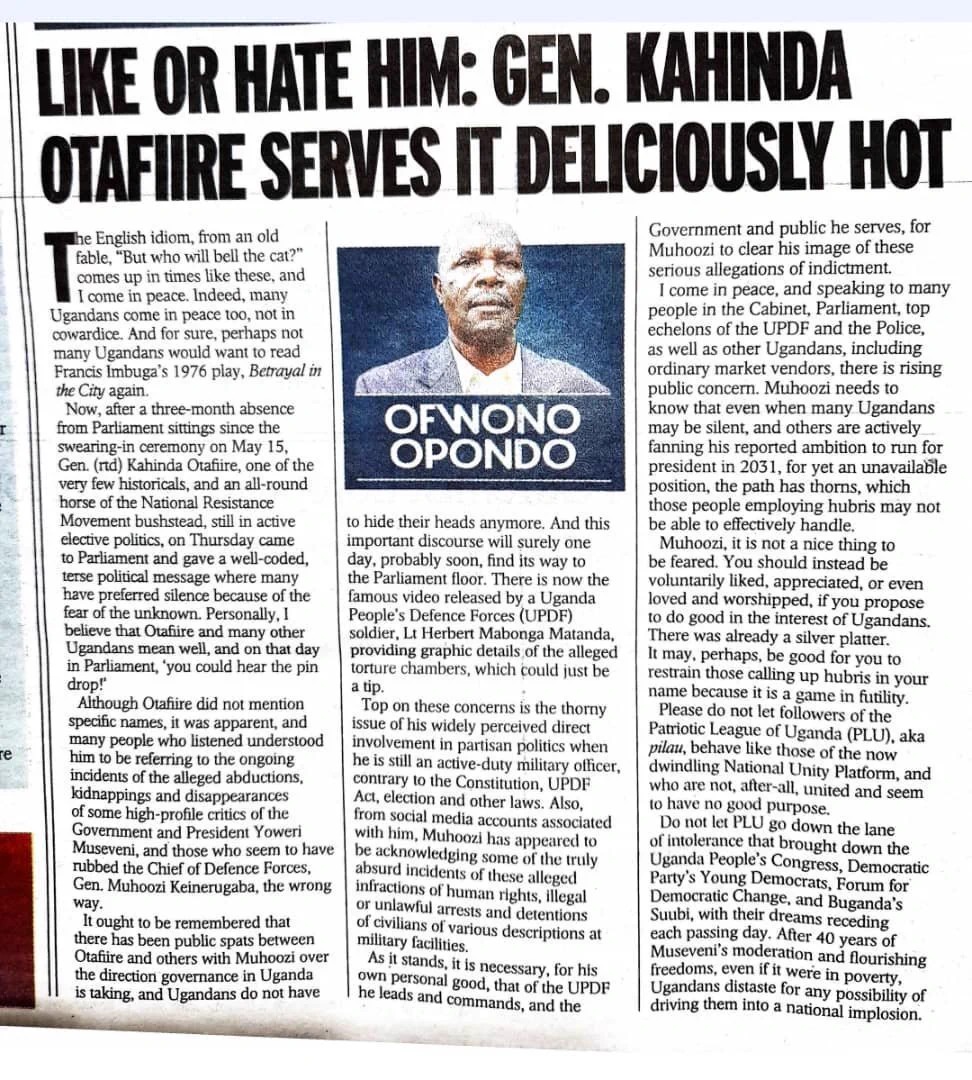
Opondo’s predicament is particularly interesting because he is not an outsider attacking the NRM from the opposition benches. He is a long-serving insider who has spent decades defending the ruling establishment and communicating its political positions.
As former government spokesperson, he was among the people entrusted with explaining government policy and defending Museveni’s administration during politically difficult moments. He is also a member of the NRM political establishment, having served in different party and government positions.
His transformation into one of the more outspoken critics of the emerging succession arrangements therefore presents a complicated challenge for the ruling party. Unlike opposition politicians, whose criticism of Museveni and his government is often dismissed as expected political opposition, Opondo’s interventions come from someone who understands the internal workings of the movement.
He knows the political history of the NRM, its internal power structures and the sensitivities surrounding the question of succession. His argument appears to be that the movement should not abandon the principles of political participation and democratic competition in the process of identifying its next leader. The confrontation also raises questions about the place of NRM historicals and veteran politicians in a political environment increasingly dominated by the PLU and younger supporters of Muhoozi.
For some within the ruling party, the CDF represents continuity and a new generation of leadership. For others, the speed with which his supporters are mobilising risks creating divisions within the movement before the succession question has been properly resolved. The fact that Kabanda has now brought up a 2004 controversy involving Opondo illustrates how quickly the debate can move from policy and political ideas to personal confrontations.
What next for Opondo?
The immediate question is whether Opondo will maintain his position despite the criticism and renewed scrutiny of his past. His response to the New Vision controversy suggests that he is not prepared to accept a narrative that he was dismissed for expressing political opinions. Similarly, his remarks on Capital FM indicate that he is determined to keep the succession debate open rather than allow it to be dictated by endorsements and political pressure.
For Kabanda, the demand for a report into the 2004 shooting incident presents an opportunity to challenge a veteran NRM figure who has become increasingly critical of the Muhoozi project. But whether the old investigation will be formally reopened, and what evidence exists regarding its outcome, remains to be established. The broader political implications are potentially more significant.
If the Muhoozi succession campaign continues to attract endorsements from ministers, MPs and influential government officials, voices such as Opondo’s could become increasingly uncomfortable for those seeking to consolidate support around the CDF. Yet, silencing or marginalising dissenting voices would risk deepening the very divisions that Opondo says the succession debate should address.
For a man who spent years defending the government as its chief spokesperson, the irony is that he now finds himself having to defend his right to question the political direction of the same establishment. And as the 2031 succession question gathers momentum, Opondo’s confrontation with Kabanda could be an early indication of the political battles awaiting the NRM as it negotiates life after Museveni. The central question is no longer simply whether Muhoozi will succeed his father. It is whether the NRM can accommodate those who question that possibility without turning internal political disagreement into a battle for survival.
Author Profile
- Charles Gazza Kodili is a seasoned journalist with over 20 years of experience in the media industry. He holds a Bachelor of Arts degree in Mass Communication. He’s currently the Chief Editor at the Investigator.
Charles can also be reached via; Tel: +256 774 108978
Email: [email protected]
Latest entries
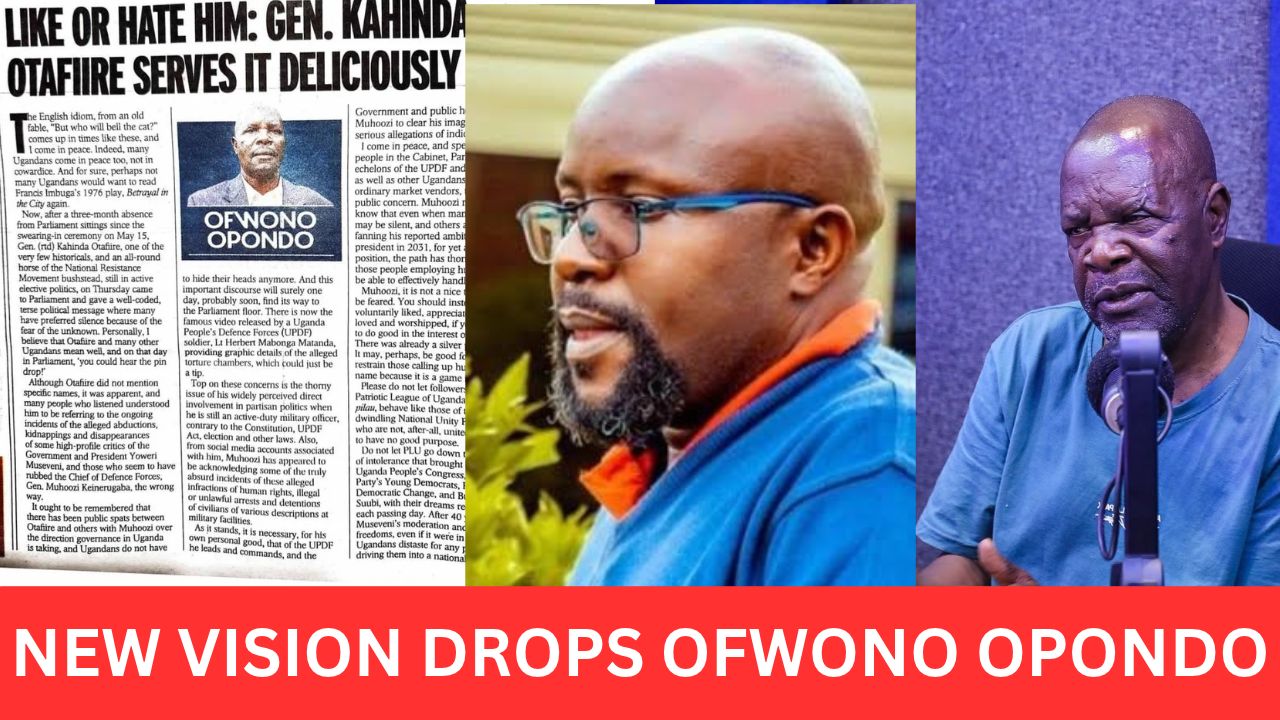 FeaturedNovember 2, 2026WHY VISION AXED OFWONO OPONDO: The Veteran Journo’s Criticism of Muhoozi’s 2031 Project, Defence of Otafiire and Questioning M7’s Succession Plan Triggered Tensions with the Government Newspaper’s Editorial
 FeaturedNovember 2, 2026WHY THE UPDF IS ENDING ITS 20-YEAR WAR IN SOMALIA: The Inside Story of the 20-Year Operation, the Generals who Commanded Missions and the Sacrifices that Made Uganda a Regional Military Powerhouse
 FeaturedOctober 31, 2026THE MUHOOZI TAKEOVER: WHY MK WANTS TO VET PRES MUSEVENI APPOINTEES! The CDF Declares, All New RDCs Must Pass His Scrutiny as PLU Seeks a Bigger Role in Determining Who Represents The President
 FeaturedOctober 30, 2026INTO THE CLASH OF TESO BIGWIGS OVER ELWELU: Why Ex Minister Musa Ecweru warned Retired Lt Gen Peter Elwelu to Surrender or Face the Full Force of Security! But Ambassador Nelson Ocheger Disputes Claims of Tension and Questions the Motives Behind the Intervention