








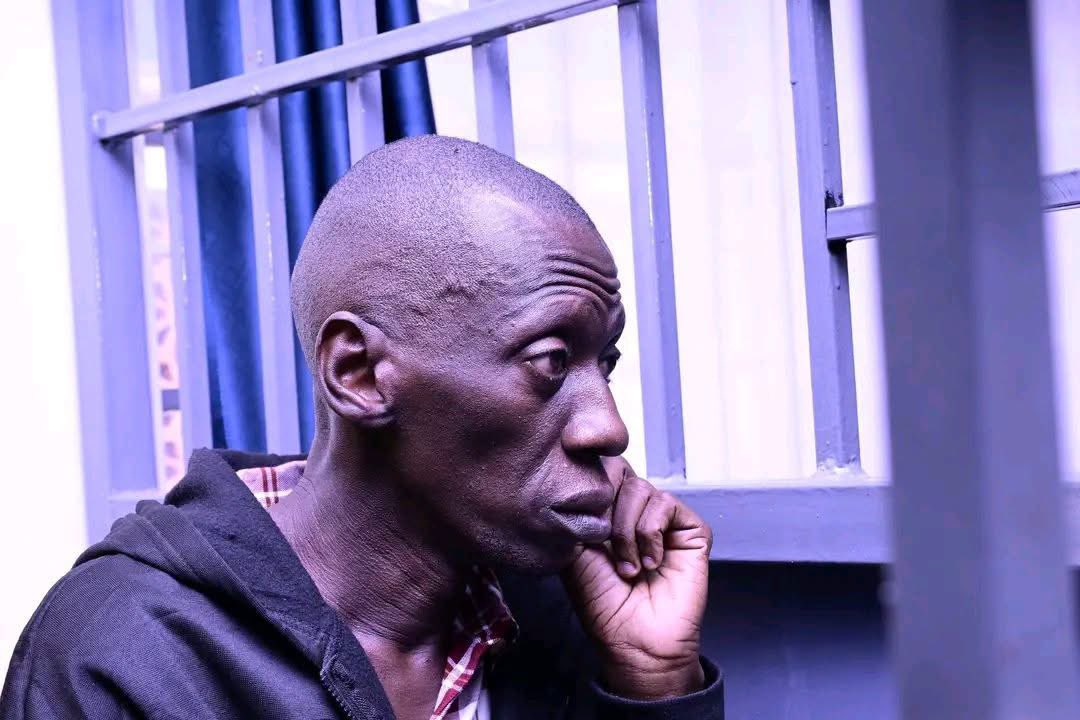
The Uganda Law Society (ULS) has intensified its confrontation with the government over the prolonged disappearance and detention of opposition activist Sam Mugumya, declaring that his eventual production before a military court does not absolve the State of alleged crimes committed during the 449 days he was held outside public scrutiny.
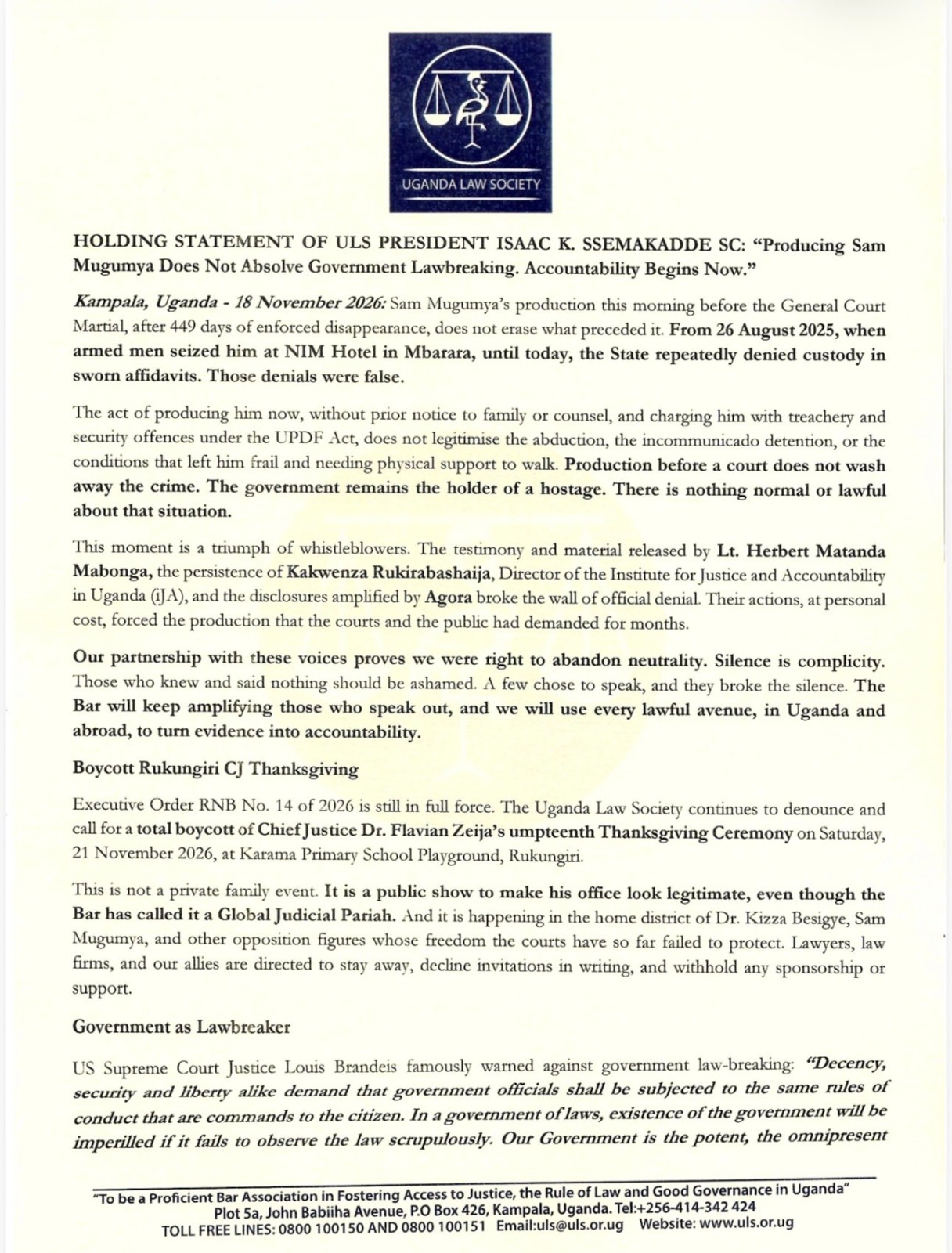
In a strongly worded holding statement, ULS President Isaac Ssemakadde, said the government’s decision to produce Mugumya before the General Court Martial at Makindye on Wednesday, cannot erase the circumstances surrounding his disappearance on August 26, 2025.
Ssemakadde described the development as an inadequate attempt to regularise what he characterised as an unlawful detention, arguing that the government must account for the period during which security agencies allegedly held Mugumya while repeatedly denying having him in custody.
The lawyer insisted that producing a citizen before a military tribunal after more than a year of secret detention does not retrospectively legalise the circumstances under which that person was arrested, held or allegedly mistreated.
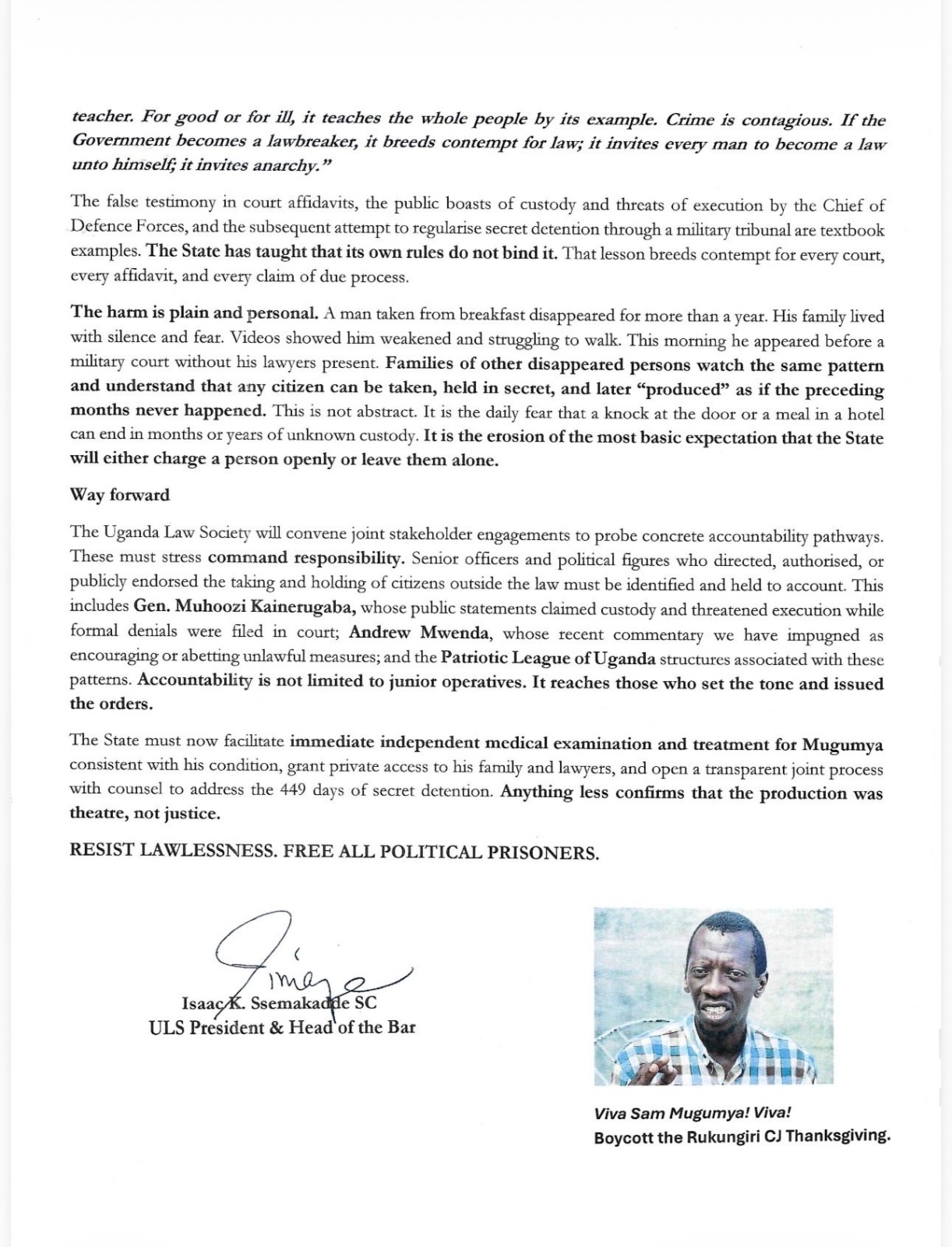
“Producing Sam Mugumya secretly before a military tribunal does not wash away the crimes of abduction, enforced disappearance, unlawful detention, and torture,” Ssemakadde said.
“The government remains the holder of a hostage. There is nothing normal or lawful about that situation.” His statement places the spotlight not only on the circumstances surrounding Mugumya’s disappearance but also on the responsibility of senior military commanders, political figures and individuals whose public statements allegedly contradicted official court filings. The ULS president specifically called for accountability to extend beyond junior security operatives to those who allegedly directed, authorised or publicly endorsed the actions.
Among those he singled out were Chief of Defence Forces (CDF) Gen Muhoozi Kainerugaba, veteran journalist Andrew Mwenda, and structures associated with the Patriotic League of Uganda (PLU).
The demands introduce a potentially significant dimension to the continuing dispute between the Bar and the military establishment: whether accountability for alleged unlawful detention should stop with the individuals who physically carried out an arrest or extend through the chain of command to those who allegedly ordered or facilitated it.
From hotel breakfast to 449 days of disappearance
Mugumya’s troubles began on August 26, 2025, when armed men reportedly seized him at NIM Hotel in Nyamitanga, Mbarara District.
According to accounts previously presented by his associates and lawyers, the men, who were reportedly dressed in civilian clothing, took him away in circumstances that left his family and political colleagues uncertain about his whereabouts.
The disappearance immediately triggered questions about the involvement of security agencies, particularly the Special Forces Command (SFC) and other military intelligence structures.
His lawyers subsequently sought judicial intervention, demanding that the authorities either produce him before court or explain his whereabouts.
The legal battle became increasingly complicated after government security agencies filed affidavits denying that Mugumya was in their custody.
One of the denials was attributed to Lt Col Edgar Musasizi, who reportedly stated that Mugumya was not detained by the UPDF and that there was no corresponding entry in the military detention records.
The affidavits became particularly controversial because they were later juxtaposed against public statements attributed to Gen Muhoozi.
On October 2, 2026, the CDF reportedly took to social media and declared: “Yes, I have Sam Mugumya. He is fine. But I will execute him soon.”
In another threatening statement, Muhoozi reportedly said he was going to shoot Mugumya to death. The statements raised serious questions about the whereabouts of an individual whose custody the military was disputing in formal court proceedings.
For the Uganda Law Society, this contradiction between public declarations and sworn court affidavits represents one of the most disturbing aspects of the matter.
Ssemakadde argues that the government cannot simultaneously deny holding a citizen before a court and have a senior military commander publicly claim responsibility for that person’s custody.
The contradiction, he maintains, undermines the credibility of official institutions and raises questions about the integrity of the judicial process.
The controversy also attracted attention from human rights activists, opposition figures and lawyers who demanded that the State disclose Mugumya’s whereabouts and guarantee his safety.
Among those who helped sustain the campaign were Lt Herbert Matanda Mabonga, activist Kakwenza Rukirabashaija and the Institute for Justice and Accountability in Uganda (iJA), alongside disclosures amplified by Agora.
Ssemakadde has credited these individuals with helping break what he describes as a wall of official denial.
He says their persistence and willingness to speak out, sometimes at considerable personal cost, helped force the government to produce Mugumya before a judicial institution.
Military court appearance raises fresh questions
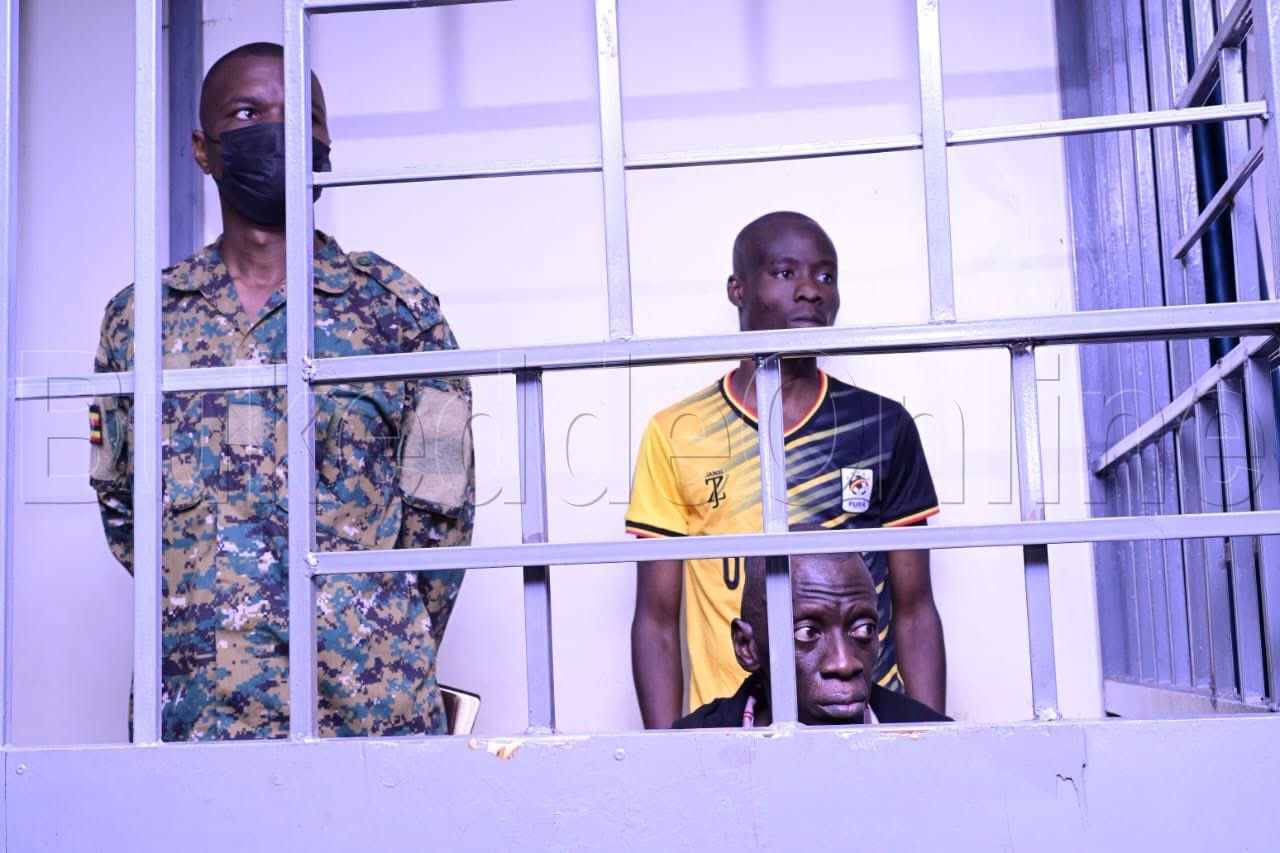
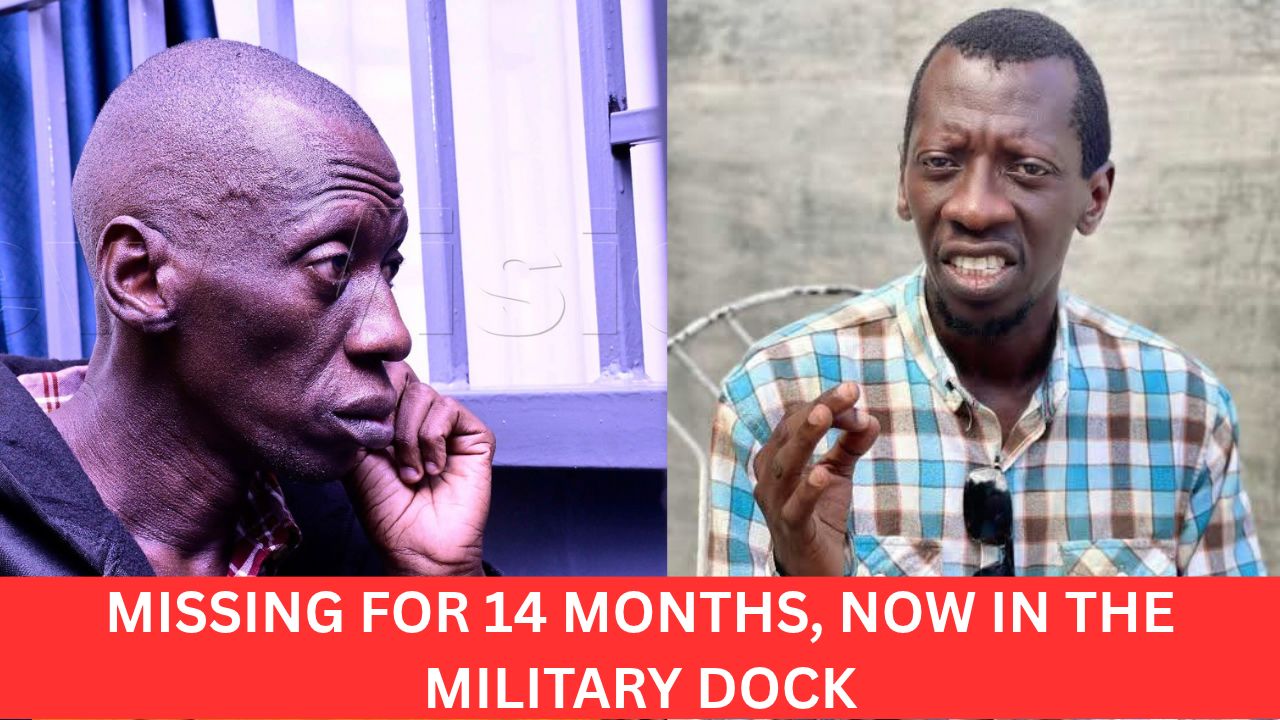
On Wednesday, the State eventually produced Mugumya before the General Court Martial at Makindye, bringing an end to 449 days during which his whereabouts had remained a subject of public controversy.
However, his appearance did not immediately settle the questions surrounding his disappearance. Instead, it opened another chapter in the dispute after prosecutors presented charges of treachery and other security-related offences under the UPDF Act.
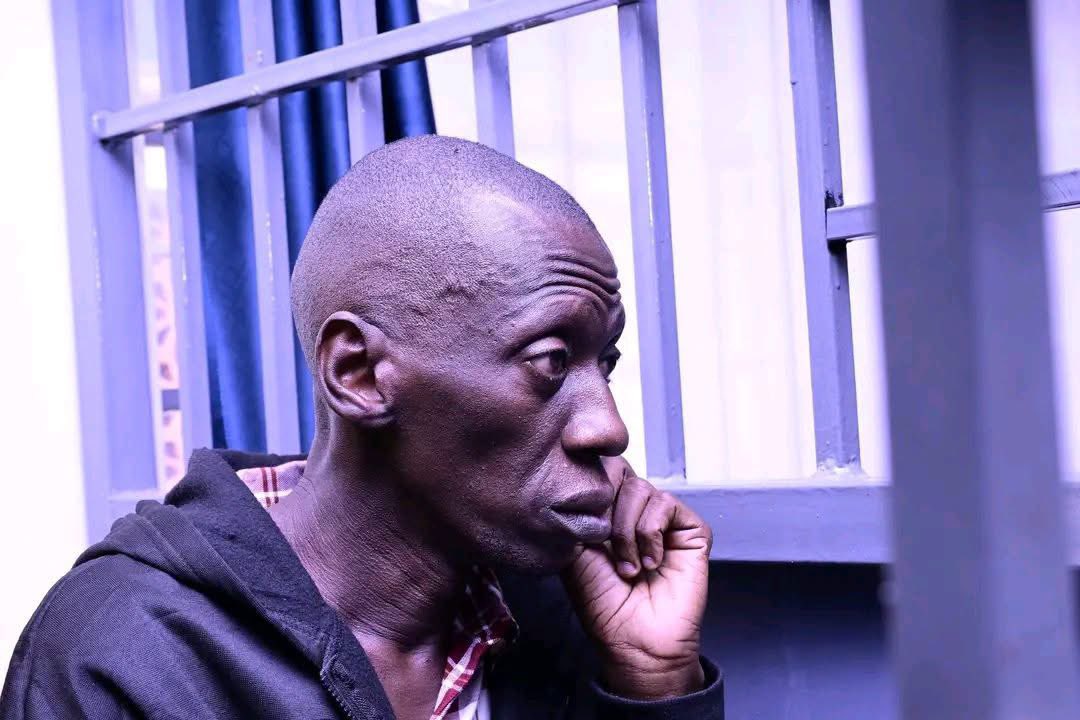
Mugumya was charged alongside UPDF officers before the military tribunal and subsequently remanded to Murchison Bay Prison in Luzira. The manner in which he was produced also attracted criticism from his lawyers and supporters, with Ssemakadde questioning why the family and legal representatives were not given prior notice of his appearance.
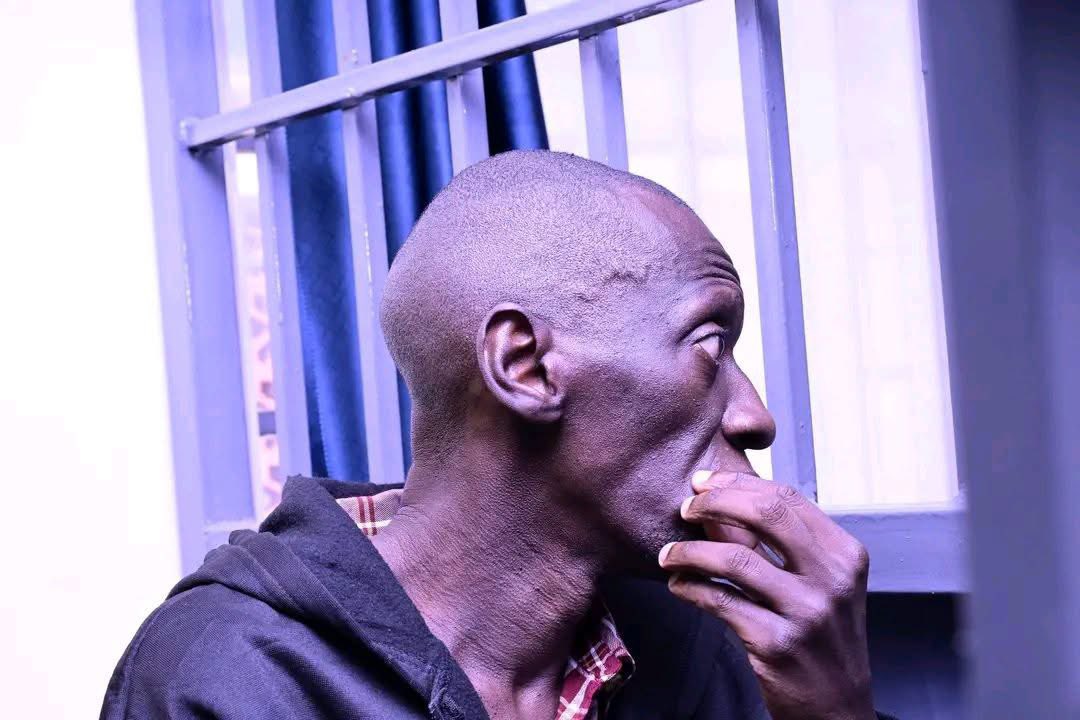
The ULS president further raised concerns about Mugumya’s physical condition, describing him as frail and requiring physical support to walk.
The reported condition of the activist has strengthened calls for an independent medical examination to establish the extent of any injuries, illness or mistreatment he may have suffered during the period of his disappearance.
For the Bar, the central question is no longer simply whether Mugumya has been charged with an offence. It is whether the State can explain how he spent more than a year outside the publicly acknowledged criminal justice system, why security agencies denied holding him and who was responsible for his detention.
Ssemakadde insists that the subsequent presentation of charges cannot erase the legal consequences of the preceding period.
The ULS also questions the appropriateness of trying a civilian activist before a military tribunal, particularly amid broader constitutional and human rights concerns surrounding military trials of civilians.
The military court proceedings, therefore, risk becoming another battleground between the government and the legal fraternity over constitutional safeguards, military jurisdiction and the limits of security operations.
Muhoozi, Mwenda and PLU structures in accountability spotlight
Perhaps the most politically explosive part of Ssemakadde’s statement is his insistence that responsibility must extend to senior figures who allegedly set the tone for the actions of security operatives.
He specifically mentioned Gen Muhoozi Kainerugaba, whose public statements about holding Mugumya and threatening to execute him became central to the controversy.
The ULS president argues that the CDF’s position makes it necessary to examine the relationship between public declarations, military operations and the subsequent official denials filed in court.
For Ssemakadde, command responsibility cannot be reduced to identifying the individuals who physically picked up Mugumya from the hotel.
It must also establish who issued instructions, who authorised the operation, who knew about the detention and who maintained or facilitated it.
This is particularly important given Muhoozi’s position as the country’s top military commander.
The ULS statement also names Andrew Mwenda, whose recent commentary Ssemakadde says the Society has impugned as encouraging or abetting unlawful measures. Mwenda has frequently been involved in public debates surrounding the military, the government and the political direction of the country.
However, the ULS president wants his alleged contribution to the atmosphere surrounding unlawful security operations examined as part of the broader accountability process.
The statement also refers to structures associated with the Patriotic League of Uganda, the political organisation chaired by Muhoozi.
Ssemakadde argues that political influence and public endorsement cannot provide immunity to individuals or organisations implicated in patterns of unlawful conduct.
The inclusion of these names makes the ULS position particularly consequential because it signals that the legal fraternity intends to pursue accountability beyond the conventional approach of investigating individual soldiers or police officers.
Nevertheless, the allegations against the named individuals must be independently investigated and established through lawful processes. Public statements, political commentary or association with an organisation should not, by themselves, be treated as proof of criminal responsibility.
The principle being advanced by the ULS is that anyone found to have ordered, facilitated, encouraged or knowingly participated in unlawful detention should answer for their role, regardless of rank or political influence.
The State cannot become a lawbreaker
To reinforce his argument, Ssemakadde invoked the famous warning by former US Supreme Court Justice Louis Brandeis about the dangers of government officials disregarding the law.
Brandeis argued that government must be held to the same standards of conduct it demands from ordinary citizens.
He warned that when government becomes a lawbreaker, it encourages contempt for the law and invites individuals to disregard established rules.
“In a government of laws, existence of the government will be imperiled if it fails to observe the law scrupulously,” Brandeis famously observed. The ULS president believes the Mugumya case illustrates precisely this danger.
According to him, the alleged abduction, prolonged secret detention, contradictory official accounts and eventual production before a military tribunal demonstrate how state institutions can undermine public confidence when they fail to observe constitutional requirements.
The consequences, he argues, extend beyond one individual. Families of other people who have reportedly disappeared under similar circumstances are left wondering whether their relatives are alive, where they are being held and whether they will ever receive an explanation from the authorities.
For these families, Mugumya’s eventual appearance before court offers some relief but also raises uncomfortable questions about the fate of other missing persons.
Ssemakadde says the Bar cannot remain neutral when citizens are allegedly subjected to unlawful security operations. “Our partnership with these voices proves we were right to abandon neutrality. Silence is complicity,” he said.
He praised whistleblowers and activists who challenged official accounts, arguing that their disclosures demonstrated the importance of independent voices in exposing alleged abuses of power.
The ULS president also warned that those who knew about the circumstances surrounding the disappearance but chose to remain silent should reflect on their responsibility.
ULS outlines the way forward
Rather than treating Mugumya’s production as the conclusion of the matter, the Uganda Law Society says it intends to pursue concrete accountability mechanisms.
Ssemakadde announced that the Society would convene joint stakeholder engagements to examine the available evidence and establish practical legal pathways for holding responsible individuals accountable. A central component of the proposed engagements will be command responsibility.
The Society wants investigators to establish the identities of senior officers and political figures who may have directed, authorised, facilitated or publicly endorsed the taking and holding of citizens outside the law.
This means that accountability should not end with the identification of the individuals who physically carried out an operation. The ULS also wants the government to facilitate an immediate independent medical examination of Mugumya and provide treatment consistent with his condition.
His family and lawyers should be granted private access to him without unnecessary restrictions. Additionally, the Society wants a transparent process involving Mugumya’s legal representatives to address the 449 days of alleged secret detention.
Such a process would need to establish where he was held, which security agencies had access to him, who supervised his detention and why the authorities repeatedly denied having him in custody.
The ULS says it will use every lawful avenue available, both within Uganda and internationally, to transform the evidence surrounding the disappearance into meaningful accountability.
The government is therefore facing pressure to explain not only the charges brought against Mugumya but also the events that preceded his appearance before the military tribunal.
Another confrontation between the Bar and government
The latest statement adds to the growing confrontation between the Uganda Law Society and the government over the treatment of opposition figures, the role of military institutions in civilian justice and the independence of the legal profession.
Ssemakadde has increasingly positioned the Bar as a defender of constitutional freedoms, particularly amid allegations of arbitrary arrests, detention without trial and mistreatment of government critics.
His latest intervention suggests that the ULS intends to make the Mugumya case a test of whether powerful state officials can be held accountable for alleged violations of the law.
The Society’s position is also a challenge to the government of President Museveni, which must demonstrate that its security agencies operate within constitutional limits.
For the opposition and human rights community, Mugumya’s appearance before the General Court Martial is only one part of a much bigger struggle over the protection of civil liberties.
For the government, the criminal charges against him must be addressed through a lawful and transparent judicial process, while the allegations concerning his disappearance and detention require independent examination. Ultimately, the two issues cannot be treated as mutually exclusive.
The State has a responsibility to investigate and prosecute legitimate security offences. It equally has an obligation to protect the rights of suspects, disclose their whereabouts, respect court orders and ensure that nobody is held outside the law.
Mugumya’s appearance before the General Court Martial may have ended months of uncertainty about his physical whereabouts, but it has not answered the questions surrounding the circumstances of his disappearance.
As Ssemakadde puts it, producing him before a military tribunal does not wash away what happened before that appearance. The ULS has made its position clear: the next chapter must be about accountability, not merely prosecution.
Author Profile
Charles can also be reached via; Tel: +256 774 108978
Email: [email protected]Latest entries
 FeaturedNovember 19, 2026M7 GETS TOUCHY WITH SULUHU! From Hand-Holding To Escorting The Tanzanian Leader Along The Red Carpet, Museveni Displays Rare Public Affection, Leaving Ugandans Wondering What Has Changed
 FeaturedNovember 19, 2026INSIDE MUSEVENI’S DANGOTE DEAL: WHY UGANDA NEEDS AFRICA’S RICHEST MAN: How Dangote’s Expanding East African Empire Could Reshape Uganda’s Oil Industry And Manufacturing Ambitions
 FeaturedNovember 19, 2026INSIDE ULS FIGHT FOR ACCOUNTABILITY OVER MUGUMYA’S DISAPPEARANCE: The Bar Says Mugumya’s Secret Production Before A Military Tribunal Cannot Legitimise His Disappearance, Vows Legal Action
 FeaturedNovember 18, 2026WHY SAM MUGUMYA’S COURT MARTIAL APPEARANCE RAISES FRESH QUESTIONS FOR UPDF: After The UPDF Denied Holding Him In Court, The CDF Publicly Claimed Custody Of The Opposition Activist And Threatened To Execute Him. The State Has Now Produced Him And Charged Him With Treachery