












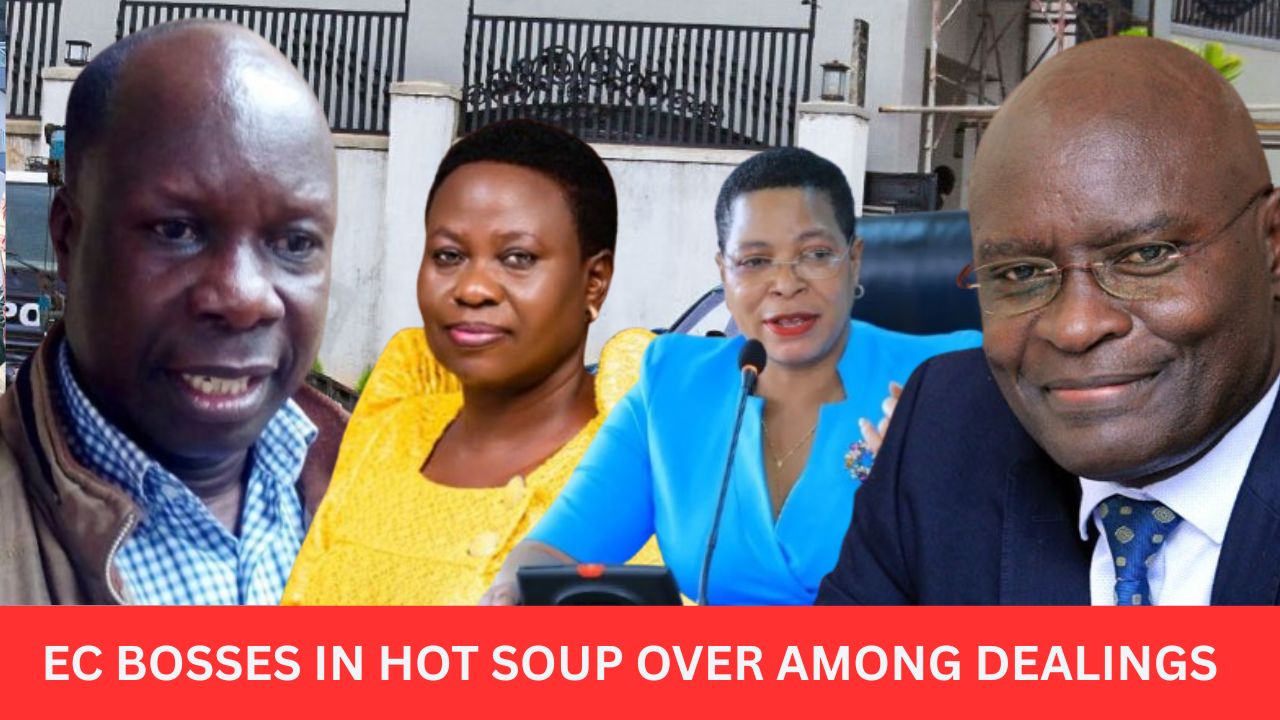
Fresh controversy has emerged around Uganda’s electoral processes after reports indicated that President Yoweri Museveni has been briefed by intelligence agencies on alleged irregularities involving Electoral Commission Chairperson Justice Simon Byabakama and NRM Electoral Commission Chairperson Tanga Odoi.
According to sources, investigators are examining allegations that some candidates were unfairly blocked from contesting in recent elections under circumstances believed to have favoured Speaker of Parliament Anita Annet Among and her political allies.
One of the cases under review involves Buyende District, where Daniel Mulirire was disqualified from contesting for the Budiope East parliamentary seat. The Electoral Commission ruled that Mulirire had failed to attach proof of resignation from public service during nomination.
Supporters of Mulirire argued that the decision was politically motivated, claiming he posed a serious challenge to incumbent MP Moses Magogo, who is married to Speaker Among.
“Mulirire had been duly nominated, so many voters were shocked when the Electoral Commission later overturned his candidature,” a voter from Buyende said.
Despite petitions to the ruling National Resistance Movement (NRM), Mulirire was reportedly never reinstated.
Attention has also shifted to Bukedea District, where several aspirants seeking to challenge Among for the Woman MP seat were disqualified before the NRM primaries. Among them was Hellen Odeke Akol, whose nomination was rejected by the NRM Electoral Commission chaired by Tanga Odoi.
Odoi then defended the decision, saying Odeke had failed to satisfy residency requirements after the NRM Secretary General allegedly informed the commission that she was not a resident of Bukedea.
“The Secretary General wrote to us indicating that Odeke is not a resident in the area. She had merely bought land there, which does not satisfy our residence requirement,” Odoi reportedly stated.
However, Odeke dismissed the claims and accused party officials of deliberately blocking her candidature.
“Besides living there, I own land and operate businesses in the trading centre. The decision was clearly intended to lock me out of the race,” she reportedly told investigators.
The matter sparked debate among civil society actors and election observers, who argue that the interpretation of residency requirements appears inconsistent with Uganda’s electoral laws.
In different media reports, Citizens Coalition for Electoral Democracy in Uganda coordinator Sarah Bireete said the disqualifications raised questions about selective application of electoral regulations.
“The law is clear on the qualifications for parliamentary candidates, but what we continue to see is uneven enforcement depending on political interests. This undermines public confidence in electoral institutions,” Bireete said.
Similarly, Alliance for Finance Monitoring Executive Director Julius Mukunda warned that electoral bodies risk losing credibility if rules are interpreted differently for different candidates.
“When institutions appear to act in favor of powerful individuals, citizens begin to doubt the independence of the electoral process. Electoral justice must not only be done, but must also be seen to be done,” Mukunda said.
Critics have pointed to what they describe as contradictions between the decisions taken by election officials and the provisions of Uganda’s electoral laws. Under Electoral Commission guidelines, a parliamentary aspirant is generally required to be a Ugandan citizen, at least 18 years old, a registered voter, and possess the minimum academic qualifications prescribed by law.
Further controversy emerged after village tribunals in Bukedea reportedly removed the names of three women who intended to challenge Among for the Woman MP seat. The affected aspirants included FDC’s Susan Norma Otai, Hellen Odeke Akol, and NUP’s Marion Mercy Alupo.
The tribunal decisions were later upheld by electoral authorities on grounds that the aspirants were not registered voters in specific parishes within Bukedea District.
Civil society leaders argue that the interpretation of voter registration and residency requirements remains legally contentious and should be clarified to avoid disenfranchising candidates.
Sources further claim that intelligence agencies are now investigating allegations that some electoral officials may have been compromised financially. Investigators are reportedly interested in establishing whether money or political influence played a role in the disputed disqualifications.
Author Profile
- Stanley Ndawula is a two and a half decades’ seasoned investigative journalist with a knack for serious crimes investigations and reporting. He’s the Founding Editorial Director and CEO at The Investigator Publications (U) Limited
Latest entries
 BusinessOctober 3, 2026NEW KID ON THE CELEBRITIES` BLOCK LT. HERBERT MABONGA UNVEILS HIS CONNECTIONS WITH THE PORTUGESE FUGITIVE: But Who Is Carlos Cohen? The Runaway Gold Dealer With M7`s Ear
 UncategorizedOctober 1, 2026ONE YEAR WITHOUT YOU, NDUGU TATYA: A Tribute to My Friend, Colleague and Brother, Daniels Nabongo Tatya, “The Prince Of Journalism, The Man From the Mineral-Rich Busoga”
 BusinessSeptember 25, 2026OF DEPUTY MUFTI SHEIK DR. HAFIDH MUHAMMAD HARUNAH BUKENYA`S BAD GOLD DEAL AND THE MISSING FILE: DPP Lino Anguzu Petitioned Over the Handling of the UGX1 Billion Criminal Case
 EducationSeptember 23, 2026MY LAST WORD ON FALLEN KING OYO`S SUCCESSION TREK: Maybe Ugandans Love a Good Story! But Punish Not the One Who Asks for Proof Simply Because the Story is Too Good to be Questioned