










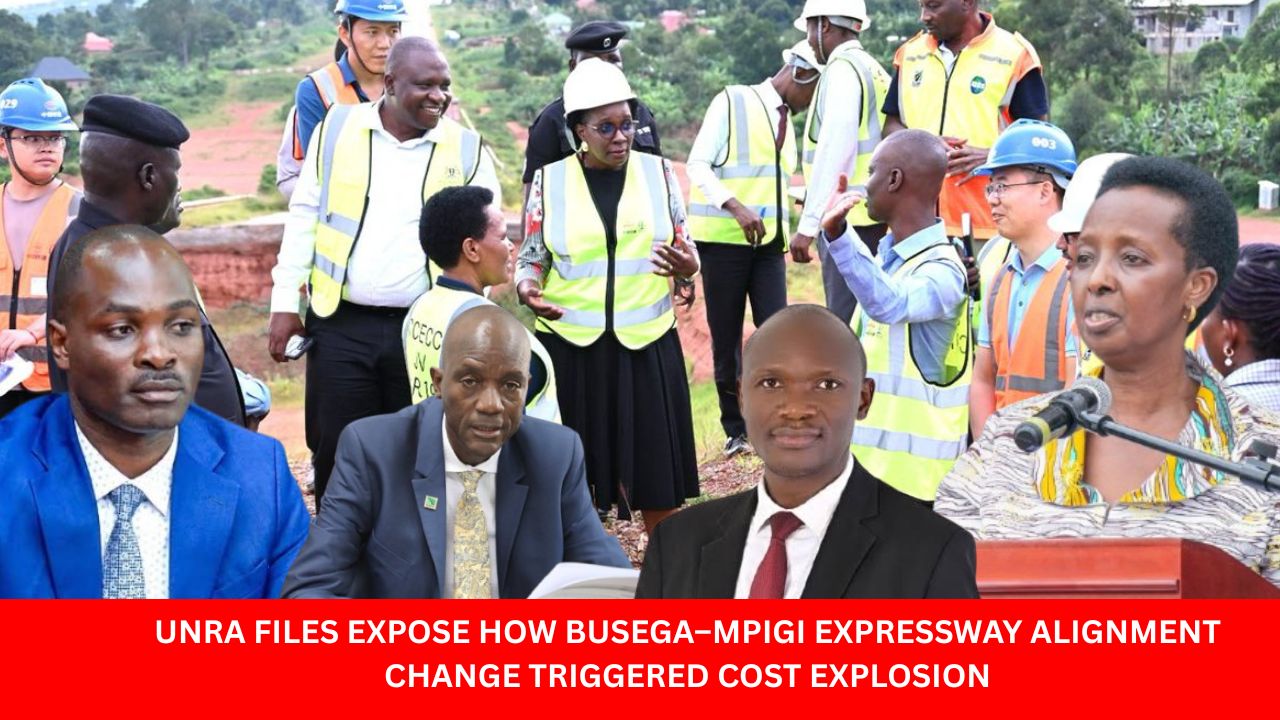
The deepening controversy surrounding the Busega–Mpigi Expressway has taken a new turn after internal records from the Uganda National Roads Authority (UNRA) reveal, in painstaking detail, how a revised road alignment triggered a major redesign, expanded the project scope, increased the contractor’s variation claim and ultimately contributed to the suspension of works.
The documents show that the original civil works contract signed in June 2019 was worth about Shs548.1 billion, but subsequent redesign and variations pushed the proposed contract value to more than Shs1.37 trillion, excluding 18 per cent Value Added Tax. The records do not, by themselves, establish that any individual acted corruptly. They do, however, provide a documentary trail of decisions, approvals and financial consequences that are now central to the government’s investigation into the troubled project.
The Busega–Mpigi Expressway, a 23.7-kilometre project financed through the African Development Bank and designed to ease congestion on the Kampala–Masaka corridor, was transferred from UNRA to the Ministry of Works and Transport under the Rationalisation of Government Agencies and Public Expenditure (RAPEX) reforms. The attached UNRA status report was prepared specifically to establish what had happened to the project before that transfer and what the Ministry inherited.
The first red flag: a new alignment
According to the UNRA records, the authority was responsible for both the civil works and consultancy contracts before the RAPEX transfer. UNRA’s Executive Director exercised the powers of Employer and Client, while the Ministry of Works and Transport, through its Permanent Secretary, was not a party to the project contracts and did not exercise contractual authority over them.
That distinction is crucial because it places the major contractual and design decisions made before December 2024 squarely within UNRA’s governance structure. The project took a decisive turn after UNRA communicated a revised road alignment to the contractor. A letter seen by The Investigatordated July 10, 2019, signed by then Director Roads and Bridges Development Eng. Samuel Muhoozi, forwarded the revised alignment to China Civil Engineering Construction Corporation (CCECC), the contractor.
The letter stated: “The purpose of this letter is to forward to you the revised road alignment to enable you plan for mobilization and other site establishments.” Muhoozi added that more drawings, including plan and profile drawings, would be issued by the appointed Engineer. That seemingly administrative communication would later become one of the most consequential decisions in the history of the project. The route change meant that the consultant had to update the design and accommodate a substantially altered scope of works.
UNRA approves the redesign
The records show that the revised alignment did not remain merely a planning proposal. The Supervision Consultant, Dohwa Engineering Company in joint venture with IDCG Engineering Group and associated firms, undertook the design review and updated the project design to reflect the new route. The exercise involved revised engineering designs, reviews and adjustments to the scope of works.
On October 8, 2021, then UNRA Executive Director Allen C. Kagina issued a no-objection to the Final Design Update. In the letter, Kagina stated that the consultant’s clarification responses had satisfactorily addressed earlier concerns. She wrote that UNRA had “no-objection to the submission made on the Final Design Review Report with necessary amendments.”
She further directed the consultant to seek the contractor’s proposal for executing the varied works under Clause 13 of the contract. That instruction is important because it effectively moved the revised alignment from a design exercise into a contractual variation process. In February 2022, UNRA again approved the issuance of instructions and drawings for works between approximately kilometre 8+700 and 21+060.
The Executive Director warned that the instructions were necessary to minimise further claims arising from delayed information and drawings. The paper trail therefore shows a progression: revised alignment, updated design, approval of the final design, instructions to proceed and subsequently a substantial variation claim.
The numbers tell the story
The financial consequences became stark by 2023. In a July 7, 2023 request for supplementary financing, UNRA told the Ministry of Finance that the design changes had produced a “significant increase in project scope”, particularly in earthworks, drainage, bridges and structures. The project’s original contract was approximately Shs548 billion.
But on March 27, 2023, the supervision consultant submitted an Engineer’s evaluation of the contractor’s variation proposal amounting to Shs1.346 trillion, inclusive of physical and financial contingencies and VAT. UNRA told the Treasury that the Engineer’s estimate was still under review but requested that it be considered for budgeting purposes while additional financing was being sought. By October 2024, the consultant’s updated evaluation projected an overall contract sum of approximately Shs1.370 trillion, including contingencies but excluding VAT. The figures expose the scale of the escalation.
The updated evaluation showed some extraordinary increases in quantities. Excavation in swamps, for example, rose from about 101,472 cubic metres to more than 2.06 million cubic metres — an increase of more than 2,000 per cent. Class DR dumped rock increased from 180,000 tonnes to more than 3.58 million tonnes, while crusher run increased from 90,000 tonnes to more than 533,000 tonnes. These were not marginal adjustments. They represented a fundamental expansion of the engineering quantities required to construct the revised scheme.
The contractor runs out of money
By May 2024, the project had entered another crisis. The consultant reported that the original contract amount had been exhausted and that the contractor had suspended works. The consultant cited the contractor’s reliance on contractual provisions relating to the Employer’s financial arrangements and suspension of works.
The report warned that the suspension would further delay completion and expose the project to additional financial charges. The consultant wrote that the lapse of time had become critical and invited the Employer to review the updated variation proposal. The sequence is significant. The contractor did not simply abandon the project. According to the documents seen by The Investigator, the suspension followed exhaustion of the original contract amount and the absence of evidence of additional financing. This was happening while the Government was still grappling with the revised cost.
The Ministry steps in
Following the transfer of functions from UNRA to the Ministry of Works and Transport under RAPEX, Works Minister Fred Byamukama ordered an independent review of the revised cost estimates. A multidisciplinary technical committee involving Ministry officials and representatives of the Engineers Registration Board examined the contractor’s variation proposal, the consultant’s cost evaluation and the broader implementation strategy.
The committee submitted its final report in April 2025. It recommended adjustments to rates and quantities and arrived at a revised project cost lower than the consultant’s October 2024 evaluation. It also concluded that continuing with the existing contractor was the more prudent option than terminating the contract and procuring a new contractor.
The committee estimated that terminating the existing contract, re-scoping the remaining works and procuring another contractor would take at least 12 months. Such a delay, it warned, could cause deterioration of already constructed works, particularly earthworks and swamp-treatment areas. More significantly, the committee said a new contractor could cost substantially more because the original tender had been conducted nearly eight years earlier and market prices had changed. The committee cited an independent cost estimate commissioned by UNRA which had placed the cost of the varied works at about Shs1.979 trillion based on 2024 market rates.
Land acquisition emerges as another fault line
The technical committee also identified delayed land acquisition as a major project risk. It recommended that the Employer expedite land expropriation and ensure the contractor received unencumbered access to the project site. This is significant because changing an alignment can affect not only engineering designs but also land requirements, valuations, compensation and access to construction sites.
The committee specifically called for the consultant, Employer and contractor to develop a reasonable cost estimate for risks arising from delayed land acquisition. The Ministry’s subsequent position has been even more forceful. Appearing before Parliament in July 2026, Byamukama said government had resolved that road contracts should not be signed unless substantial right-of-way acquisition had already been completed.
“We have agreed that no road contract will be signed unless at least 50 per cent of the required right of way has been acquired,” Byamukama told MPs, adding that President Museveni had directed that the threshold be raised to 75 per cent. The minister also blamed corruption, poor contract management and irregular payment practices for delays and cost escalation in the roads sector. He told Parliament that some contractors had been left waiting for payment while newer certificates were processed ahead of older ones.
The political reckoning
The Busega–Mpigi controversy has since escalated beyond a contractual dispute. President Yoweri Museveni ordered investigations into officials linked to the project amid allegations of financial mismanagement. By July 2026, Byamukama told Parliament that the President had dismissed six engineers connected to major infrastructure projects.
“As I was leaving my office this morning, I saw a letter from the President sacking six engineers, including a few I am seeing on this front bench here,” Byamukama told MPs. He said the Ministry would cooperate with investigative agencies and would not shield officials implicated in corruption. The wider investigations have included senior engineers associated with Busega–Mpigi, including Patrick Muleme and Isaac Wani. Public reporting has also captured a dispute over responsibility for the earlier alignment change.
Wani, who has defended his role, has argued that the critical issue is not simply who transmitted a revised alignment but who made the decision to change it and why. His account places the technical origin of the revised alignment within the Design Department and disputes the suggestion that his subsequent involvement amounted to approval of the original decision. That defence is important because the UNRA documents show that the revised alignment eventually received institutional approval and became the basis for the updated design and variation process.
A project caught between two versions of the truth
The documents now raise a fundamental accountability question. If UNRA approved the revised design and instructed the consultant to proceed with variations, responsibility cannot be reduced to the contractor’s subsequent claim for additional money. Investigators will have to establish who initiated the new alignment, what engineering analysis justified it, who approved it at every stage, whether the financial implications were adequately understood and whether the resulting land acquisition and compensation consequences were properly anticipated.
The documents also show that UNRA’s own officials were deeply involved in managing the consequences of the revised design. Muhoozi formally transmitted the revised alignment to the contractor. Kagina subsequently issued the no-objection to the updated design and directed the consultant to obtain the contractor’s proposal for the varied works.
The consultant then negotiated a variation that eventually took the projected contract value to about Shs1.37 trillion before VAT. The contractor subsequently suspended works after the original contract amount was exhausted. The Ministry later inherited a project requiring additional financing, further land acquisition and a massive increase in scope.
The unanswered billion-shilling questions
The Busega–Mpigi saga is therefore no longer simply about a delayed road. It is about how an infrastructure project that began with an original contract of roughly Shs548 billion reached a variation of about Shs1.37 trillion and is now projected by government to cost far more. Byamukama has said the project could ultimately exceed Shs2 trillion, attributing the escalation to delays, redesigns, funding interruptions and alleged corruption.
The Ministry’s technical committee, however, cautioned against terminating the existing contractor because restarting the procurement process could cause at least another year of delay and potentially make the remaining works even more expensive. That leaves taxpayers with a difficult choice: spend more to complete the existing project, or spend even more to start again. But before either decision is made, investigators must establish how the project arrived here.
1-Who authorised the change in alignment?
2-Why was the route changed?
3-What engineering evidence supported it?
4-Who assessed its impact on land acquisition?
5-Why did the revised scope produce such extraordinary increases in swamp excavation and rock quantities?
6-And, most importantly, who understood the financial consequences before the Government committed itself to the additional expenditure?
Those questions are now at the heart of the Busega–Mpigi investigation. The UNRA records provide the chronology. The Ministry’s technical review provides the financial warning signs. The minister’s parliamentary testimony provides the political response. What remains for the investigators is to connect the dots — and determine whether the Shs1 trillion-plus escalation was the unavoidable consequence of an evolving engineering project, or whether decisions taken along the way exposed the public purse to costs that could have been prevented.
For a project that was supposed to unlock the Kampala–Masaka corridor, the road to completion has instead become a long audit trail of redesigns, variations, delayed land acquisition and unanswered questions. And the biggest question remains: who changed the road, and who knew what that change would cost Uganda?
Author Profile
- Charles Gazza Kodili is a seasoned journalist with over 20 years of experience in the media industry. He holds a Bachelor of Arts degree in Mass Communication. He’s currently the Chief Editor at the Investigator.
Charles can also be reached via; Tel: +256 774 108978
Email: [email protected]
Latest entries
 FeaturedOctober 9, 2026UGANDA ECONOMY TO HIT $73.96B: President Museveni Cites Decades Of Economic Growth As He Receives A Top National Honour During The 64th Independence Anniversary Celebrations At State House, Entebbe
 FeaturedOctober 9, 2026KABALEGA: THE KING WHO FOUGHT THE BRITISH: From Battles Against Sir Samuel Baker To Uganda’s Independence In 1962, The Bunyoro King Became A Symbol Of Resistance Against Foreign Domination
 FeaturedOctober 8, 2026UGANDA AT 64: From Obote Receiving the Instruments of Power in 1962 to Museveni Receiving a National Medal in 2026, Uganda’s Independence Story Remains Unfinished. We Journey With You the Thorney 6+ Decades of Uhuru
 FeaturedOctober 8, 2026AFRICA MUST PREPARE FOR NEW WARS – MUSEVENI: The President Challenges Defence Chiefs to Link Military Strength With Economic Power, Political Stability and Regional Integration as African Armies Rethink Security Beyond Conventional Warfare