












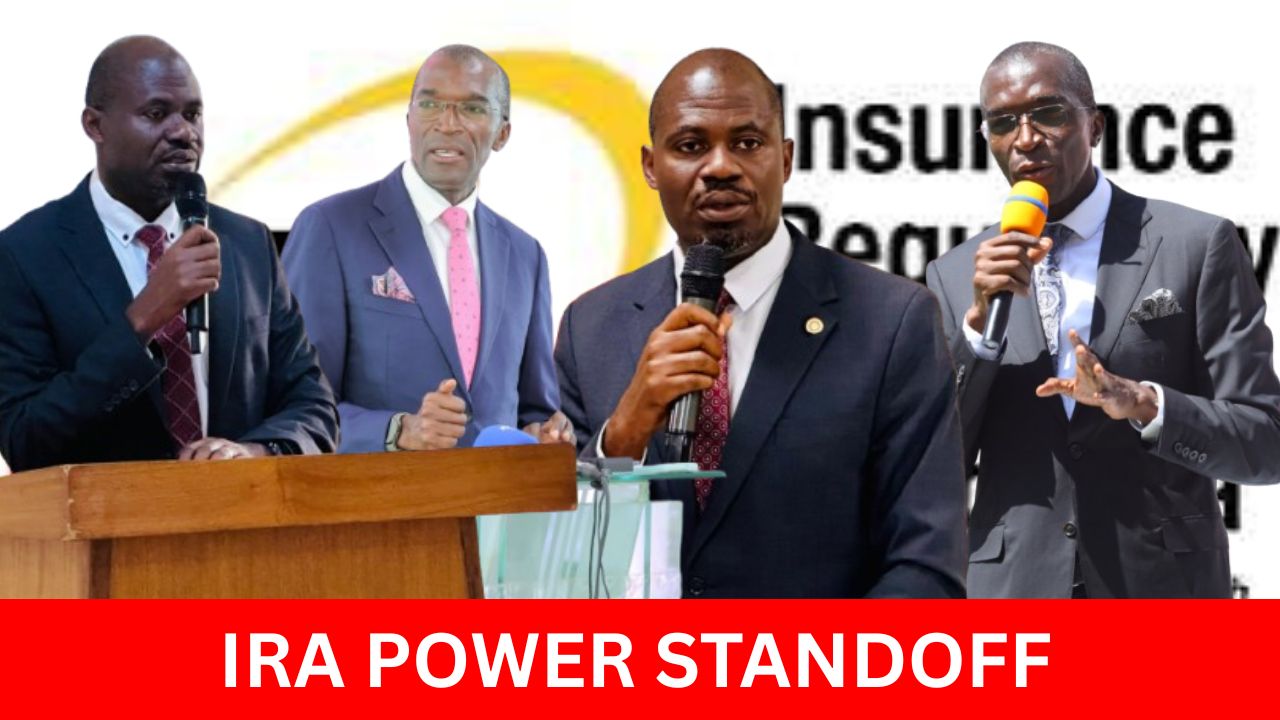
A bitter leadership dispute at the Insurance Regulatory Authority of Uganda (IRA) dramatically spilled into Parliament on Monday after former chief executive officer Alhaj Ibrahim Kaddunabbi Lubega refused to accept that his tenure had ended and appeared before the Committee on Commissions, Statutory Authorities and State Enterprises (COSASE) insisting that he remains the substantive CEO.
Kaddunabbi appeared alongside Dr Protazio Sande, the official appointed acting CEO after Kaddunabbi’s five-year contract expired on May 31, 2026.
The extraordinary confrontation left MPs facing a simple but fundamental question: who is legally in charge of Uganda’s insurance regulator?
The committee had convened to scrutinise the Auditor General’s report on the IRA, including questions surrounding the regulator’s financial management. Instead, the proceedings were nearly paralysed when two men presented themselves as the institution’s chief executive.
Sande introduced himself as the Acting CEO. Kaddunabbi, however, would have none of it. He maintained that he remains the substantive CEO, arguing that a High Court order issued on May 29 preserved the status quo pending determination of his court case challenging the decision by the IRA Board not to recommend him for another term.
“On May 29, 2026, the High Court of Uganda, through my application, undertook to maintain the status quo of what was happening at the IRA, and that position is still the case,” Kaddunabbi told the committee.
He went further, telling the MPs: “As far as the law is concerned, I am the chairman of the IRA,” apparently referring to himself as the chief executive.
The committee immediately demanded documentary proof. Kaddunabbi was asked to produce certified copies of the court order and ruling upon which he based his claim, but he was unable to present the documents at the time.
Why Kaddunabbi refuses to leave
At the heart of the standoff is Kaddunabbi’s unsuccessful bid for another term at the helm of the regulator.
He had served at the institution for about 16 years, first joining the regulator in 2011. His most recent five-year contract ran from June 1, 2021, to May 31, 2026.
But on February 16, 2026, the IRA Board declined to recommend him for another five-year term. The decision subsequently triggered a legal battle.
Kaddunabbi challenged the Board’s decision in the High Court, arguing that the process was illegal, irrational, biased and procedurally unfair. He contends that he was denied a fair opportunity to respond to matters raised against him and that his previous performance evaluations had been strong. He also argues that he had a legitimate expectation to be fairly considered for another term.
His court challenge seeks orders quashing the Board’s decision and preventing government institutions from relying on the contested findings and decisions arising from the process.
The Auditor General’s investigation and findings form a critical part of the dispute because the Board relied on concerns raised during reviews and audits when it decided not to recommend him for reappointment. The IRA and its former board leadership have maintained that the decision was informed by governance and financial-management concerns.
Kaddunabbi’s legal strategy has therefore been central to his refusal to concede that his leadership has ended.
He believes the High Court’s intervention preserved the status quo. The IRA, however, interprets the court proceedings differently.
Sande takes over
While Kaddunabbi went to court, the IRA Board moved to prevent a leadership vacuum. Dr Protazio Sande, who had been serving as Director of Strategy and Market Development, was appointed Acting CEO effective June 1, 2026, one day after Kaddunabbi’s contract expired.
The IRA officially announced the appointment on June 2, saying it was made under Clause 6.11(h) of the Authority’s Human Capital Management Manual. The regulator said Sande’s appointment was intended to ensure continuity and stability.
Sande consequently appeared before COSASE as the acting head of the Authority. His presence next to Kaddunabbi created an unprecedented situation in which the committee had two men claiming authority over the same institution.
The leadership dispute became so serious that COSASE suspended consideration of the Auditor General’s report.
Sande maintained his position as acting CEO and was prepared to account for the institution’s affairs before Parliament.
However, MPs wanted evidence. The committee discovered that the letter from Permanent Secretary and Secretary to the Treasury Ramathan Ggoobi appointing Sande had not initially been formally received by the IRA, prompting questions about the authenticity and transmission of the document.
Sande told MPs that, because of the urgency of the matter, an officer had been sent to the Ministry to obtain the appointment letter.
“If you may allow, because of the urgency of this issue, we asked one of our officers to go and get the letter from the Ministry. Because I was very sure that if I come here without it, then we shall be wasting the committee’s time,” Sande told the committee.
The office property standoff
The leadership battle has also spilled into the physical control of the IRA offices. Kaddunabbi has been accused of refusing to fully hand over office responsibilities and property, including files and office keys, despite the expiry of his contract.
The dispute over the handover is important because an outgoing accounting officer or chief executive is expected to facilitate an orderly transfer of institutional records, assets and responsibilities to the successor or acting office bearer.
IRA officials have maintained that the transition process was initiated before the expiry of Kaddunabbi’s contract.
According to court documents cited in earlier proceedings, the Board directed Kaddunabbi on April 29 to proceed on outstanding leave and undertake a formal handover ahead of the May 31 expiry of his contract.
The Authority has maintained that the handover was completed and that Sande subsequently assumed office. But Kaddunabbi’s continued insistence that he remains the substantive CEO has complicated the question of who has authority over institutional property and records.
His position is effectively that he cannot be treated as an ordinary former employee while his legal challenge and the court orders he relies upon remain unresolved.
The IRA’s position is the opposite: that his fixed-term contract expired by operation of law and that the appointment of Sande was necessary to ensure continuity.
Muwada refuses to pick sides
COSASE Chairperson Muwada Nkunyingi found himself at the centre of the institutional confrontation.
Rather than immediately declaring one of the two men legitimate, Nkunyingi said the committee would rely on certified court documents and official clarification from the Treasury.
“We don’t want to go into the interpretation of who is right and wrong without reference to a court arbitration, since some of these aspects are largely matters touching a matter before court. We shall see how to proceed when relying on validated documents,” Nkunyingi said.
He ordered both sides to return with certified copies of the relevant court orders and rulings.
“The challenge is that what the head of legal was reading was different from what Hajji Kaddunabbi was reading. I want to first interrogate the two when they present certified copies,” Nkunyingi added.
The committee also resolved to summon the Permanent Secretary and Secretary to the Treasury to clarify who is legally authorised to head the IRA and account for its affairs before Parliament. That decision effectively placed the dispute beyond the personalities of Kaddunabbi and Sande. It transformed the controversy into a question of institutional authority.
A regulator caught between court and Parliament
The IRA leadership dispute now sits at the intersection of three powerful institutions: the regulator’s Board, the courts and Parliament. The Board says Kaddunabbi’s contract ended on May 31 and that Sande was properly appointed in an acting capacity. Kaddunabbi says the court preserved the status quo and that he remains the substantive CEO.
Parliament, meanwhile, wants to know who should account for the public resources and management decisions under examination in the Auditor General’s report.
The legal battle has therefore produced a governance paradox: two men claiming authority over one statutory institution while lawmakers are trying to establish who has the legal mandate to answer their questions.
For Kaddunabbi, the fight is not merely about occupying an office. It is also about overturning the decision that ended his long tenure and challenging the findings that he says were used against him. For the IRA, however, the priority is continuity and institutional stability.
The regulator’s official position remains that Sande succeeded Kaddunabbi after his contract expired, while the Board has praised Kaddunabbi’s contribution during his long tenure.
The immediate loser in the confrontation may therefore be the institution itself.
Until the court documents are clarified and Treasury formally establishes who should account for the IRA before Parliament, COSASE’s scrutiny of the Auditor General’s report remains caught in the middle.
What began as a dispute over the renewal of one man’s contract has now become a test of institutional succession, accountability and respect for the boundaries between a board, the executive, Parliament and the courts.
And for now, Kaddunabbi is refusing to surrender the title he believes the law still gives him.
Author Profile
- Charles Gazza Kodili is a seasoned journalist with over 20 years of experience in the media industry. He holds a Bachelor of Arts degree in Mass Communication. He’s currently the Chief Editor at the Investigator.
Charles can also be reached via; Tel: +256 774 108978
Email: [email protected]
Latest entries
 FeaturedOctober 16, 2026KAWOOYA UNDER FIRE AS MINISTRY DENIES DR CANDIA SUSPENSION: Health Ministry Says Arua Doctor Remains In Office After Minister Reportedly Ordered Him To Hand Over For “Pocketing”
 FeaturedOctober 14, 2026MATHEW BAGONZA BAIL DEAL DEALS A BLOW TO CDF GEN. MUHOOZI: Rwabwogo’s Camp Sees Relief After Weeks Of Confrontation, As Reported First Family Tensions Raise Questions About The CDF’s Fight With His Brother-In-Law
 FeaturedOctober 14, 2026GOVERNMENT TO CASH IN ON CHARCOAL TRADE: Government Plans To Formalise The Charcoal Business Through Trade Licences, Taxation And Strict Monitoring Of Producers And Dealers
 FeaturedOctober 13, 2026‘PRODUCE SAM MUGUMYA NOW’ — SSENYONYI: LoP Tells Parliament Families Of Missing Ugandans Deserve Answers, Freedom And Justice As He Challenges Government Over The Opposition Activist’s Fate