










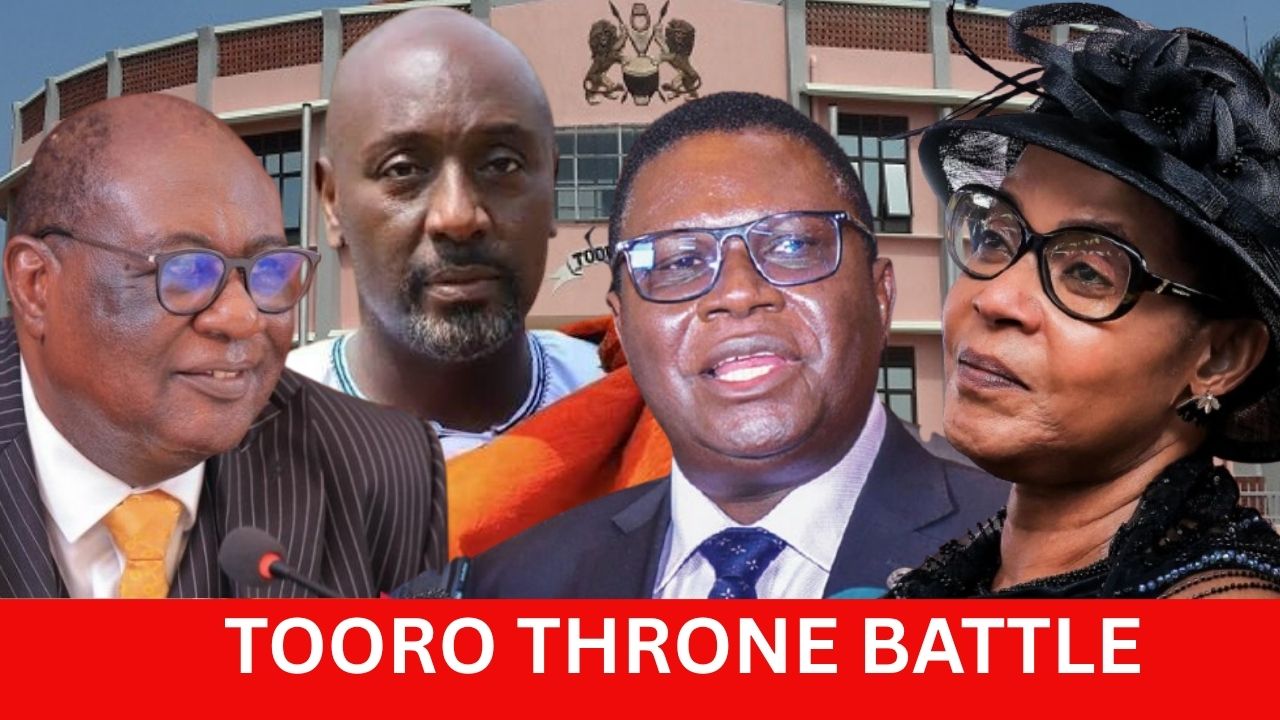
Justice and Constitutional Affairs Minister Norbert Mao has said the Government has not yet given President Yoweri Museveni its final position on the bitter dispute over who should succeed the late Tooro King Oyo Nyimba Kabamba Iguru Rukidi IV.
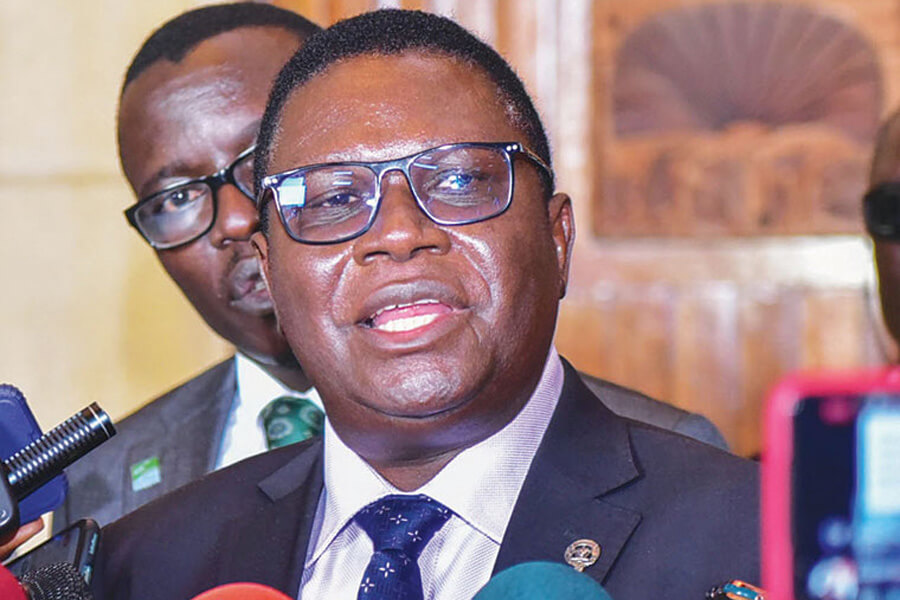 Mao said his ministry was working with the Attorney General to examine the competing claims within the Tooro royal family before advising the President on the way forward.
His remarks came as a fresh legal opinion attributed to Attorney General Sam Mayanja appeared to complicate the succession of Prince Edward Rukiidi Nyabongo I, who was recently selected and enthroned following the death of King Oyo.
Mao, who had just returned from Fort Portal after attending Oyo’s burial at the Karambi Royal Tombs on Saturday, called for restraint from the royal family and the people of Tooro. He said the dispute should be handled through lawful processes rather than through competing declarations, ceremonies or political pressure.
“I have just returned from Fort Portal; we buried King Oyo, but the conflict there is untouchable,” Mao said, according to a report on his remarks. “As the minister who oversees the Constitution, I will coordinate with the Attorney General and advise the President.” Mao stressed that the succession question could not simply be regarded as settled because a royal candidate had been selected or traditional rituals had begun.
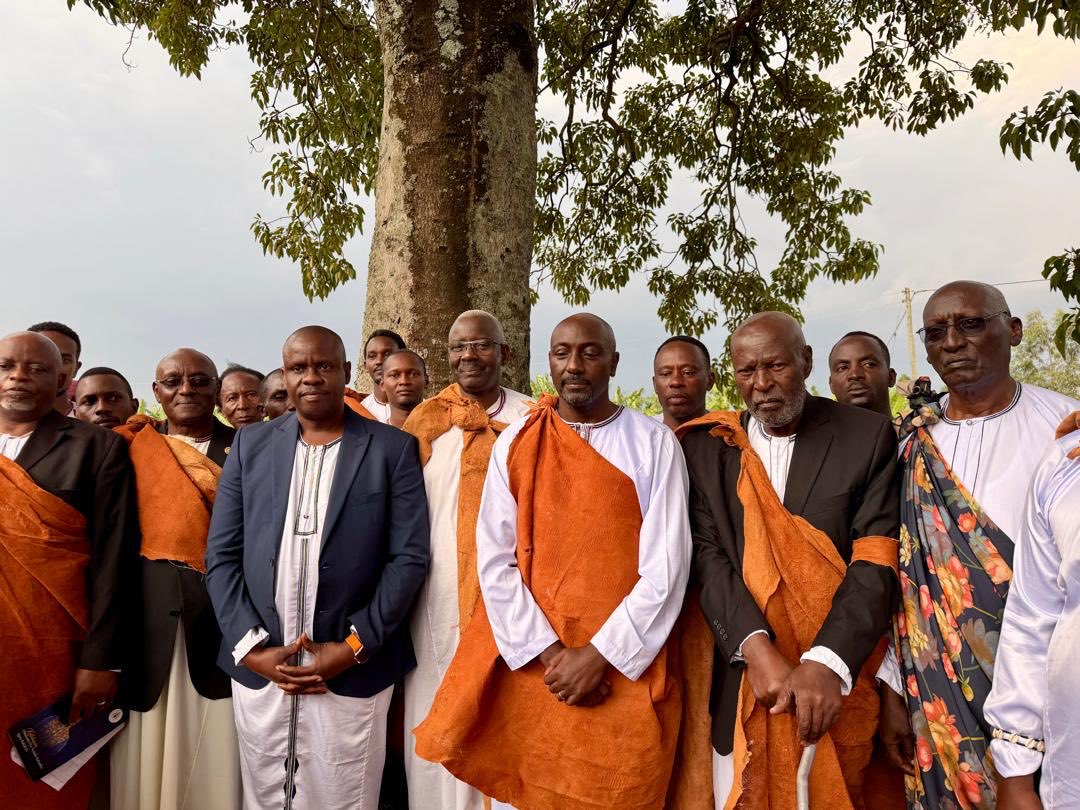 He said the law requires the succession question to be resolved before the name of a new traditional leader is formally entered into the national gazette. “The enthronement is not complete until the successor’s name is included in the national gazette,” Mao said. His comments effectively placed the Government’s position at the centre of the unfolding dispute, despite the royal family having already moved to install Nyabongo as the successor.
AG backs Oyo’s will
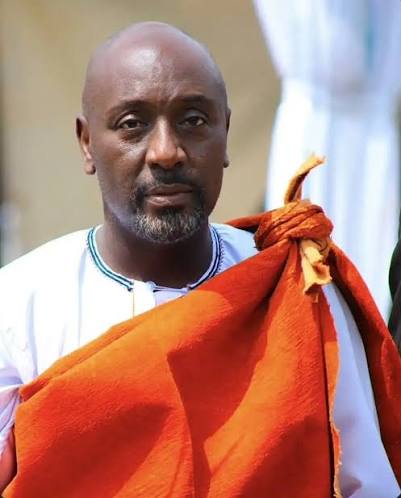 The latest legal development came from Attorney General Sam Mayanja, who reportedly submitted a three-page legal opinion to President Museveni on Saturday. According to the opinion, Uganda’s Constitution, the Institution of Traditional or Cultural Leaders Act and the customs and traditions of the Batooro provide the legal framework for determining succession to the Tooro throne.
Mayanja argued that where a deceased king leaves a valid will providing for succession, that will should be respected. “The law recognises that, in ascending to the throne, allegiance principally is derived from birth and subsequently by descent,” Mayanja wrote.
He added that where there is a direct descendant of the King by birth, that person, in accordance with a valid will, would ascend to the throne in accordance with the culture and customs of the Batooro people. The Attorney General reportedly relied on a will dated September 14, 2022, in which Oyo provided for the succession to the throne.
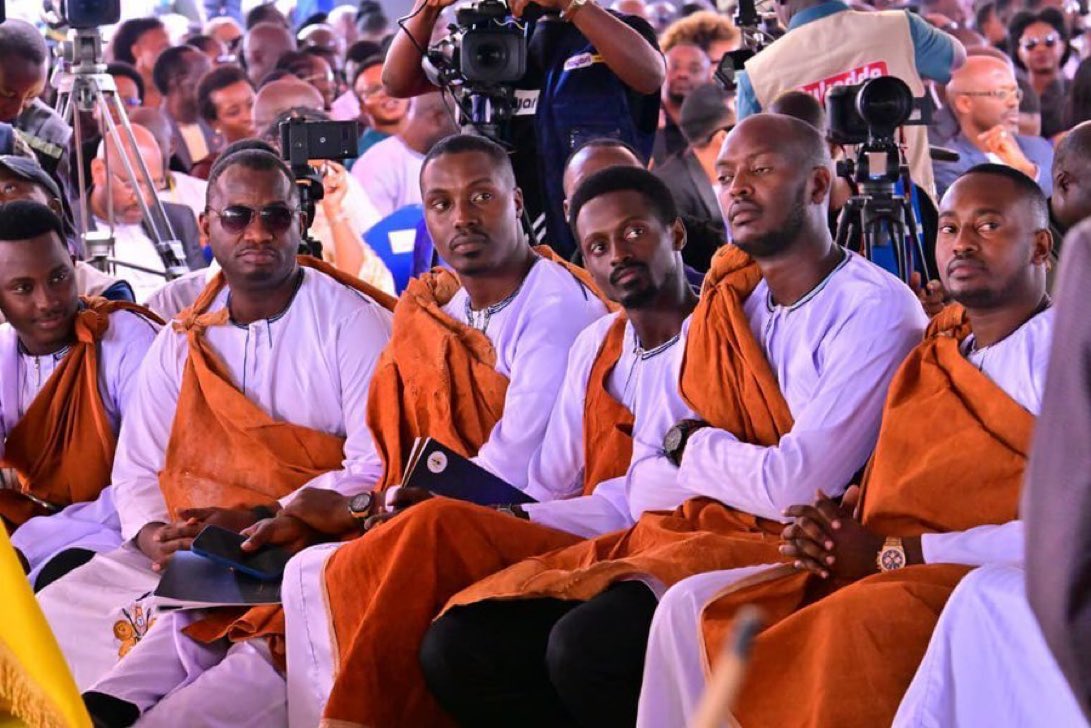 According to the legal opinion, Oyo stated that if he was survived by a son lawfully recognised as his biological son, that son would become his heir to the Tooro Kingdom. This position directly touches the most controversial issue in the succession dispute—the claim by members of Oyo’s immediate family that the late King had left instructions naming his biological son as his first successor.
However, the royal succession committee had previously proceeded on the basis that no eligible heir had been presented to it. According to the report of Mayanja’s opinion, the committee asked Oyo’s family to present the alleged son or a photograph of him but did not receive the required evidence, prompting it to look elsewhere within the royal lineage.
Will provides alternative
Mayanja’s opinion also reportedly identified an alternative succession arrangement contained in Oyo’s will.
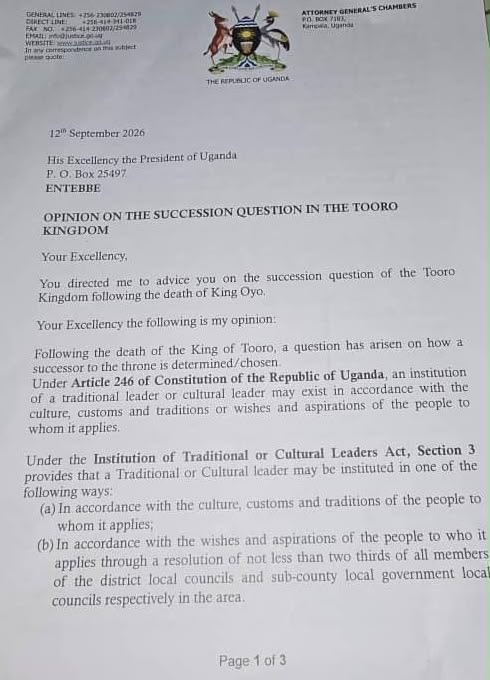 If Oyo had no son able to succeed him, or if his son died before assuming the throne, was permanently incapacitated or otherwise unable to perform the duties of the monarch, the will named his cousin Prince Komwiswa Omukama, son of Omusuuga Charles, as the alternative heir.
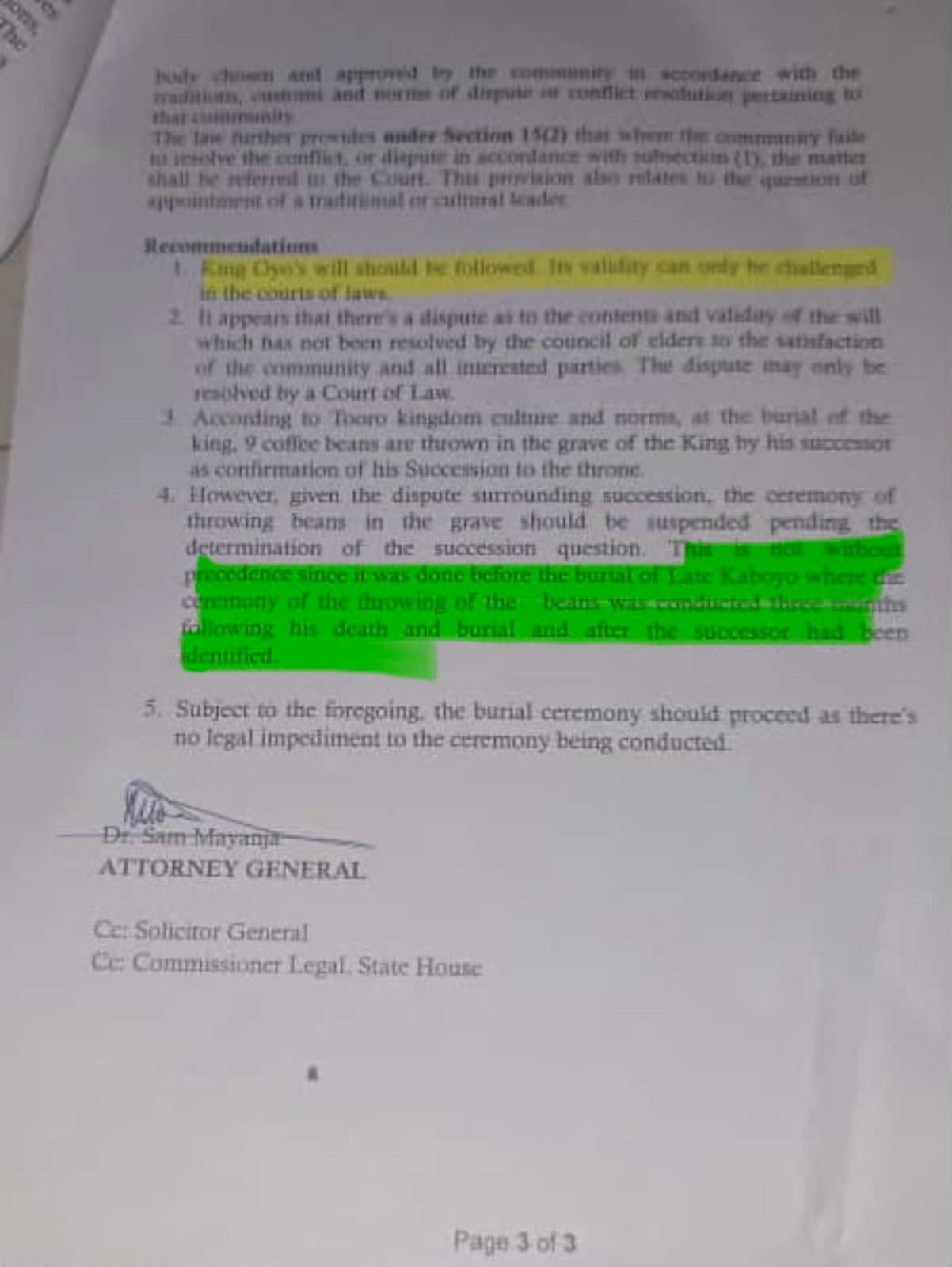
This provision has introduced another dimension into a succession dispute that had initially centred on whether the royal committee had properly selected Nyabongo. The Attorney General’s position was that the will should be followed unless its validity was successfully challenged before a court of law.
“King Oyo’s will should be followed. Its validity can only be challenged in the courts of law,” Mayanja said. That position could potentially shift the dispute from a contest between royal factions to a formal legal battle over the validity, interpretation and effect of the document.
Tooro constitution suspended
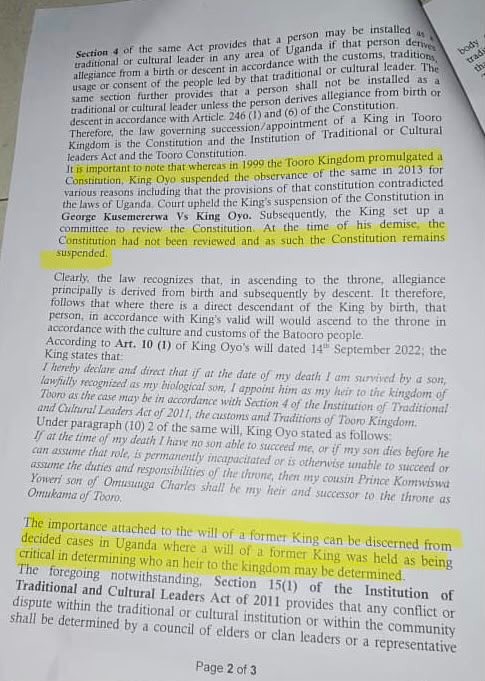
Mayanja also reportedly rejected the suspended Tooro Kingdom Constitution as the immediate legal basis for resolving the succession dispute.
 The Tooro Constitution was promulgated in 1999 but its operation was suspended by King Oyo in 2013. The suspension was subsequently upheld by the High Court in the case of George Kusemererva v King Oyo, according to the Attorney General’s opinion.
Mayanja therefore said the document remained suspended and could not simply be invoked to settle the current dispute. Instead, he relied on Article 246 of the Constitution and the Institution of Traditional or Cultural Leaders Act, which recognise traditional leadership in accordance with the customs and traditions of the communities concerned.
The legal opinion also recognised the role of traditional mechanisms in settling disputes. Mayanja said conflicts within a traditional institution should initially be addressed by councils of elders or cultural leaders. But where the dispute over Oyo’s will remained unresolved, he said the matter could ultimately be determined by a court. “The dispute may only be resolved by a Court of Law,” he said.
Nine coffee beans ritual in doubt
 The Attorney General also reportedly advised against completing one of the most important traditional rituals associated with the installation of a Tooro king. Under Tooro custom, the successor throws nine coffee beans into the grave of the deceased monarch as confirmation of succession.
Mayanja advised that the ritual should be suspended until the succession dispute was settled. “Given the dispute surrounding succession, the ceremony of throwing beans in the grave should be suspended pending the determination of the succession question,” he said. He reportedly cited the burial of Oyo’s father, the late King Kaboyo, saying the coffee-bean ritual was performed three months after the burial, once his successor had been identified. Mayanja nevertheless found no legal impediment to Oyo’s burial itself. “Subject to the foregoing, the burial ceremony should proceed as there’s no legal impediment to the ceremony being conducted,” he said.
Royal family urged to remain calm
 Mao’s intervention now comes at a critical moment for Tooro, where the death of the 34-year-old King Oyo has exposed deep divisions within the royal establishment.
The royal succession committee initially selected George Desmond Kamurasi but, after he sought more time to consult his family, the process moved on and Edward Rukiidi Nyabongo was selected and subsequently enthroned. Nyabongo has since begun traditional activities associated with his new reign. However, members of Oyo’s immediate family have challenged the process, insisting that the late King’s wishes must be considered.
The Attorney General’s opinion has now strengthened the argument that the dispute cannot simply be closed through the selection and enthronement of a successor. For Mao, the priority is to prevent the succession crisis from becoming a wider conflict.
 He urged the royal family and the people of Tooro to remain calm as the Government examines the legal questions.
The minister’s position also suggests that the State does not consider the succession process finally concluded until the outstanding legal and constitutional questions have been addressed. With the Attorney General recommending that Oyo’s will be respected unless successfully challenged in court, the next stage of the Tooro crisis could therefore move from the royal compound in Fort Portal to Uganda’s legal institutions. For now, the throne remains at the centre of a contest between royal tradition, the late King’s alleged wishes, the decisions of the succession committee and the law.
Author Profile
- Mr. Stephen Kasozi Muwambi is a seasoned crime investigative writer, majoring in judicial-based stories. His two decades’ experience as a senior investigative journalist has made him one of the best to reckon on in Uganda. He can also be reached via [email protected]
Latest entries
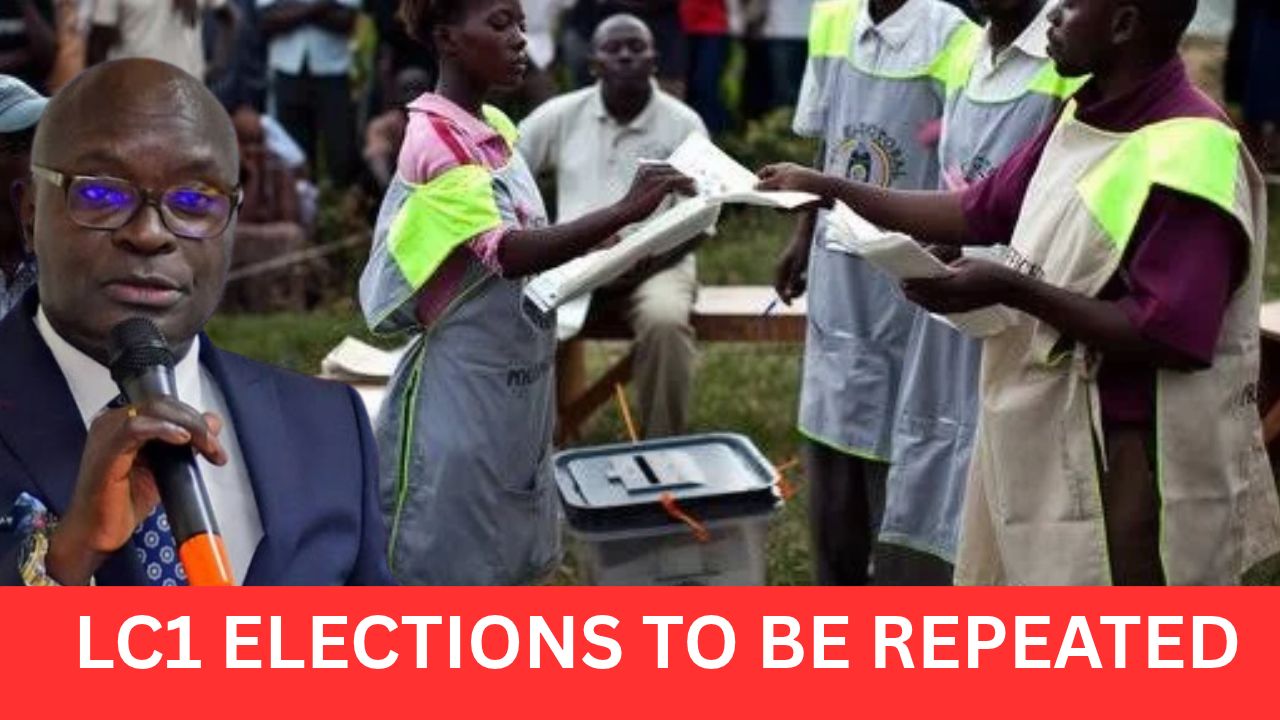 FeaturedOctober 8, 2026INTO WHY EC ORDERED FRESH LC1 POLLS IN 54 VILLAGES: Justice Simon Byabakama Cites Complaints, Disputed Results and Irregularities as the Commission Orders for Fresh Voting in the Affected Villages
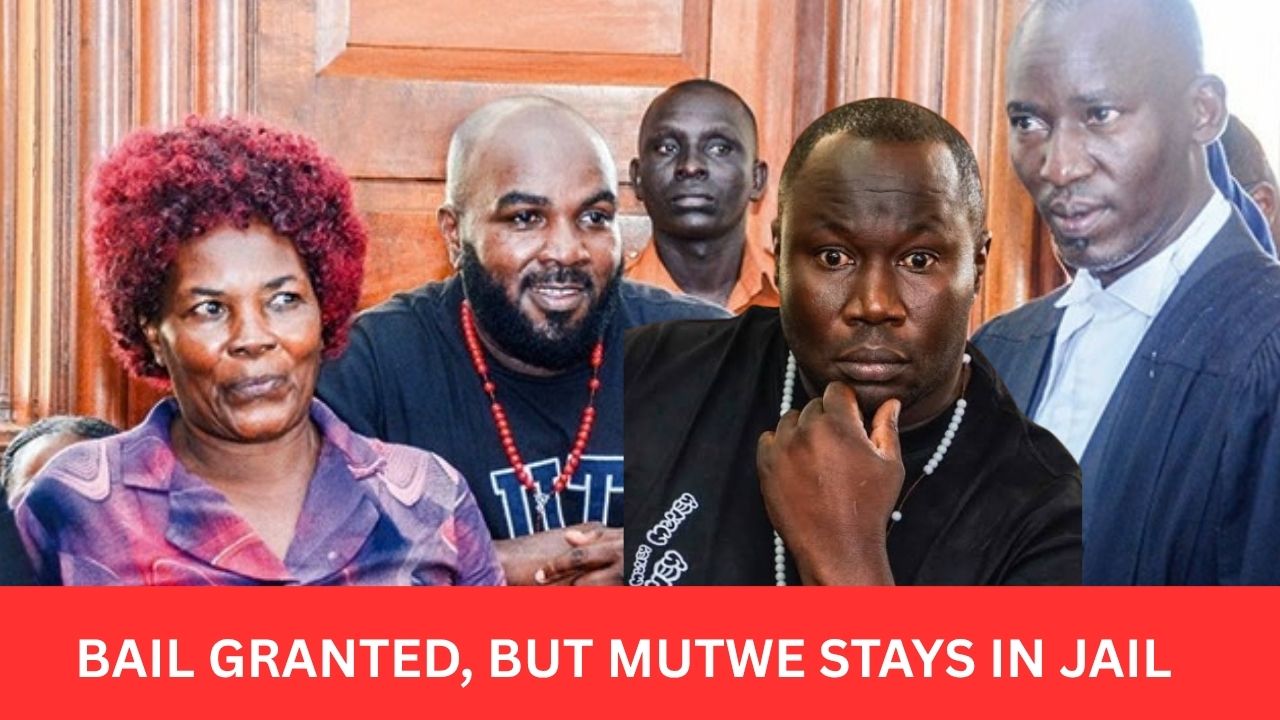 FeaturedOctober 7, 2026EDDIE MUTWE WINS BAIL, BUT REMAINS IN LUZIRA: Bobi Wine’s NUP Bodyguard’s Freedom Blocked By Second Case As Court Orders Sh5m Cash Bail And Sh50m Surety Bond
 FeaturedOctober 6, 2026WITNESS, NOT SUSPECT: In A Dramatic Twist, The DPP Has Cleared Mose Matovu’s Female Companion Of Prosecution. Investigators Will Now Rely On Tumusiime’s Testimony As The State Tightens Its Case Against Nsamba
 FeaturedOctober 5, 2026INSIDE THE DIGITAL PLATES SCANDAL: Why Angry MPs Sent Ministry Officials To Coolers As Investigations Closes In On A Top Minister Whose Arrest Is Imminent