









The political battle over who should lead Uganda’s parliamentary Opposition has entered a new phase after the controversial Administration of Parliament (Amendment) Bill, 2026 was formally gazetted, paving the way for its possible introduction and debate in Parliament.
The Bill, sponsored by Buyaga West County MP Dennis Namara, is listed as Bill No. 15 in the Uganda Gazette, Volume CXIX, No. 95, dated October 23, 2026.
Its gazetting gives fresh momentum to a proposal that has already generated sharp divisions between the ruling National Resistance Movement (NRM), the Opposition and political actors aligned to the Patriotic League of Uganda (PLU).
At the centre of the proposed legislation is the office currently occupied by Nakawa West MP Joel Ssenyonyi, who was retained by the National Unity Platform (NUP) as Leader of the Opposition after the 2026 general elections.
Under the existing law, the Opposition party with the largest numerical strength in Parliament selects the Leader of the Opposition. The Speaker then formally announces the nominee to Parliament. The current Administration of Parliament Act defines the Leader of the Opposition as the parliamentary leader of the party in opposition to government with the greatest numerical strength.
Namara’s Bill seeks to overturn that arrangement by allowing all Opposition MPs to participate in electing the Leader of the Opposition, rather than leaving the decision to the largest Opposition party.
The proposal would further require Opposition MPs to approve the Shadow Cabinet, create additional grounds for removing the Leader of the Opposition and broaden consultation in the appointment of Opposition representatives to parliamentary leadership positions.
Parliament granted Namara leave to introduce the Private Member’s Bill on July 8, following a debate chaired by Deputy Speaker Thomas Tayebwa. The parliamentary administration confirmed that the proposal seeks to strengthen accountability, democracy and inclusiveness within the Opposition.
Namara has repeatedly defended the proposal as a question of accountability rather than an attack on the Opposition.
“Democracy cannot only be on the side of the National Resistance Movement (NRM). It should be on two sides,” Namara told Parliament during the debate.
He added: “When you say Government must be accountable, even on your side you should be accountable.”
Namara also questioned why ministers can be censured while the Leader of the Opposition, who also draws resources from the Consolidated Fund, should operate without similar mechanisms of accountability.
“If every minister of the Government of Uganda can be censured because they draw money from the consolidated fund. How come there are no checks and balances on the side of the leader of opposition who draws money from the consolidated fund?” he asked.
PLU fingerprints
Although Namara has presented the Bill as a parliamentary reform, its progress has unfolded alongside a sustained campaign by PLU leaders to remove Ssenyonyi.
The most prominent intervention came from PLU chairman and Chief of Defence Forces (CDF) Gen Muhoozi Kainerugaba, who publicly demanded a change in the Opposition leadership and directed his political organisation to find a way of removing Ssenyonyi.
Muhoozi recently declared that PLU had begun the process of getting its own Leader of the Opposition, turning what had initially been a political confrontation between him and Ssenyonyi into a parliamentary and legislative campaign.
The campaign was subsequently taken up by Kasambya County MP Daudi Kabanda, who heads the PLU office of the national chairman.
Kabanda a former General Secretary of PLU has repeatedly defended the proposed changes, arguing that the law provides mechanisms for removing the President, Speaker, ministers and MPs but does not clearly provide a procedure for removing the Leader of the Opposition.
When PLU endorsed Namara’s Bill in July, Kabanda said PLU-aligned MPs would support its passage.
The PLU campaign was revived again in October, with reports that the organisation had renewed its efforts to remove Ssenyonyi. Namara and Kibanda North MP Linos Ngompek have remained among the legislators backing the proposed amendments.
The political significance of the proposal is heightened by the numerical strength of the NRM in the 12th Parliament. The ruling party commands a large majority, while NUP remains the largest Opposition party. That means allowing all Opposition and independent MPs to participate in choosing the LoP could fundamentally change the balance of power over the office.
NRM support and Opposition resistance
The Bill has found support among NRM legislators aligned to the PLU project. Namara and Ngompek, both associated with PLU, were among the MPs who initiated the legislative process, while Kanyum County MP Simon Peter Okwalinga was also associated with the effort.
Deputy Speaker Tayebwa also cleared the procedural hurdle for Namara to proceed, although he did not endorse the substance of the Bill. Instead, he ruled that a private member had a right to introduce legislation and that Parliament should debate its merits once formally presented.
“A private member has a right to move a bill here,” Tayebwa said, arguing that it was not his role at the leave stage to determine whether MPs should ultimately support the proposal.
The Opposition, however, has largely viewed the initiative with suspicion. NUP MPs have questioned why a group of ruling-party legislators should determine how the Opposition chooses its own parliamentary leader.
Kassanda North MP Patrick Nsamba Guma-Oshabe, for example, criticised the proposal as a revival of an earlier attempt to alter the same system.
The resistance is also rooted in the concern that NRM-leaning independents could influence the choice of an Opposition leader. Critics argue that this could allow the ruling party, directly or indirectly, to influence the person expected to scrutinise the Government.
Alliance for National Transformation acting national coordinator Alice Alaso warned that the initiative should be viewed within the wider concentration of power in the Executive, Parliament and security sector.
“Those in power already control the Executive, Parliament, and the security sector. If they do not apply reverse gear, it is only a matter of time before the country is pushed into very chaotic circumstances,” Alaso warned.
Senior lawyer and former Busiro East MP Medard Lubega Sseggona similarly questioned the legal basis for using the proposed changes to remove the sitting Opposition leader.
“They simply do not have legal grounds to remove the Leader of the Opposition under the existing constitutional framework. I see this more as political pressure than a legally viable process,” Sseggona said.
A battle fought before
The current Bill is not entirely new. A similar proposal was introduced in the previous Parliament by former Mityana South MP Richard Lumu. His Administration of Parliament (Amendment) Bill, 2024 sought to change the method of selecting the Leader of the Opposition, introduce additional removal mechanisms and strengthen parliamentary involvement in Opposition leadership.
The proposal attracted strong resistance from Opposition parties, including the Forum for Democratic Change, Uganda People’s Congress and ANT, which argued that it threatened multiparty democracy and could create an “opposition within the Opposition.”
The earlier Bill was eventually withdrawn in March 2026. Former Kawempe South MP Mubarak Munyagwa said he had opposed Lumu’s Bill from the beginning because he considered it inconsistent with the existing legal framework.
The new legislation therefore represents a second attempt to change the architecture of Opposition leadership.
What happens next?
Gazetting does not mean the Bill has become law. It is a formal legislative step that allows the proposed law to proceed through Parliament’s legislative process.
Namara must still take the Bill through the relevant stages, including first reading, committee scrutiny, stakeholder consultations and subsequent debate before it can be passed.
Parliament’s Legal and Parliamentary Affairs Committee is expected to play a critical role in examining its constitutionality, implications for multiparty democracy and the relationship between political parties and Parliament.
The stakes are particularly high because the Bill could determine whether Ssenyonyi remains Opposition leader or whether Parliament gets an opportunity to elect a new occupant under a radically different system.
For the NRM and PLU, the proposal is being presented as a question of accountability and inclusive representation. For the Opposition, it risks allowing the ruling establishment to acquire influence over the leadership of the very political forces expected to hold it accountable.
With the Bill now gazetted, the battle that began with Muhoozi’s demand for a new Opposition leader has moved from political statements and social media declarations into the formal machinery of Uganda’s lawmaking process.
One important qualification: I found documented statements from NRM/PLU-backed MPs supporting the proposal and named Opposition critics, but I could not verify a named NRM MP who has publicly opposed the 2026 Bill itself. I have therefore not attributed such opposition to an NRM MP without evidence.
Author Profile
- Charles Gazza Kodili is a seasoned journalist with over 20 years of experience in the media industry. He holds a Bachelor of Arts degree in Mass Communication. He’s currently the Chief Editor at the Investigator.
Charles can also be reached via; Tel: +256 774 108978
Email: [email protected]
Latest entries
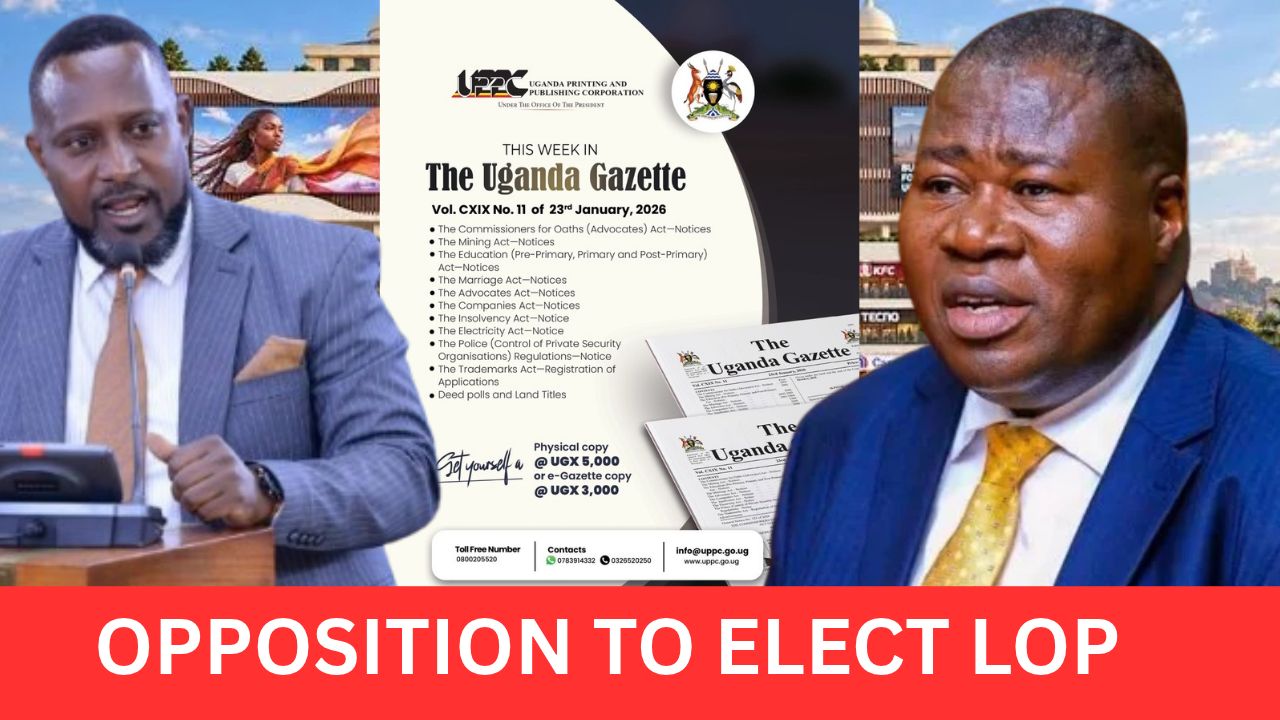 FeaturedOctober 23, 2026BILL TO CHANGE ELECTION OF OPPOSITION LEADER GAZETTED: Buyaga West MP Dennis Namara’s Bill Seeks To Give All Opposition Mps A Vote In Choosing The Leader Of The Opposition, Raising Fears Of Ruling-Party Interference
 FeaturedOctober 23, 2026MATOVU’S MYSTERY DEATH: NUP Raises Questions Over Sudden Death Of Former Busiro South MP As He Battled In Court To Overturn Kenan Opio’s Disputed Election Victory
 FeaturedOctober 23, 2026OFWONO OPONDO: WE MUST STOP PRESIDING OVER IMPUNITY: The veteran NRM voice Challenges His Own Government To Explain Alleged Abductions, Torture And Secret Detention Of Citizens, Warning That The Ruling Party Must Not Shield Security Agencies From Accountability
 CrimeOctober 22, 2026MUFTI SUMMONED OVER SHS1.2BN GOLD SCAM: Kampala City Hall Court Has Summoned Deputy Mufti, Muhammad Haruna Bukenya, And Businessman Elias Muzamiru Lubega Over Allegations Of Obtaining $288,000 From Muhammad Kwaido In A Deal Involving Three Kilogrammes Of Gold