











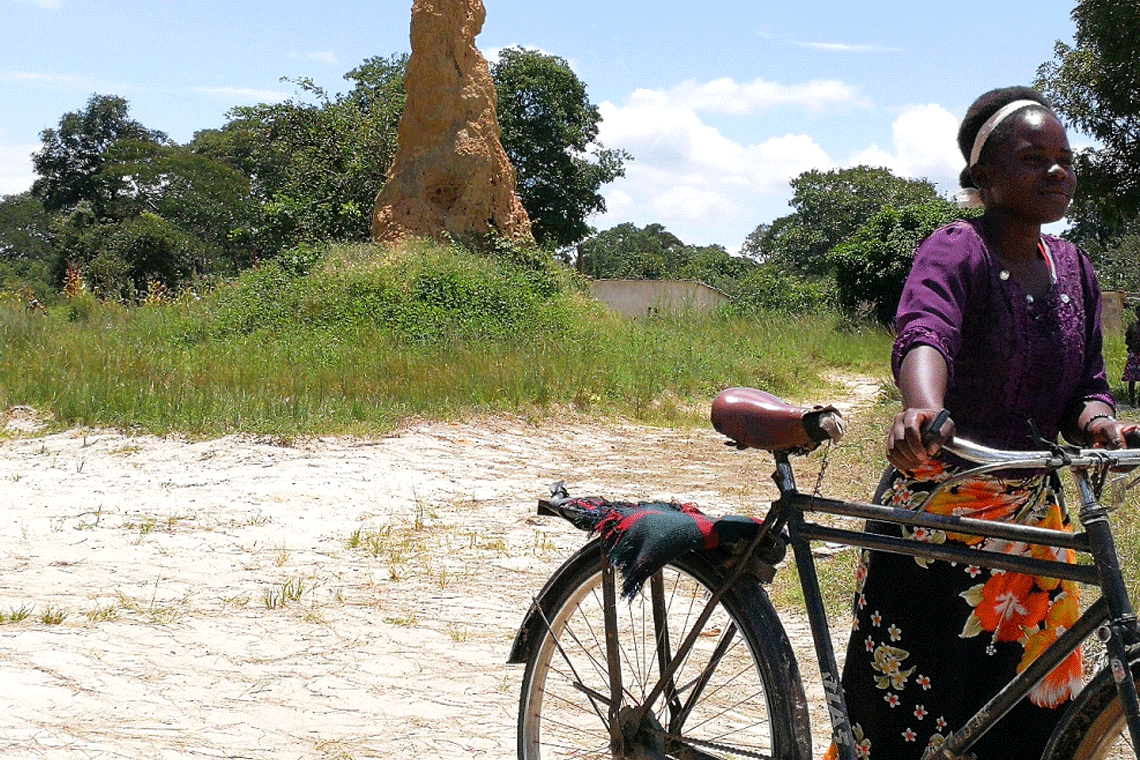


A bitter land ownership dispute between the family of the late Prince Yusufu Suuna Kiweewa and the Madhvani Group has intensified, with the family challenging a proposed Shs170b Government transaction involving 948.1 acres of land at Nakigalala in Wakiso district.
The dispute centres on land comprised in Busiro Block 366 at Kansiri and Blocks 372-373 at Nakigalala, which the Kiweewa family says formed part of the estate of the late Prince Yusufu Suuna Kiweewa and was bequeathed to his daughter, Princess Kasalina Nkinzi.
The family has now accused Madhvani of benefiting from what it calls a fraudulent process through which the company acquired or maintained title to the land, allegations the company has yet to publicly answer in the documents provided.
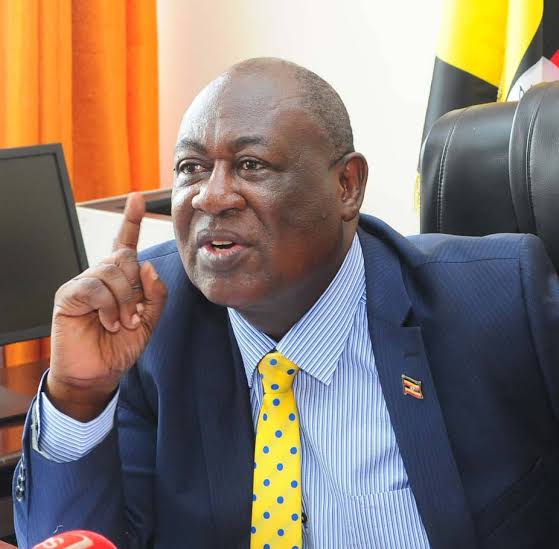
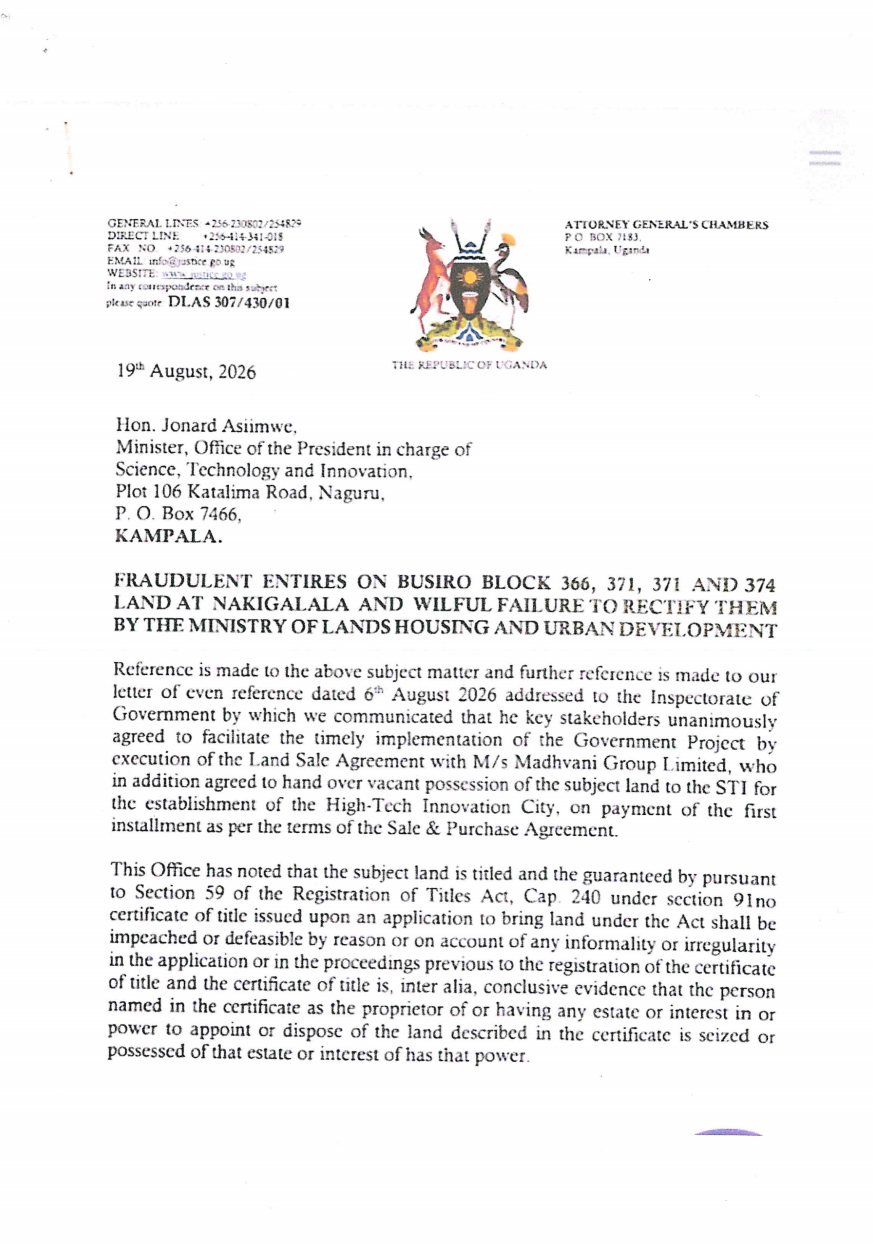 The Attorney General, however, has taken a substantially different position, advising the Government that Madhvani Group Limited is the registered proprietor and in possession of the disputed land, and that there is no legal or occupancy claim by a third party capable of defeating Madhvani’s claim.
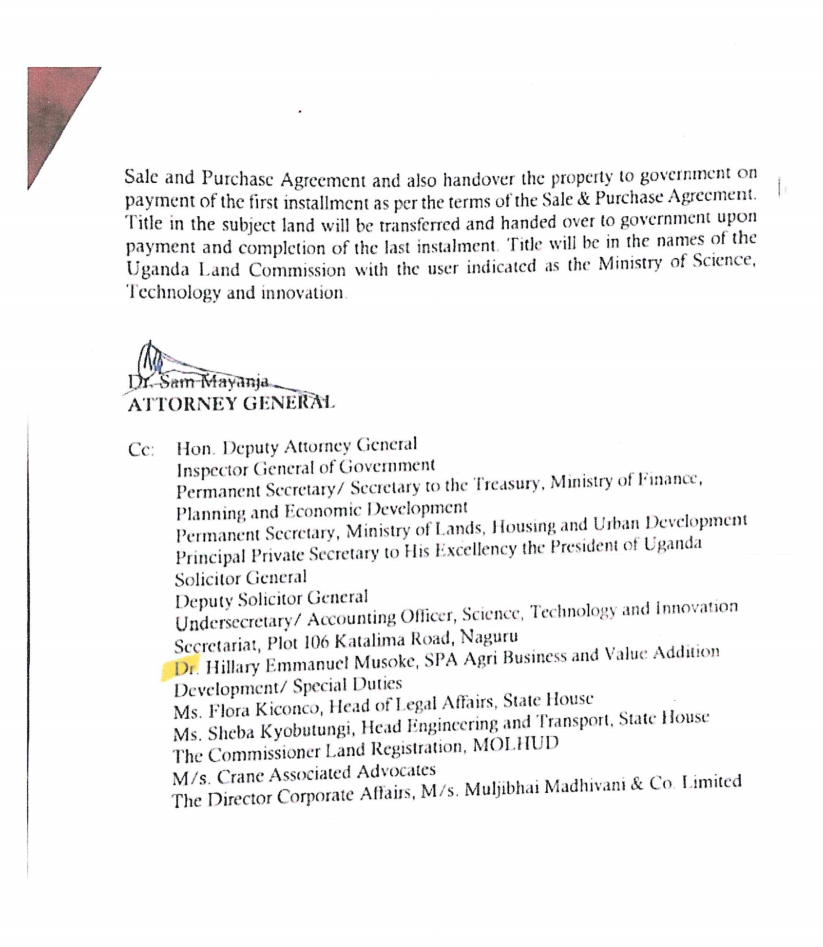
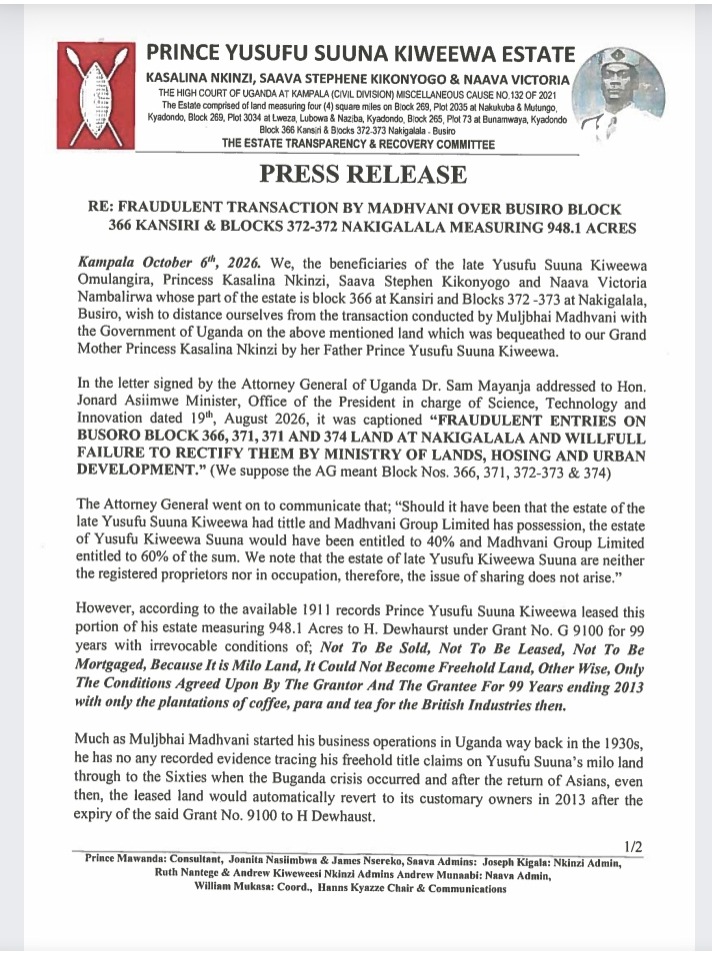
The Attorney General’s position is contained in a letter dated August 19, 2026, addressed to Jonard Asiimwe, Minister in the Office of the President in charge of Science, Technology and Innovation. The letter clears the way for the Government to proceed with the purchase of the land from Madhvani Group for establishment of the proposed High-Tech Innovation City. But the Kiweewa family has rejected the transaction, saying the Government risks spending billions of taxpayers’ money on land whose ownership is still the subject of active court proceedings.
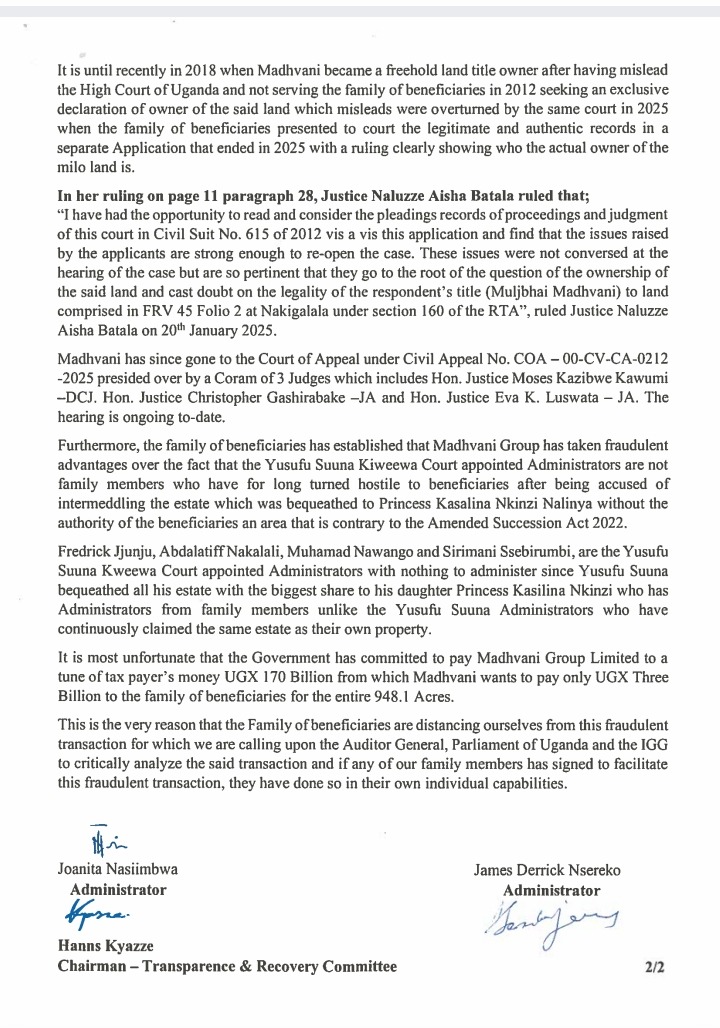
 In a strongly worded press release dated October 6, 2026, the family beneficiaries said they were distancing themselves from the transaction between Madhvani and the Government. They called upon the Auditor General, Parliament and the Inspectorate of Government to scrutinise the transaction and establish how Madhvani acquired its interest in the land. At the heart of the dispute is the historical status of the land.
The 1911 lease
According to records cited by the Kiweewa family, Prince Yusufu Suuna Kiweewa leased approximately 948.1 acres of his estate to H. Dewhaurst in 1911 under Grant No. G9100 for 99 years. The family says the grant contained restrictive conditions, including that the land was not to be sold, leased or mortgaged because it was classified as Milo land.
The family argues that the lease was specifically for plantations, including coffee, para and tea, and was due to expire in 2013. Its argument is that upon expiry of the lease, the land should have reverted to its customary owners rather than being converted into freehold land and subsequently transferred to Madhvani.
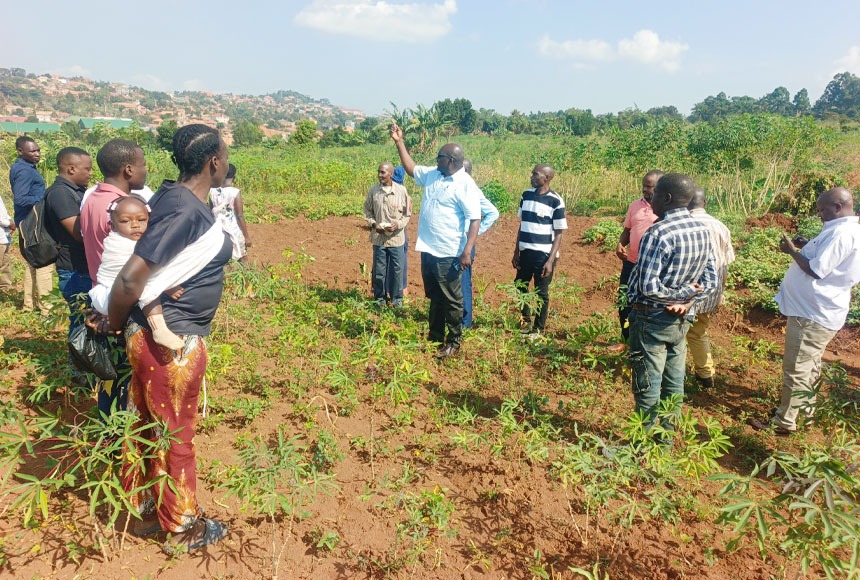 The family says it has been unable to trace a legitimate chain of title showing how Madhvani acquired rights over the original Milo land.
“Madhvani started his business operations in Uganda way back in the 1930s,” the family says in its statement, “but there is no recorded evidence tracing his freehold title claims on Yusufu Suuna’s Milo land through to the 1960s when the Buganda crisis occurred and after the return of Asians.” The family further argues that the lease automatically expired in 2013 and that the land should have reverted to its customary owners. That position, however, is directly challenged by the Attorney General.
AG backs Madhvani title
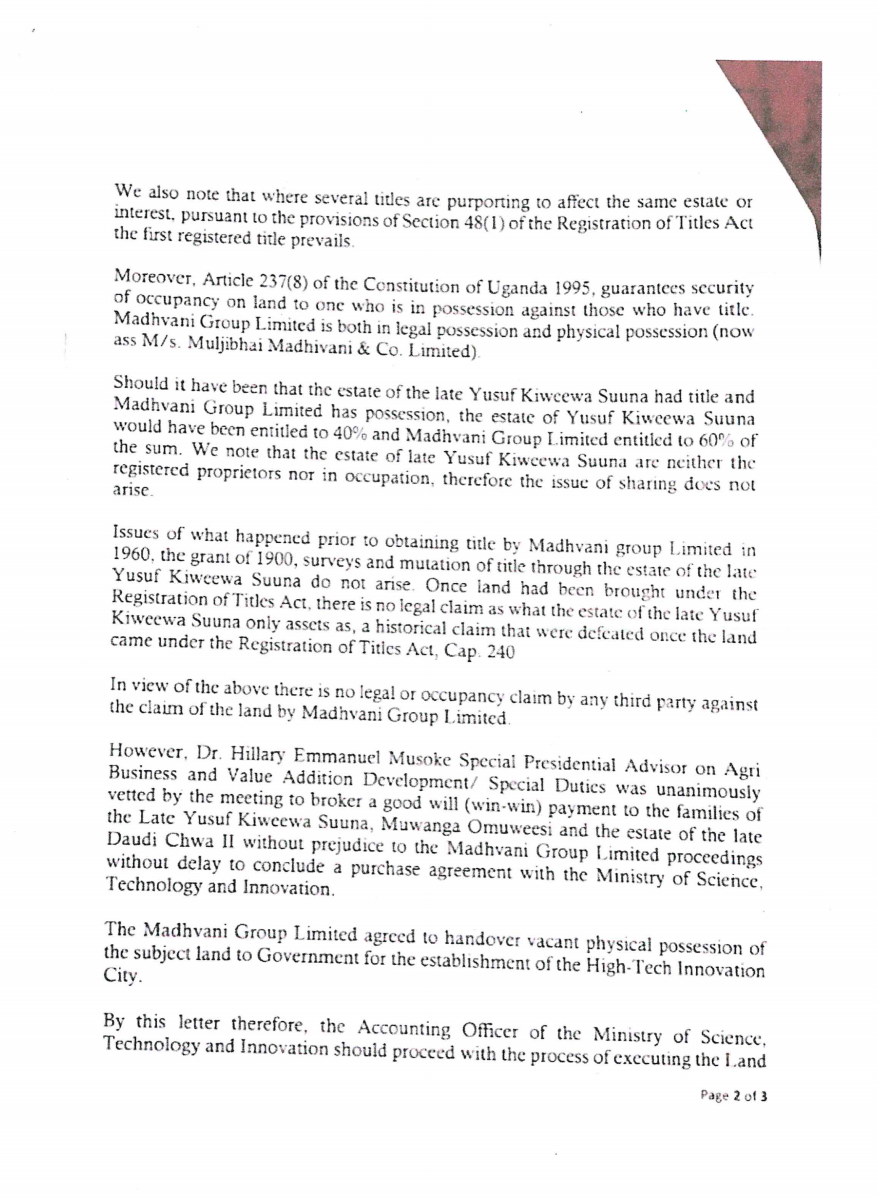
In his August 19 letter, Attorney General Dr Sam Mayanja relied on the Registration of Titles Act to argue that a certificate of title issued under the Act is conclusive evidence of ownership, subject to the law.
 The Attorney General also cited provisions relating to competing titles, arguing that where several titles purport to affect the same estate or interest, the first registered title prevails. He further noted that Madhvani Group Limited was in both legal and physical possession of the property.
The Attorney General told the STI minister that if the Kiweewa estate had title while Madhvani had possession, the estate would have been entitled to 40% of the proceeds and Madhvani 60%. But, he added, the Kiweewa estate was neither the registered proprietor nor in occupation. “Therefore, the issue of sharing does not arise,” the Attorney General said.
He also dismissed the relevance of events preceding Madhvani’s title, including the 1900 grant, surveys and mutations allegedly undertaken through the estate of Prince Yusufu Suuna Kiweewa. According to the Attorney General, once land had been brought under the Registration of Titles Act, historical claims could not be used to defeat the registered title. The Attorney General therefore concluded that there was no legal or occupancy claim by a third party against Madhvani’s claim to the land.
 Government deal worth Shs170b
The dispute has become more explosive because the land is at the centre of a major Government development project. The Attorney General’s letter says key stakeholders had agreed to facilitate implementation of the Government project through execution of a Land Sale and Purchase Agreement with Madhvani Group Limited.
Madhvani, according to the letter, agreed to hand over vacant possession of the land to Government for establishment of the High-Tech Innovation City. The arrangement provides for Government to make payments in instalments, with the title eventually transferred to the Uganda Land Commission, while the user would be indicated as the Ministry of Science, Technology and Innovation.
The Kiweewa family, however, says the transaction could result in the Government paying about Shs170b of taxpayers’ money to Madhvani for the land. The family claims Madhvani intends to pay only about Shs3b to the family beneficiaries out of the transaction. That allegation has become one of the major flashpoints in the dispute. The family argues that it is unacceptable for a large public payment to be made over land whose ownership remains contested in court.
Court battle still alive
The Kiweewa family is relying heavily on a ruling delivered by Justice Naluzze Aisha Batala on January 20, 2025. According to the family, the ruling reopened questions surrounding the ownership of the land and the legality of Madhvani’s title. The family quoted Justice Batala as finding that issues raised by the applicants were sufficiently strong to warrant reopening the case because they went to the root of ownership and cast doubt on the legality of the respondent’s title over land comprised in FRV 45 Folio 2 at Nakigalala.
The family says the ruling followed presentation of what it describes as authentic historical records concerning the land. Madhvani has since appealed the decision. The family says the matter is now before the Court of Appeal under Civil Appeal No. COA-00-CV-CA-0212-2025, where it is being heard by a three-judge panel.
This means that while the Attorney General has advised Government that Madhvani’s title should be treated as valid, the underlying ownership dispute has not disappeared from the courts. It is this apparent contradiction that the Kiweewa family wants Parliament, the Auditor General and the Inspectorate of Government to examine.
1960 or 2018?
Another potentially significant issue emerging from the documents is the chronology of Madhvani’s title.
 The Attorney General’s letter refers to Madhvani obtaining title in the 1960s and says that issues arising before the title was obtained in 1960 do not arise. The Kiweewa family, however, claims Madhvani only became a freehold title holder over the disputed land in 2018.
The family alleges that Madhvani had earlier gone to court seeking an exclusive declaration of ownership and that the proceedings were subsequently reopened after the beneficiaries presented records challenging the basis of the title.
The conflicting accounts about when and how the title was acquired could become an important issue in determining the history of the property. The family is therefore demanding that the land records, original grants, surveys, mutations and subsequent titles be subjected to an independent forensic review.
Who represents the estate?
The dispute has also opened another front involving the administration of the late Prince Yusufu Suuna Kiweewa’s estate. The family says court-appointed administrators—Fredrick Jjunju, Abdalatiff Nakalali, Muhammad Nawango and Sirimani Ssebirumbi—are not family members and accuses them of being hostile to the beneficiaries.
The beneficiaries allege that the administrators have interfered with property that had been bequeathed to Princess Kasalina Nkinzi. They further contend that Princess Kasalina had her own family administrators and that the administrators of the wider Kiweewa estate have no authority to treat the disputed property as their personal asset.
These are allegations contained in the family’s statement and would need to be tested against the estate administration records and court decisions. The family has also raised concerns about the involvement of individual members of the family in the Government-Madhvani negotiations. It warned that any family member who may have signed documents facilitating the transaction did so in an individual capacity and not on behalf of all beneficiaries.
The proposed compromise
Interestingly, the Attorney General’s letter acknowledges the existence of the competing family claims even as it rejects them as a legal impediment to the transaction. The letter says Dr Hillary Emmanuel Musoke, the Special Presidential Adviser on Agribusiness and Value Addition Development/Special Duties, was vetted by stakeholders to broker a goodwill, or “win-win”, payment to the families of the late Prince Yusufu Suuna Kiweewa, Muwanga Omuweesi and the estate of the late Daudi Chwa II.
The proposed payment was to be made without prejudice to Madhvani’s proceedings and without delaying conclusion of the Government’s purchase agreement. This arrangement appears intended to settle the competing interests politically or administratively while allowing Government to proceed with the High-Tech Innovation City project. But the Kiweewa family has rejected that approach. For the beneficiaries, the central question is not simply how much compensation they should receive, but who legally owns the 948.1 acres in the first place.
A costly legal and political test
The Nakigalala dispute now presents Government with a difficult balancing act. On one side is the Attorney General’s legal advice that the registered title and possession held by Madhvani provide sufficient basis for Government to proceed with the purchase. On the other is a family-backed court challenge questioning the origin, legality and history of that title. The Government could therefore find itself acquiring land at a cost of Shs170b while litigation over the underlying ownership remains unresolved.
The Kiweewa beneficiaries insist that they are not opposed to development but want the Government to establish that it is purchasing land from the legitimate owner. They argue that taxpayers should not be required to finance a transaction that could later become the subject of further litigation or compensation claims.
The controversy also raises wider questions about Uganda’s land administration system: how historical customary interests are dealt with when land enters the registered-title system; how old colonial grants are interpreted; how competing claims are resolved; and whether Government should conclude major land purchases while ownership disputes remain before the courts.
For now, the Attorney General has given the green light for the transaction to proceed. The Kiweewa family, however, has drawn a line in the sand. It wants the Auditor General, Parliament and the Inspectorate of Government to investigate the transaction before public money changes hands. And with the Court of Appeal still seized of the ownership dispute, the battle over the 948.1 acres at Nakigalala is far from over.
Author Profile

- Charles Gazza Kodili is a seasoned journalist with over 20 years of experience in the media industry. He holds a Bachelor of Arts degree in Mass Communication. He’s currently the Chief Editor at the Investigator.
Charles can also be reached via; Tel: +256 774 108978
Email: [email protected]
Latest entries
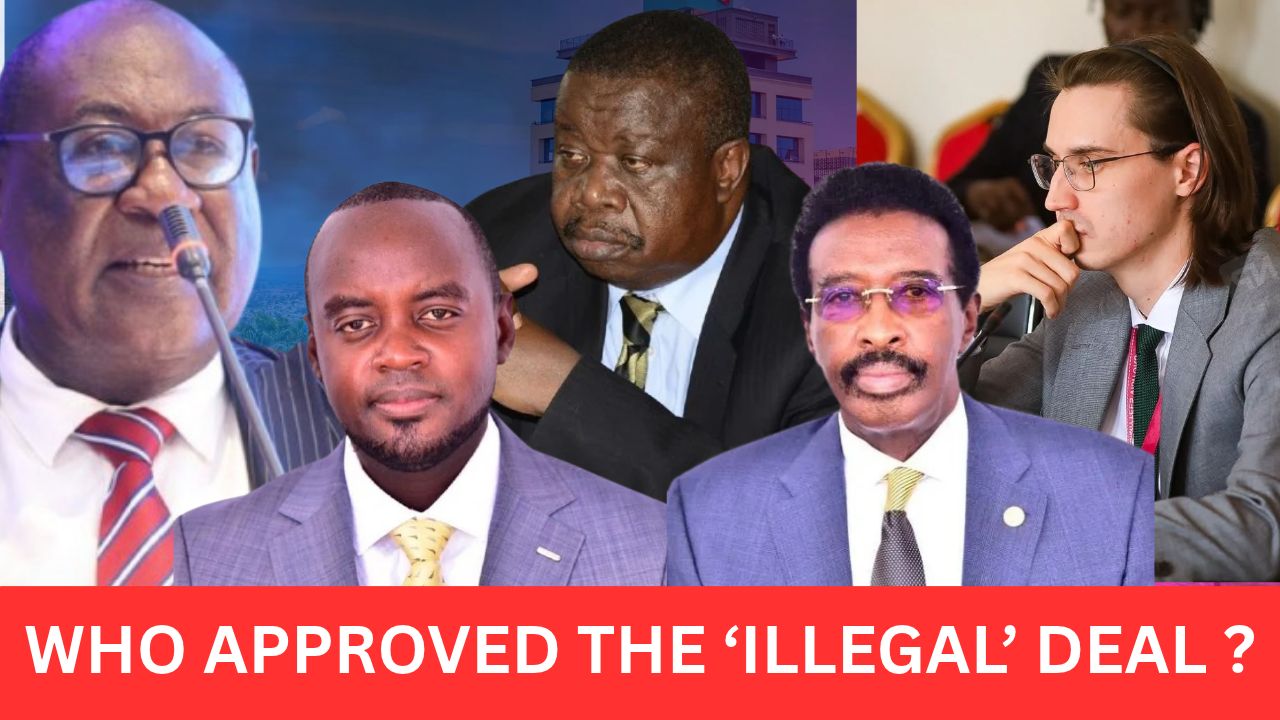 FeaturedOctober 7, 2026DIGITAL NUMBER PLATE SCANDAL: No Feasibility Study. No Financial Clearance. No Proper Value-For-Money Assessment. Parliament Now Wants Answers Over Who Authorised The Troubled Digital Number Plate Venture
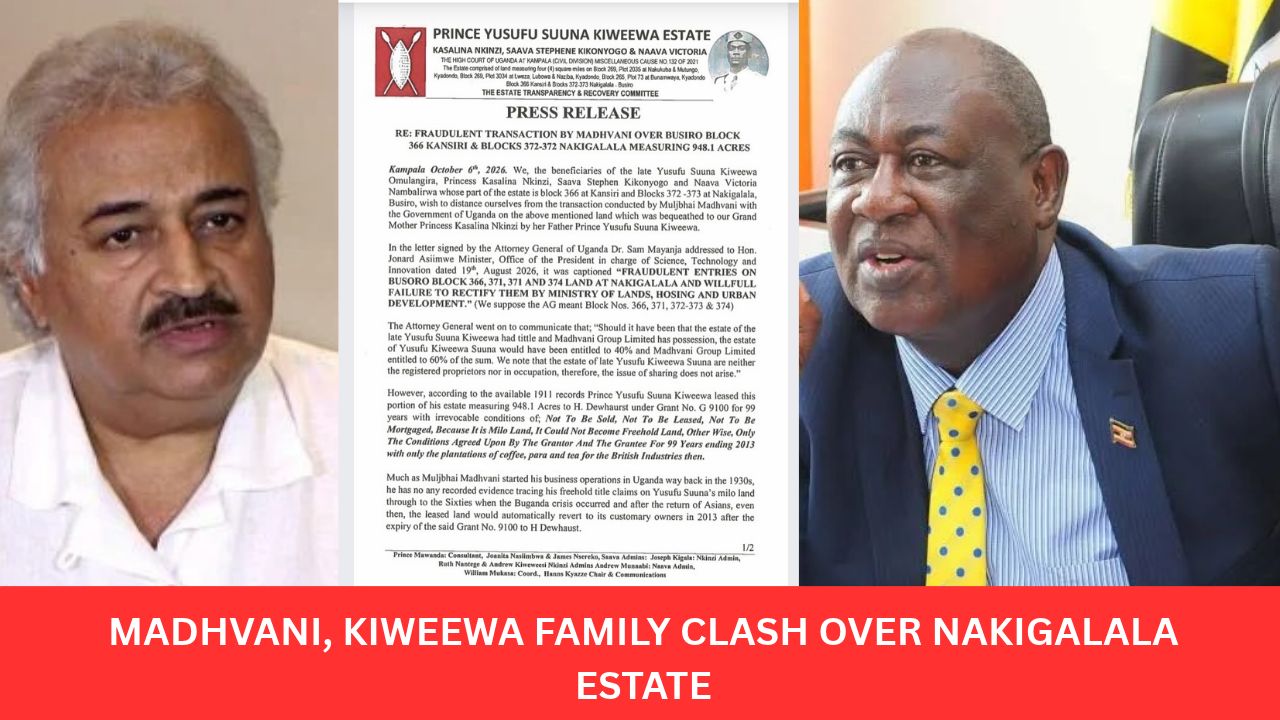 FeaturedOctober 7, 2026MADHVANI ON SPOT OVER A LAND BATTLE WITH PRINCE KIWEEWA FAMILY: Family Challenges UGX170b Government Deal, Says 948-Acre Estate Was Buganda `Milo Land` That Should Have Reverted To Customary Owners In 2013
 FeaturedOctober 6, 2026OF WHY IS MUSEVENI CHANGING HIS INNER SECURITY RING: Intelligence Alerts, Changing Threats and Presidential Discretion Behind Quiet Reshuffle of the Men and Women Closest to the Commander-in-Chief
 FeaturedOctober 6, 2026VIRUS CROSSES BORDERS: The Patient Travelled By Road From The DRC To Kampala Before Flying To Nairobi. Kenyan Authorities Are Tracing 28 Contacts And 23 Passengers And Crew, While Uganda Faces Renewed Scrutiny Despite Being Declared Ebola-Free By WHO