















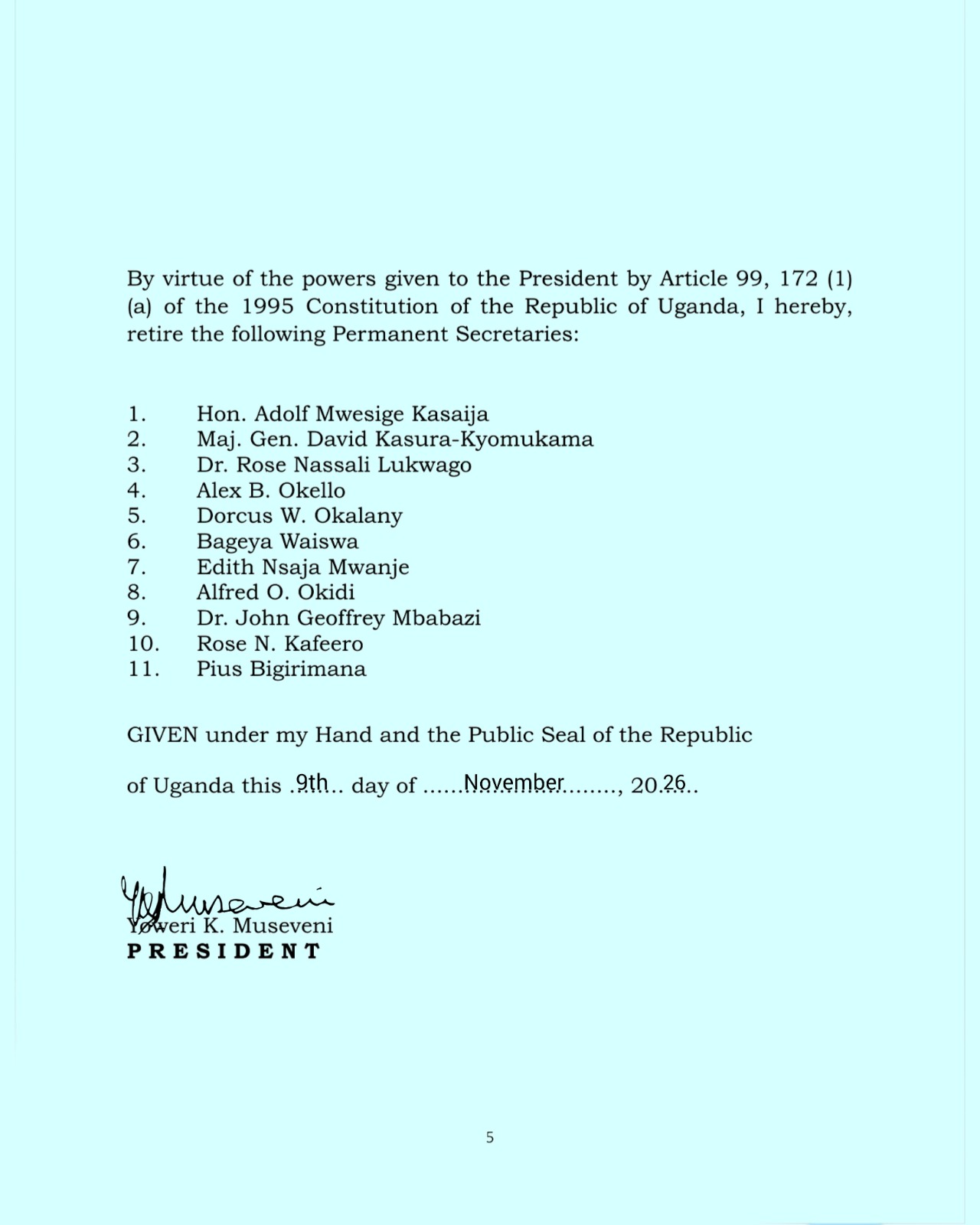
President Museveni’s decision to retire 11 Permanent Secretaries marks one of the most significant administrative shake-ups in Uganda’s public service in recent years, ending the careers of several long-serving technocrats who have occupied influential positions in government for decades.
The changes, announced today, affect some of the most recognisable names in Uganda’s civil service, including Pius Bigirimana, Alex Okello, Dorcus Okalany, John Geoffrey Mbabazi and Rose N. Kafeero.
The retirement list also includes Adolf Mwesige Kasaija, Maj Gen David Kasura-Kyomukama, Dr Rose Nassali Lukwago, Bageya Waiswa, Edith Nsaja Mwanje and Alfred O. Okidi.
The decision is particularly significant because Permanent Secretaries are the administrative and accounting heads of ministries and government departments. They oversee policy implementation, public expenditure, procurement, human resource management and the day-to-day running of government institutions.
Unlike political ministers, whose tenure is tied to presidential and political considerations, Permanent Secretaries are career public officers expected to provide institutional continuity, technical expertise and administrative stability.
By retiring 11 of them at once, Museveni has effectively opened a new chapter in the management of Uganda’s public service, creating room for a younger generation of technocrats while retaining several experienced officials in strategic positions.
The changes also raise questions about succession, institutional memory, performance expectations and the President’s priorities as his administration prepares for another phase of national development.
Expired contracts, performance reviews and the succession question
Although the announcement may appear to be a sudden political decision, the developments leading to the retirement of the 11 officials had been unfolding for several months.
A critical background is the contractual arrangement governing Uganda’s Permanent Secretaries. They are appointed on renewable three-year contracts, with their continued service dependent on assessment and approval through the public service system.
In October 2026, Deputy Head of Public Service Jane Mwesiga Kyarisiima disclosed that the contracts of some Permanent Secretaries had expired on July 28, 2026.
She explained that the absence of a fully constituted Public Service Commission had delayed the assessment process. The President subsequently appointed a new nine-member commission, chaired by Vincent Seruma, with Jen Sanji as deputy chairperson. The commission was sworn in on October 16.
Kyarisiima explained that officers whose contracts had expired were not continuing in office pending assessment, but that acting officers had been assigned to prevent administrative vacancies.
The constitution of the new commission therefore provided the institutional mechanism through which the outstanding contracts could be reviewed and recommendations submitted to the President.
This background is important because it suggests that the November shake-up was not simply a matter of dismissing officials overnight. It followed an administrative process involving expired contracts, performance assessment and presidential decisions on renewal, retirement and redeployment.
However, the scale of the retirement exercise raises a wider question: what informed the decision not to renew the contracts of these particular officials, while retaining other senior administrators whose contracts were also subject to review?
The official announcement does not provide individual performance findings or explain the specific reasons for each retirement. It would therefore be premature to conclude that all 11 were removed for poor performance.
What is clear is that Museveni has chosen to use the contract-review process to reorganise the senior administrative leadership of government.
The departure of Pius Bigirimana and the Judiciary
One of the most consequential departures is that of Pius Bigirimana, who served as Secretary to the Judiciary. Bigirimana is among Uganda’s most experienced public administrators. Before joining the Judiciary, he held senior positions in the civil service, including Permanent Secretary in the Ministry of Gender, Labour and Social Development and the Ministry of Justice and Constitutional Affairs.
His public service career has been associated with some of the country’s most demanding administrative assignments, particularly in public-sector management and institutional reforms.
His appointment to the Judiciary placed him at the centre of the institution’s administrative operations, including budgeting, staffing, procurement and the implementation of judicial programmes.
The Judiciary is one of the three arms of government and has faced persistent challenges involving case backlogs, inadequate infrastructure, staffing shortages and the need to expand access to justice.
Bigirimana’s retirement consequently represents a significant change in the administrative leadership of the institution.
His departure also comes at a time when the government is under pressure to strengthen institutional efficiency, improve accountability and ensure that public resources translate into better service delivery.
The retirement of such a senior technocrat illustrates the extent to which the latest changes are intended to refresh leadership across government rather than simply fill a few vacant offices.
The exit of Adolf Mwesige Kasaija
Another notable departure is Adolf Mwesige Kasaija, who served as Clerk to Parliament. The Clerk is the chief administrative officer of Parliament, responsible for overseeing its institutional operations, staffing, financial administration and support services for legislators.
The office is particularly important because it provides the administrative machinery through which Parliament conducts its legislative, oversight and representative responsibilities.
Mwesige’s departure creates an opportunity for a change in the management of Parliament at a time when the institution faces demands for stronger oversight, improved legislative efficiency and better management of public resources. President Museveni has nominated Edward Sengonzi Damulira as his replacement.
Damulira’s elevation is particularly interesting because of his background in government administration. He previously served in State House, where he was responsible for state scholarships at Okello House, before moving to the Ministry of Finance and rising through the ranks to become a senior accounting officer and Permanent Secretary.
His movement to Parliament represents a transition from the executive’s administrative machinery to the legislative arm.
It also illustrates the President’s preference for experienced administrators who have worked within the government system and understand its institutional structures.
Alfred Okidi, Okalany and the long-serving technocrats
The retirement of Alfred O. Okidi is another important change, particularly for the Ministry of Water and Environment.
Okidi has been associated with the management of Uganda’s water and environmental programmes, a portfolio that involves large public investments in water infrastructure, sanitation, natural resource management and climate resilience.
The ministry is responsible for programmes ranging from rural water supply and urban sanitation to the protection of wetlands, forests and other natural resources.
His departure comes as Uganda continues to invest in major water infrastructure projects, including the expansion of urban water systems and rural water access.
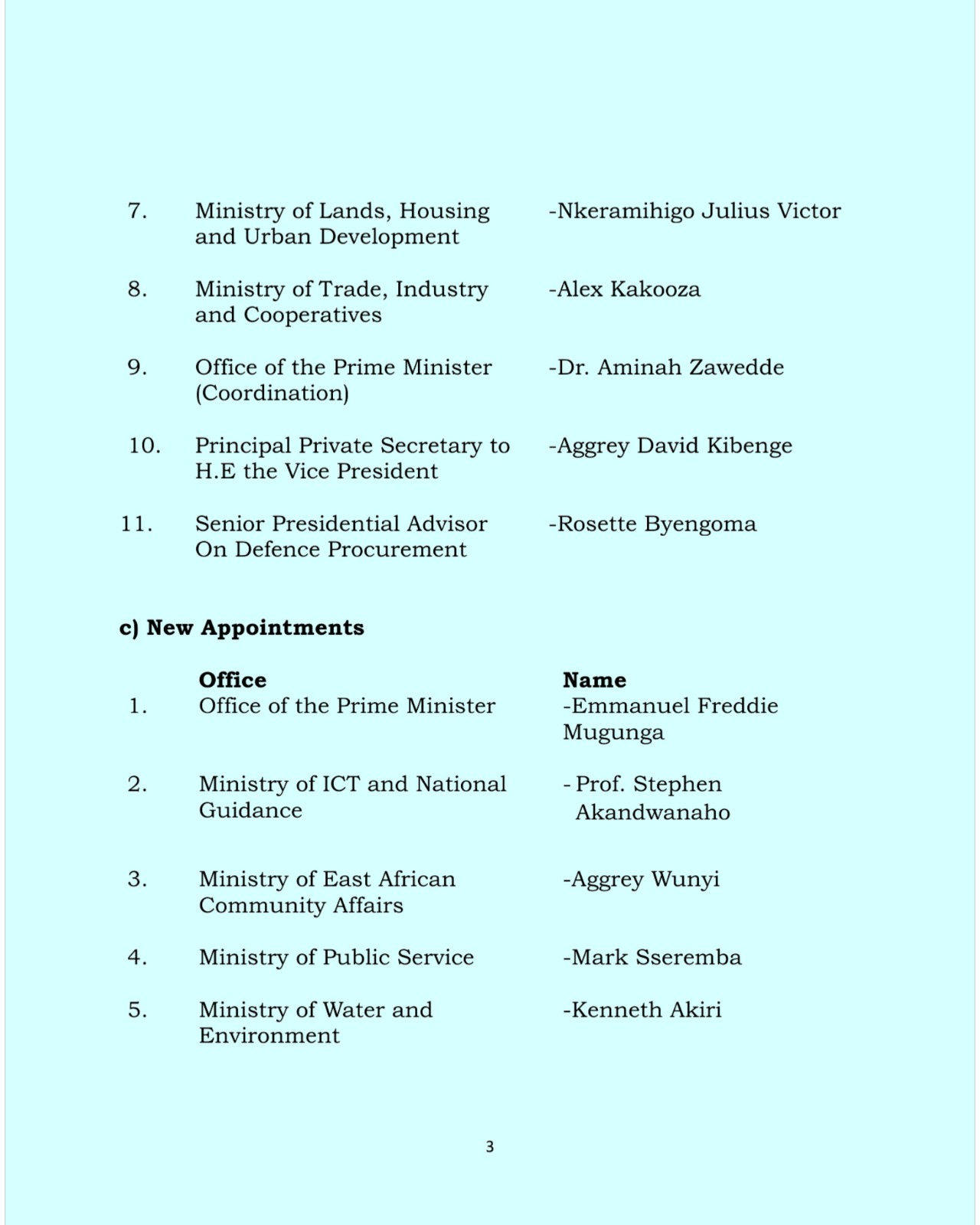
Kenneth Akiri has been appointed to take over the ministry, creating an opportunity for fresh administrative leadership in a sector where effective project supervision and accountability are critical.
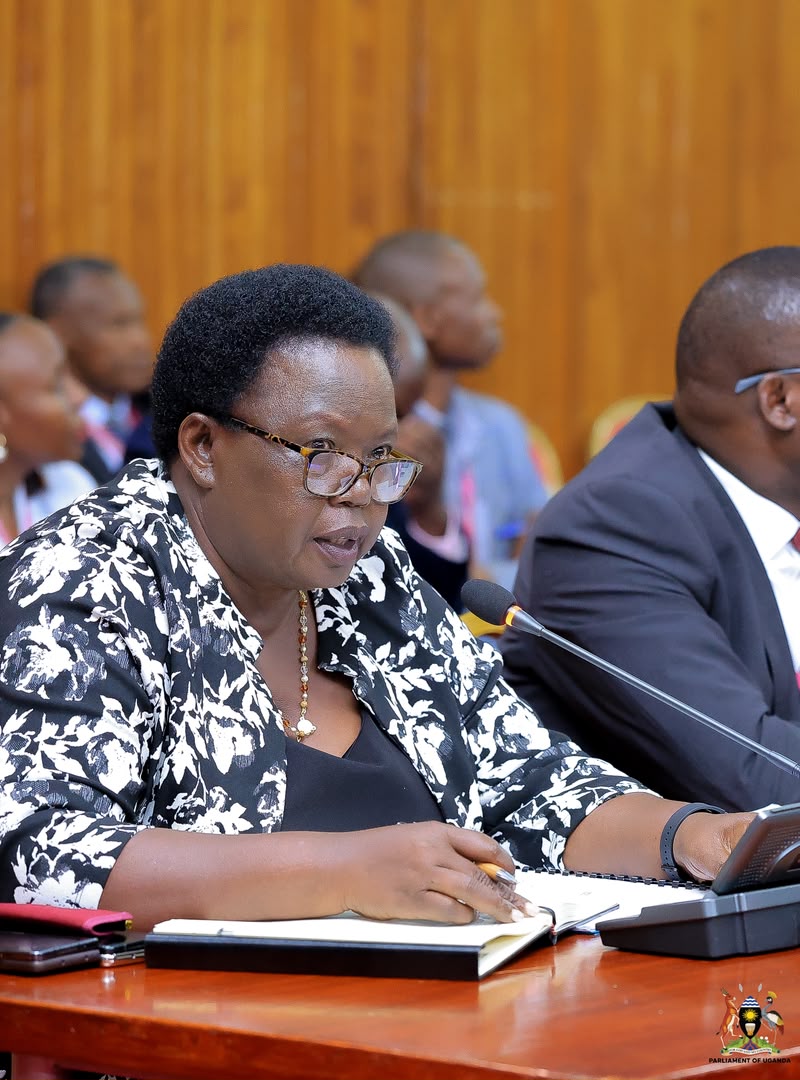 Dorcus W. Okalany, who served as Permanent Secretary in the Ministry of Lands, Housing and Urban Development, is another notable departure.
She belonged to a generation of female technocrats who rose through the public service to occupy some of the most influential administrative positions in government.
Her ministry oversees land administration, physical planning, housing policy and urban development, sectors that have become increasingly important as Uganda experiences rapid urbanisation and persistent disputes over land ownership.
Her retirement comes against the backdrop of continuing public concerns over land grabbing, overlapping land titles, delayed land registration and the management of urban growth.
The President has redeployed Julius Victor Nkeramihigo to the Lands Ministry, although the appointment of a new Permanent Secretary for the institution was not among the 13 appointments announced in the presidential instrument.
Another long-serving official, Bageya Waiswa, has been retired from the Ministry of Works and Transport.
The ministry manages some of the government’s most expensive development projects, including road construction, bridges, railway development and transport infrastructure.
Bageya’s departure comes at a time when government is under pressure to improve the execution of infrastructure projects, address delays in road construction and strengthen contract supervision. Eng. Flavia Guto Bwire has been appointed to take over the ministry’s administrative leadership.
Edith Nsaja Mwanje’s retirement is particularly significant for Uganda’s regional integration agenda. Mwanje served as Permanent Secretary in the Ministry of East African Community Affairs and was among the longest-serving accounting officers, having headed the ministry since 2007.
Her departure ends nearly two decades of administrative involvement in Uganda’s engagement with the East African Community.
During that period, the regional bloc expanded its integration agenda through the Customs Union, Common Market and Monetary Union protocols, while also pursuing political federation.
Her replacement, Aggrey Wunyi, inherits a ministry that must coordinate Uganda’s regional interests at a time when trade facilitation, cross-border infrastructure, regional security and the movement of people remain central to East African integration.
The retirement list also includes Dr Rose Nassali Lukwago, Alex B. Okello, Dr John Geoffrey Mbabazi and Rose N. Kafeero.
Lukwago’s departure is part of the wider reshaping of constitutional and oversight institutions, while Okello’s retirement affects the Ethics and Integrity docket.
Mbabazi’s departure from the Public Service Commission is particularly important because the commission plays a central role in the recruitment, assessment and management of public officers.
Kafeero, who served at the Inspectorate of Government, leaves an institution charged with fighting corruption, investigating abuse of authority and promoting accountability in public administration.
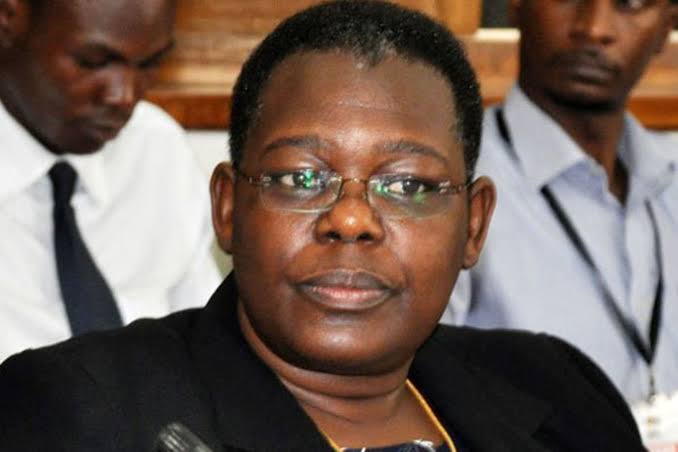
Maureen Kasande has been appointed to head the Inspectorate’s administrative machinery. These departures collectively affect institutions that are central to government accountability, public service management and the implementation of national programmes.
Why Museveni retained some of the old guard
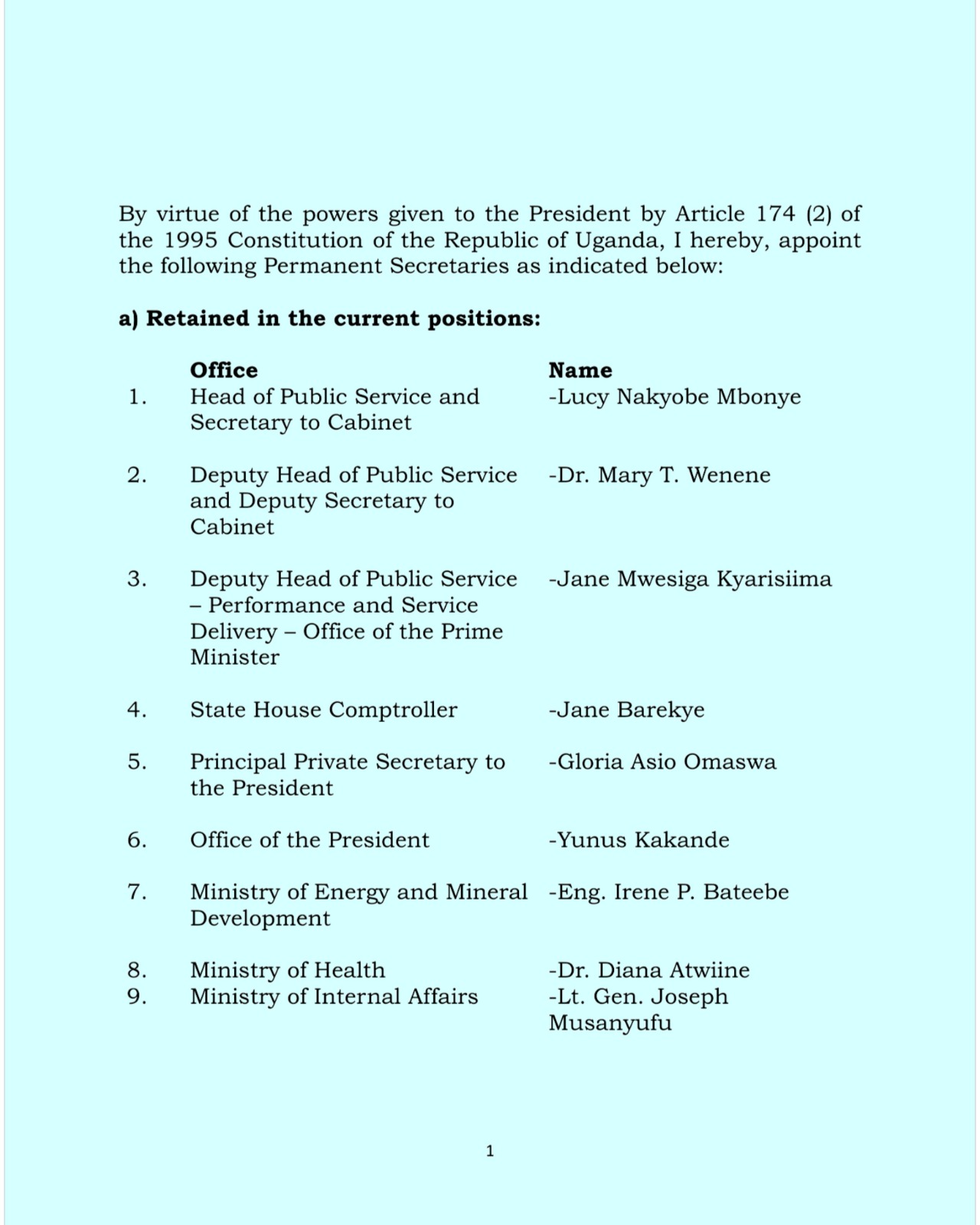
While 11 Permanent Secretaries have been retired, Museveni has retained 16 senior officials in their existing positions, demonstrating that the exercise is not a wholesale purge of the established civil service leadership.
At the top of the administrative hierarchy, Lucy Nakyobe Mbonye has retained her position as Head of Public Service and Secretary to Cabinet.
Nakyobe is one of the most influential public servants in the country, coordinating government administration and serving as a key link between the Presidency, Cabinet and the wider public service. Her retention signals continuity at the centre of government operations.
Her deputy, Dr Mary T. Wenene, has also retained her position as Deputy Head of Public Service and Deputy Secretary to Cabinet.
Jane Mwesiga Kyarisiima remains Deputy Head of Public Service responsible for Performance and Service Delivery in the Office of the Prime Minister.
Jane Barekye has retained her position as State House Comptroller, while Gloria Asio Omaswa remains Principal Private Secretary to the President. Yunus Kakande has also been retained at the Office of the President.
The retention of these officials preserves an experienced administrative team around the Presidency and the central government machinery.
In the economic sector, Dr Ramathan Ggoobi remains Permanent Secretary and Secretary to the Treasury at the Ministry of Finance, Planning and Economic Development.
His continued stay is significant given his responsibility for coordinating government financial management, budget implementation, revenue mobilisation and economic policy.
The retention also comes as government pursues its long-term ambition of transforming Uganda into a higher-income economy through industrialisation, infrastructure investment and increased private-sector participation.
At the Ministry of Energy and Mineral Development, Eng. Irene P. Bateebe has retained her position.
Her ministry is central to the country’s petroleum development, electricity generation and transmission, mineral exploration and the wider energy transition.
The retention of Dr Diana Atwiine at the Ministry of Health also preserves continuity in the administration of the country’s healthcare system.
Atwiine has been one of the prominent technocrats in the health sector, overseeing administrative coordination in a ministry dealing with hospital infrastructure, medical supplies, disease prevention and healthcare delivery.
Dr Kedrace T. Rwankore Turyagyenda remains at the Ministry of Education and Sports, while Lt Gen Joseph Musanyufu continues at the Ministry of Internal Affairs.
Robert Kasande has been retained at the Ministry of Justice and Constitutional Affairs, with Pius Perry Biribonwoha remaining Solicitor General.
Other retained officials include Dr Asuman Lukwago at the Education Service Commission, Ketty Lamaro at the Health Service Commission and Kainza Agnes Nzogi at the Office of the Director of Public Prosecutions.
The composition suggests that Museveni is seeking to preserve continuity in strategic institutions, particularly those responsible for national security, economic management, education, healthcare and the administration of justice. It also demonstrates that the President’s decisions were selective, rather than an across-the-board retirement of senior public officers.
The 13 new faces and the generational transition
The new appointments bring a mixture of experienced public administrators, technocrats and officials being elevated into senior leadership positions. The most prominent appointment is that of Edward Sengonzi Damulira as Clerk to Parliament, replacing Adolf Mwesigye.
Damulira’s background includes service at State House, where he handled state scholarship matters at Okello House, before moving to the Ministry of Finance and rising through the administrative ranks.
At the Office of the Prime Minister, Emmanuel Freddie Mugunga has been appointed to replace Alex Kakooza. The appointment places him at the centre of government coordination, where the Permanent Secretary oversees administrative support for national programmes and coordination between ministries and government agencies.
Maureen Kasande takes over the administrative leadership at the Inspectorate of Government, while Sheeba Kyobutungi Rujoki has been appointed to the Office of the President, where she will oversee Science, Technology and Innovation.
Kenneth Akiri takes over at Water and Environment, while Barbara Namugambe has been appointed to Agriculture, Animal Industry and Fisheries.
Charles Ssentongo takes over the administrative leadership at Foreign Affairs, while Prof Stephen Akandwanaho has been appointed to ICT and National Guidance.
Mark Sseremba has been appointed Permanent Secretary at Public Service, while Eng. Flavia Guto Bwire takes over at Works and Transport.
Edith Butuuro, previously an Under Secretary in the Ministry of Defence and Veteran Affairs, has been elevated to Permanent Secretary in the same ministry.
Her appointment is particularly notable because she replaces Maj Gen David Kasura-Kyomukama, who had occupied the position.
Aggrey Wunyi has been appointed to East African Community Affairs, while Betty Mutesa Cwinya-ai takes up the position at the Public Service Commission.
The appointments affect 13 offices, including Parliament, and reflect a deliberate redistribution of administrative responsibilities across government.
The redeployment of 11 officials
Beyond the 11 retirements and 13 new appointments, Museveni has also redeployed 11 senior public officers, indicating that the changes are intended to reorganise government rather than simply replace outgoing officials.
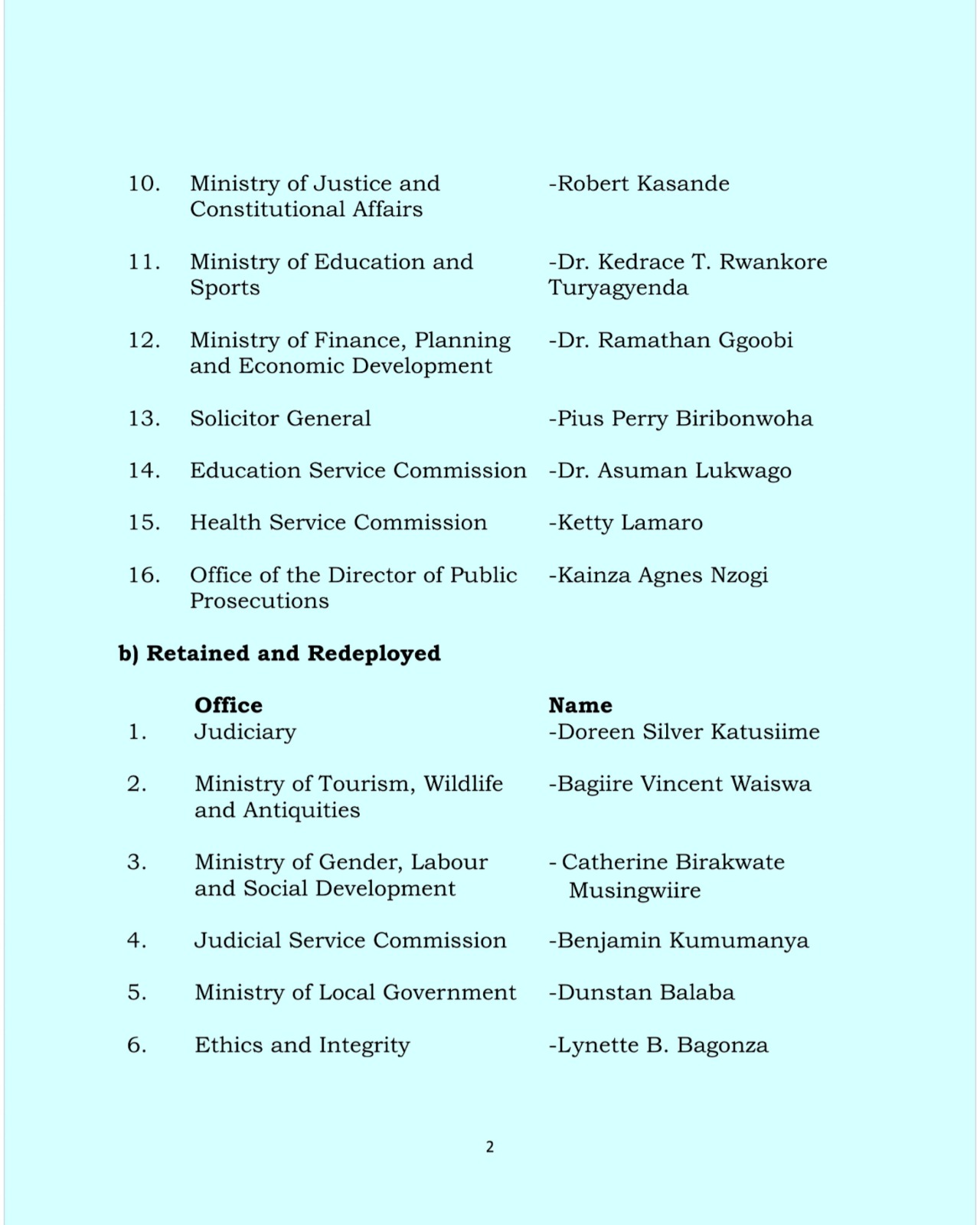
Among the most significant movements is that of Doreen Silver Katusiime, who moves from Tourism, Wildlife and Antiquities to the Judiciary, effectively taking over the administrative position previously occupied by Bigirimana.
Bagiire Vincent Waiswa moves to Tourism, Wildlife and Antiquities, while Catherine Birakwate Musingwiire has been moved to Gender, Labour and Social Development.
Benjamin Kumumanya moves to the Judicial Service Commission, Dunstan Balaba to Local Government and Lynette B. Bagonza to Ethics and Integrity.
Other changes include Julius Victor Nkeramihigo to Lands, Housing and Urban Development, Alex Kakooza to Trade, Industry and Cooperatives, and Dr Aminah Zawedde to the Office of the Prime Minister, where she will handle coordination.
Aggrey David Kibenge has been appointed Principal Private Secretary to Vice President Jessica Alupo, while Rosette Byengoma, formerly associated with the administration of the Defence Ministry, has been appointed Senior Presidential Advisor on Defence Procurement.
A test of performance or a political administrative reset?
The latest reshuffle raises important questions about the future direction of Uganda’s public service.
For years, the Permanent Secretary position has been one of the most powerful administrative offices in government. Its occupants control the financial and administrative machinery through which ministerial policies are implemented.
They are also responsible for ensuring that government programmes comply with financial regulations, procurement laws and public service procedures.
Consequently, the retirement of 11 accounting officers is more than an ordinary personnel change. It affects institutional memory, administrative relationships and the implementation of government programmes.
Museveni’s decision also sends a message to the wider civil service that seniority and years of experience do not automatically guarantee continued tenure.
The three-year renewable contract system provides the President with an opportunity to periodically assess the performance of accounting officers and determine whether they should continue serving.
However, the effectiveness of this arrangement will ultimately depend on the transparency and consistency of the assessment process.
The President has not publicly attributed individual failures or misconduct to the 11 retirees. Their retirement should therefore not be interpreted as evidence of wrongdoing.
The bigger test will be whether the new appointees can deliver measurable improvements in public expenditure management, project implementation, accountability and service delivery.
There is also the question of institutional continuity. Uganda has accumulated considerable administrative experience through the work of veteran civil servants. Replacing them with new officials must not result in the loss of institutional knowledge or disruption of ongoing government programmes.
The new Permanent Secretaries will inherit ministries facing significant challenges, from the management of public debt and infrastructure projects to healthcare financing, education quality, environmental protection and regional integration.
The appointment of technocrats to these positions will therefore be judged less by their professional titles and more by their ability to translate government policy into tangible results. There is also a constitutional dimension to the changes.
Museveni cited Articles 99 and 172(1)(a) of the 1995 Constitution in retiring the 11 Permanent Secretaries, while invoking Article 174(2) in making the new appointments.
The presidential instruments also direct the Public Service Commission to assess the suitability of the designated appointees and advise him accordingly. The appointments should therefore be understood within that assessment process.
The departure of Bigirimana, Mwesige, Okidi, Okalany, Mwanje and other veteran officials closes an important chapter in the country’s civil service history.
The retention of Nakyobe, Ggoobi, Atwiine, Bateebe and other senior administrators, meanwhile, shows that Museveni is not abandoning the old guard entirely.
Instead, he appears to be combining continuity in strategic offices with a substantial renewal of leadership elsewhere.
Whether the reshuffle becomes a genuine public service transformation or simply another rotation of senior government officials will depend on what the new team delivers.
For the 11 retirees, it is the end of long careers in public administration. For the 13 incoming appointees, it is the beginning of a demanding test of competence, accountability and loyalty to the public interest.
Author Profile

- Charles Gazza Kodili is a seasoned journalist with over 20 years of experience in the media industry. He holds a Bachelor of Arts degree in Mass Communication. He’s currently the Chief Editor at the Investigator.
Charles can also be reached via; Tel: +256 774 108978
Email: [email protected]
Latest entries
 FeaturedNovember 10, 2026WHY BIGIRIMANA, OKIDI AND OKALANY WERE SHOWN THE EXIT: What Triggered The Departures Of Bigirimana, Okidi, Okalany And Other Long-Serving Permanent Secretaries? Inside The Succession Battle, Performance Questions And Changing Priorities Behind The Biggest Civil Service Shake-Up In Years
 BusinessNovember 9, 2026EQUITY BANK vs DEI PHARMACEUTICALS: Inside the Muwema-Equity Bank Showdown Over Magoola’s Impending Property Auction
 FeaturedNovember 9, 2026THE PRESIDENT’S TRUSTED ECONOMIST: HOW DAMULIRA ROSE FROM STATE HOUSE TO PARLIAMENT: From Managing State House Scholarships To Becoming Finance Ministry Under Secretary And Accounting Officer, Dr Edward Sengonzi Damulira’s Appointment As Clerk To Parliament Signals The Rise Of A Trusted Presidential Technocrat
 FeaturedNovember 6, 2026FIVE GENERALS, ONE POWERFUL SEAT: WHO WILL SUCCEED MUHOOZI? With Gen Muhoozi Kainerugaba Announcing His Intention To Leave The CDF Position, Five Senior Commanders Are Emerging In The Succession Conversation, With Kayanja Muhanga And David Mugisha Tipped As Leading Contenders