





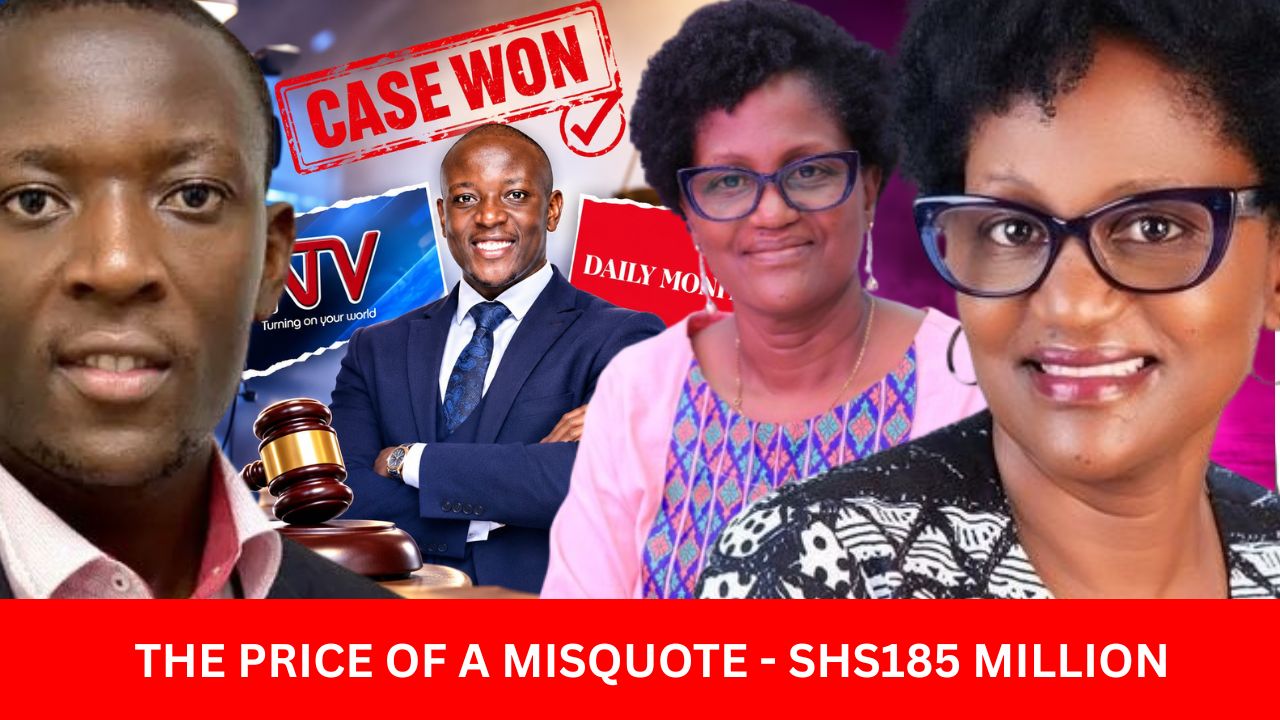
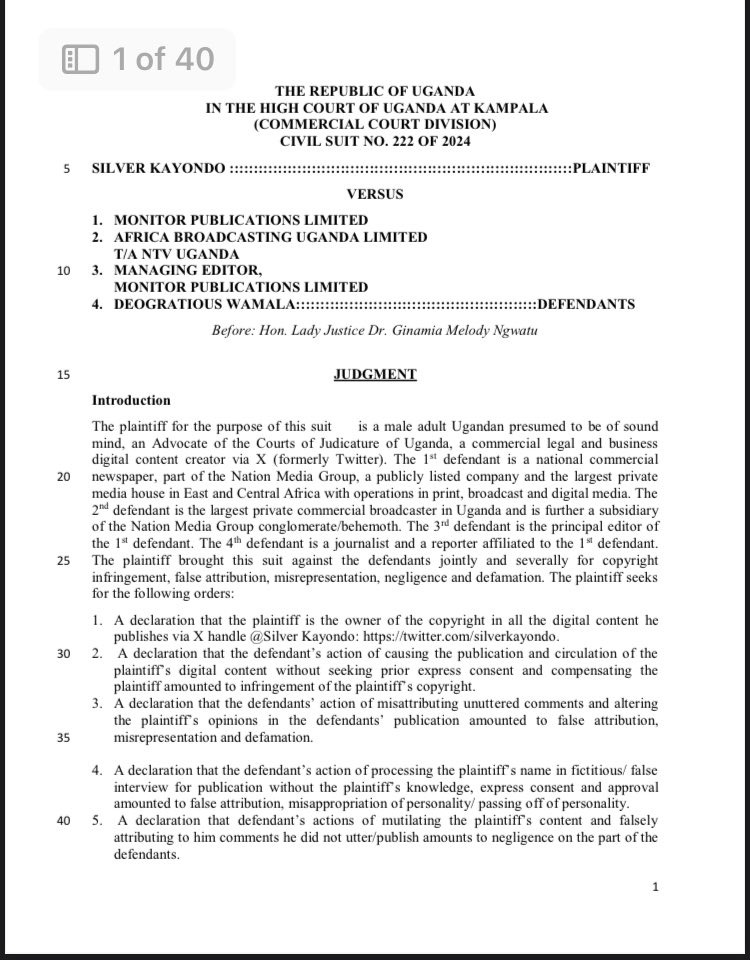
In what legal observers say is one of Uganda’s most significant decisions on copyright, journalistic ethics and media accountability, the High Court has ruled that Monitor Publications Ltd, NTV Uganda and journalist Deogratious Wamala must jointly pay Kampala lawyer Silver Kayondo Shs185 million after finding that they infringed his copyright, falsely attributed statements to him, distorted his work and defamed him.
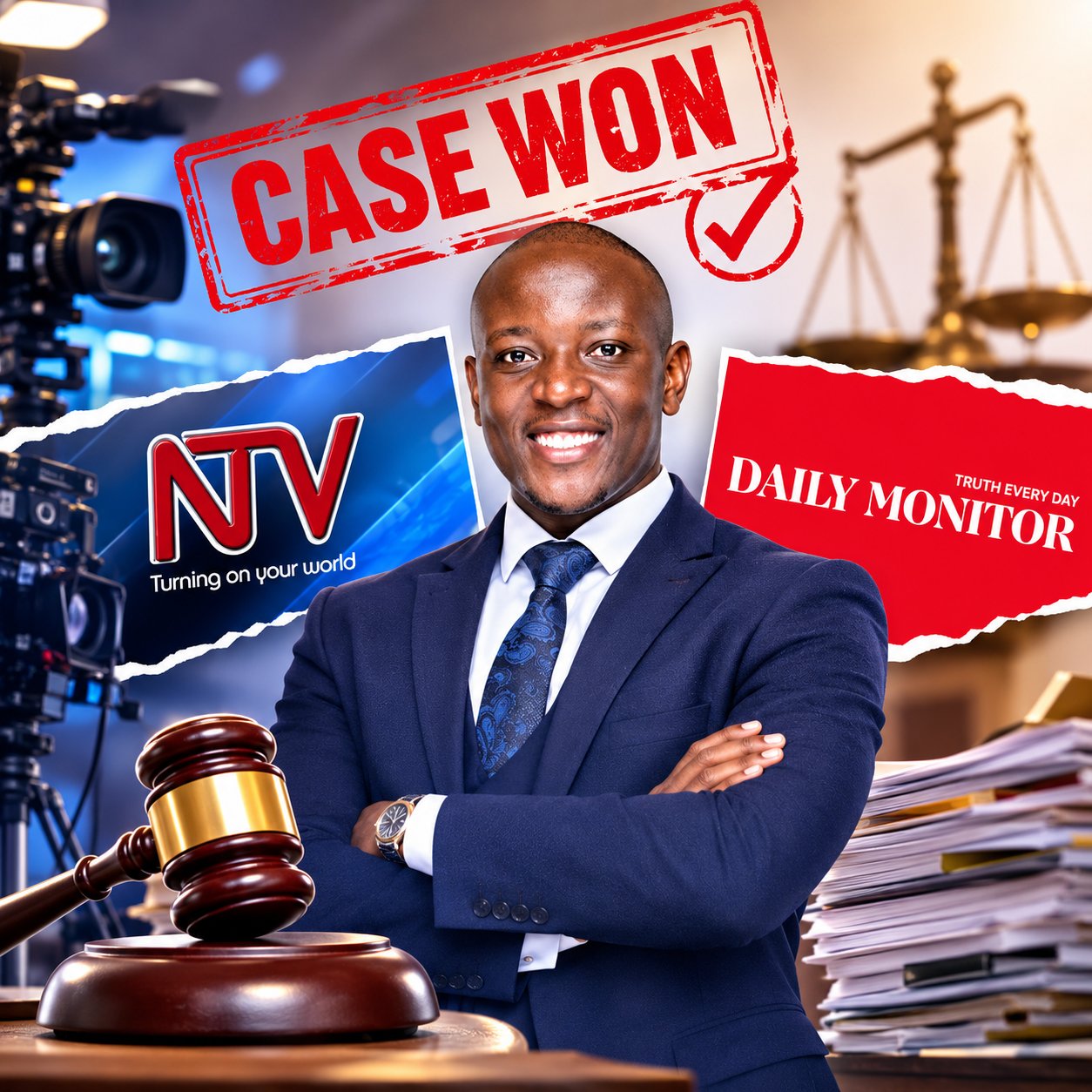
Justice Dr. Ginamia Melody Ngwatu also ordered the media organizations to publish an apology across their print and digital platforms. But this case was never simply about copying someone’s work. It was about changing what that work meant.
When One Word Changed Everything
The dispute stemmed from a Daily Monitor story published in September 2023 concerning Uganda’s negotiations with the World Bank after the suspension of new funding following the enactment of the Anti-Homosexuality Act.
The newspaper quoted analysis that Kayondo had earlier posted on his X (formerly Twitter) account. However, in reproducing the post, the publication altered key wording and attributed additional comments to him. To many readers, the changes appeared minor.
To the court, they were anything but. Justice Ngwatu found that the grammatical alterations materially changed the meaning of Kayondo’s original work and exposed his professional reputation to potential harm.
The judgment contains one of the strongest judicial warnings yet issued to Uganda’s media industry on the importance of accuracy.
“In my view, any grammatical error that changes the meaning of the work to the detriment of the author goes beyond just a mere error. Anyone who understands English should be aware that a slight change in anything can alter the meaning of the statement. While making publications consisting of quoted work, it is mandatory that the accuracy is prioritised and unreasonable mistakes, or errors should be avoided because it can discourage creators from putting their work out there or create anything at all, if they use such effort and time to come up with work only to be misused by a person in a way that damages their reputation.”
For many lawyers and journalists, that paragraph alone is likely to become required reading in every newsroom.
Fair Use Has Limits
Perhaps the most consequential aspect of the ruling is the court’s interpretation of “fair use.” Daily Monitor and NTV argued that the publication concerned a matter of immense public interest, acknowledged Kayondo as the source and therefore qualified as fair use under copyright law. Justice Ngwatu disagreed.
The court held that fair use does not provide immunity where a publication alters an author’s intended meaning.In effect, the judgment establishes an important legal principle: fair use is not a licence to misquote.
Freedom of the press, the court emphasized, does not excuse inaccurate quotations that distort an author’s views or falsely place words in their mouth.Once a quotation is materially altered in a way that damages the author’s reputation, the protection ordinarily associated with fair use no longer applies.
The Right Not to Be Misquoted
Equally significant is the court’s recognition of false attribution as a distinct legal wrong. The judgment reinforces an author’s right to insist: “I never wrote that.” “I never said that.”
According to the court, forcing altered words onto someone and presenting them as genuine can constitute a separate violation of both copyright and personality rights.That finding is expected to influence future disputes involving social media content, digital publications and online journalism.
A Reputation Built Over Years
Kayondo is no ordinary social media commentator. A Kampala-based advocate, he specializes in corporate and commercial law, technology, telecommunications, media law and international finance.He also lectures at the Law Development Centre (LDC) and has built a substantial following online through legal and economic commentary.
Court heard that Kayondo had invested more than Shs370 million (approximately $100,000) over several years developing his expertise and professional reputation.His legal analysis regularly attracts attention from policymakers, lawyers and financial experts.
According to his testimony, the controversy came to his attention on September 16, 2023, after a colleague shared the Daily Monitor story in a WhatsApp group of lawyers.
Upon reading it, Kayondo immediately noticed that his original analysis had been reproduced with altered wording and supplemented with statements he insisted he had never made.
He maintained that neither Monitor nor NTV sought his permission before publishing the material, compensated him for its use, or accurately represented his views.
The Legal Battle
In his suit, Kayondo asked the court to declare that he owned the copyright in the material published through his X account.He further argued that the defendants had infringed his copyright, violated his personality rights, negligently altered his work, misrepresented his opinions and defamed him.
He sought damages, an injunction, an apology and legal costs. The media organizations denied liability.They argued that the social media posts consisted merely of ideas and concepts rather than protected literary works.
They also contended that the publication constituted fair use because it discussed an issue of public importance, acknowledged Kayondo as the source and served an educational purpose.
Additionally, they argued there was no restriction preventing the reproduction of publicly available social media content and claimed the publication had enhanced, rather than harmed, Kayondo’s profile.
A Trial That Took an Unexpected Turn
The proceedings took an unexpected twist when Monitor Publications and NTV failed to comply with court directives requiring the filing of witness statements.
When the matter came up for hearing, counsel for the media organizations sought an adjournment after indicating that one of the advocates handling the matter was unwell.
Kayondo’s lawyer, Sadam Solomon, opposed the request, arguing that the defendants had already been afforded sufficient time. The court agreed. Justice Ngwatu allowed the trial to proceed without the defendants presenting evidence. That decision left Kayondo’s evidence largely unchallenged.
Social Media Content Is Protected
One of the most important aspects of the judgment concerns digital content. Justice Ngwatu rejected the argument that posts on social media are merely opinions lacking copyright protection.
Instead, she held that once an idea has been expressed in a material form—even through a social media post—it qualifies for legal protection.”Any work that has been reduced to material form ceases to be an opinion or a mere view. It becomes one’s expression.”
The court also noted that social media itself enabled verification of Kayondo’s original work, allowing the judge to compare the authentic post with what had ultimately been published.
Accuracy Is a Legal Duty
Justice Ngwatu further relied on the Press and Journalist Act, which requires journalists and editors to avoid publishing inaccurate, misleading or distorted information. The judgment stresses that editorial responsibility extends beyond merely reproducing content.
Editors have a legal obligation to scrutinize quoted material carefully before publication.
Constitutional protection of press freedom, the court ruled, cannot be used to justify inaccurate reporting or distorted quotations.
The Final Verdict
Justice Ngwatu declared Kayondo the owner of the copyright in the disputed digital content and found that Monitor Publications, NTV Uganda and journalist Deogratious Wamala had:
Infringed his copyright.
Falsely attributed statements to him.
Misrepresented his views.
Negligently altered his work.
Violated his personality rights.
Defamed him.
The court awarded Shs165 million in general damages and Shs20 million in aggravated damages, bringing the total award to Shs185 million.
The media organizations were also ordered to publish an apology.
Why This Judgment Matters
Beyond the financial award, this case may become one of Uganda’s defining authorities on copyright, fair use and responsible journalism in the digital age. For journalists, editors, publishers, bloggers and content creators, the message is unmistakable. Accuracy is not merely good journalistic practice. It is a legal obligation. The judgment sends a clear warning that reproducing someone’s work—even on a matter of public interest—does not give a publisher the right to rewrite it, however slightly. Reputations are often built over decades.
As this case demonstrates, they can be undermined by a single careless edit—and that edit can carry a very expensive price. For every newsroom, the lesson is simple: before pressing “publish,” ask one question—have you preserved the author’s meaning, or have you accidentally rewritten it?
The answer could determine not only the credibility of a publication, but also its legal liability.
Author Profile
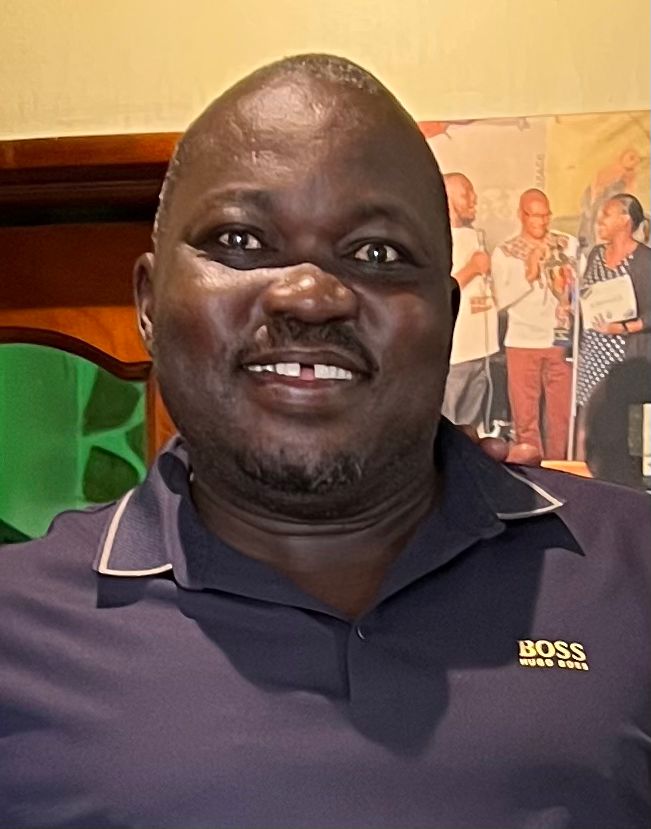
- Charles Gazza Kodili is a seasoned journalist with over 20 years of experience in the media industry. He holds a Bachelor of Arts degree in Mass Communication. He’s currently the Chief Editor at the Investigator.
Charles can also be reached via; Tel: +256 774 108978
Email: [email protected]
Latest entries
 FeaturedOctober 10, 2026MUHOOZI UNDER FIRE OVER DEATH THREATS New York Times article puts Muhoozi’s human rights record under fresh scrutiny as UPDF cries foul
 FeaturedOctober 9, 2026UGANDA ECONOMY TO HIT $73.96B: President Museveni Cites Decades Of Economic Growth As He Receives A Top National Honour During The 64th Independence Anniversary Celebrations At State House, Entebbe
 FeaturedOctober 9, 2026KABALEGA: THE KING WHO FOUGHT THE BRITISH: From Battles Against Sir Samuel Baker To Uganda’s Independence In 1962, The Bunyoro King Became A Symbol Of Resistance Against Foreign Domination
 FeaturedOctober 8, 2026UGANDA AT 64: From Obote Receiving the Instruments of Power in 1962 to Museveni Receiving a National Medal in 2026, Uganda’s Independence Story Remains Unfinished. We Journey With You the Thorney 6+ Decades of Uhuru