



















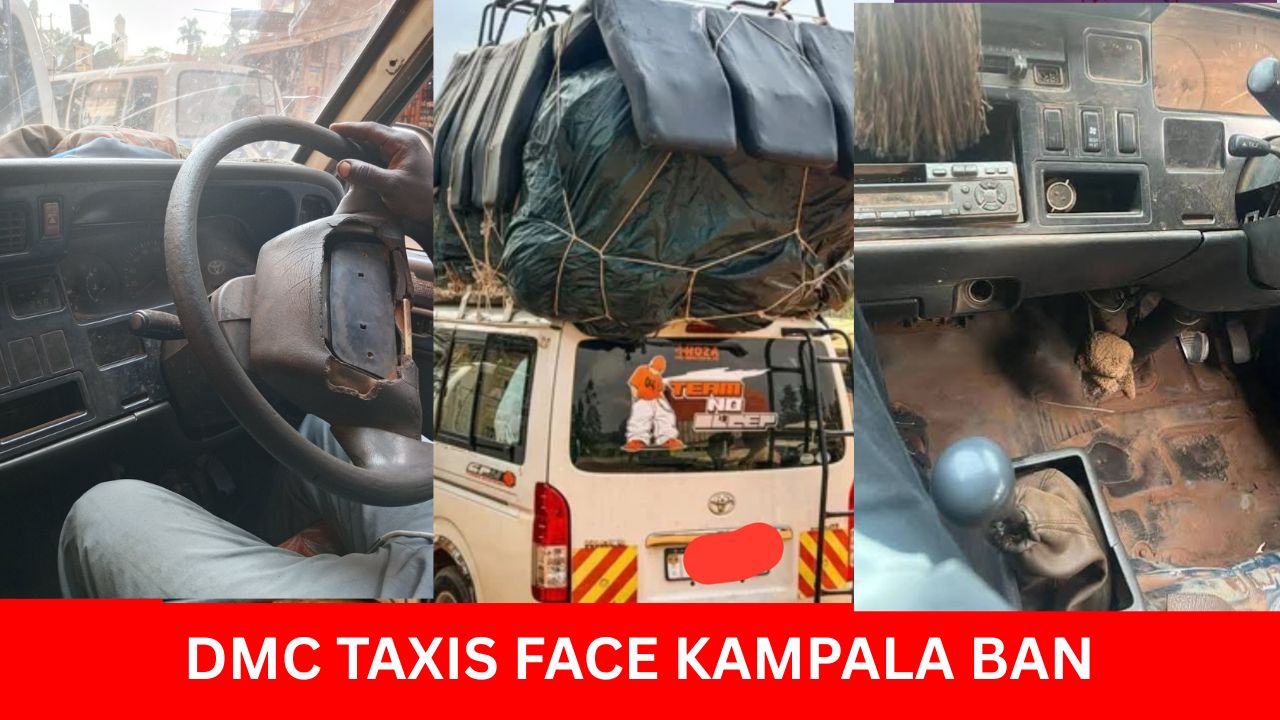
Works and Transport Minister Fred Byamukama has ordered an immediate crackdown on taxis operating in Dangerous Mechanical Condition (DMC) in the Greater Kampala Metropolitan Area, warning that poorly maintained commuter vehicles are putting passengers’ lives at risk.
The directive, which takes effect on Monday, August 24, 2026, will see police conduct a 100-day operation targeting taxis deemed mechanically unsafe, with particular attention on the ageing 14-seater commuter vans popularly known as “Ganyegenya.”
The minister said the government could no longer allow public transport vehicles in dangerous mechanical condition to continue carrying passengers on Kampala’s busy and increasingly congested roads. “Starting Monday, 24th August, no DMC Taxis will be allowed within the Greater Kampala-Metropolitan Area,” Mr Byamukama said.
He added: “I have directed Police to launch a 100-day operation in the Greater Kampala Metropolitan Area targeting commuter taxis found to be in a Dangerous Mechanical Condition (DMC).” According to the minister, the campaign is intended to restore safety standards in public transport and prevent road crashes linked to mechanically defective vehicles. “Our roads must not become death traps because of poorly maintained vehicles,” Byamukama said.
He singled out the dilapidated 14-seater taxis commonly known as “Ganyegenya”, saying the operation would particularly focus on vehicles in poor mechanical condition. “Public transport must be safe, roadworthy and fit for purpose. We owe Ugandans nothing less,” the minister said.
Why the Government Is Acting
The directive comes amid persistent concerns about the condition of some commuter taxis operating in Kampala and surrounding districts. Some of the older vehicles have continued operating despite visible mechanical problems, including worn-out bodywork and other defects that raise questions about their roadworthiness.
For the government, the issue is not simply about the age of a vehicle but whether it is mechanically fit to transport passengers. The 100-day operation therefore puts police at the centre of enforcement, with officers expected to identify and remove DMC taxis from the roads. However, the directive has immediately triggered a wider debate about the responsibility of government and taxi operators in maintaining safe public transport. Some Ugandans have welcomed the move as long overdue, while others argue that enforcement alone will not solve the problem unless the government also addresses Kampala’s poor road infrastructure.
Taxi Operators Face Disruption
The Uganda Taxi Operators Association has been among the stakeholders expected to face the biggest impact from the directive, given the large number of commuter taxis operating within the metropolitan area. Taxi operators have long argued that the condition of public transport vehicles cannot be separated from the state of the roads on which they operate. A taxi may be mechanically sound when it is purchased, but constant operation on badly damaged roads can accelerate wear and tear, operators argue.
This argument has been echoed by social media user Bulius Bsaire, who questioned whether banning DMC vehicles without fixing the roads would address the root of the problem. “A taxi is a car that moves up and down from 5am to 11pm on our bad roads. That’s why they get damaged very fast,” Bsaire said. He added: “However much you put this law in practice minus fixing the roads, you are wasting time. A taxi is not a salon car.” The concern reflects a broader argument among taxi operators and commuters that road conditions contribute significantly to the deterioration of public transport vehicles.
“Fix Roads First”
Several Ugandans have welcomed the minister’s concern for passenger safety but questioned the sequence of government intervention. Ssekabira Patrick says removing old taxis without improving the roads could punish operators and passengers without solving the underlying problem. “Road safety is important, but before removing these old taxis, why not first fix the roads they use?” he asked.
He called for better roads, bridges, drainage systems and traffic lights before demanding that taxi operators upgrade their vehicles. Ssekabira also questioned whether the directive could leave drivers and conductors without livelihoods. “Fix the roads, support people to upgrade their taxis, and create jobs. Don’t punish ordinary Ugandans for problems the government has failed to solve,” he said.
Support for the Ban
Despite the criticism, the minister’s announcement received considerable support from Ugandans who have experienced travelling in poorly maintained taxis. Gonzalez Prince described the vehicles targeted by the government as extremely dangerous, saying the minister had his support. “Actually these are not taxis but moving graves,” he said.
Lauben Mukiga also backed the operation, saying he had personally experienced taxis in extremely poor condition. “I recently used a taxi and the condition was worse than what you can imagine,” he said, urging the government to ban such vehicles.
Victor Sserunkuuma also supported the objective of the operation but raised concerns about enforcement, arguing that some DMC vehicles could have connections to powerful individuals. “That’s good Hon. minister but I want to tell you that this will not work because some very DMC taxis are owned by police officers, army personnel, government officials,” he said. His comments highlight one of the biggest challenges facing the operation: ensuring that enforcement is applied fairly and without political or institutional interference.
Where Will Passengers Go?
Another major concern is what happens to passengers if a significant number of taxis are removed from the roads. Ben Bens Ampaire welcomed the move on safety grounds but questioned whether the government had prepared alternatives. “Great move for safety, however what alternative have you put in place as government for passengers to use in case these DMCs are impounded and passengers remain stranded on roads?” he asked.
Martin similarly argued that protecting passengers must remain the priority but said safe transport should also be affordable and accessible. “Protecting passengers should never be negotiable,” Martin said. “But alongside removing DMC taxis, government should ensure affordable, reliable alternatives so ordinary Ugandans aren’t left stranded.” Bigirwa Moses described the directive as a good move for passenger safety but warned that implementation without alternatives could have serious consequences for drivers and conductors who depend on taxis for their livelihoods.
Calls for Nationwide Operation
Some Ugandans have also challenged the government to extend the operation beyond Kampala. Into the World of Physics said other cities should also be covered, arguing that road safety should not be limited to the Greater Kampala Metropolitan Area. Ken similarly called for the directive to apply across the country and for all forms of public transport to be subjected to safety standards.
Karl Wega said the operation was welcome but should address dangerous practices such as overloading. He cited instances in parts of western Uganda where passengers are allegedly squeezed into vehicles beyond their intended capacity. “We cannot wait until people die and then blame every tragedy on bad roads,” he said, calling for enforcement covering vehicles, passenger loading and the general safety of road users.
The Road Condition Question
One of the most recurring concerns in the public reaction is the condition of Kampala’s roads. Wycliffe Lubowa supported the minister but cited the Nateete-Nakawuka-Kasanje road as an example of infrastructure that could damage even relatively new vehicles. Jo22flash similarly welcomed the directive but pointed to the Kibuye-Busega road, saying poor road conditions were contributing to vehicle deterioration.
Another user, ArinDan, warned that police officers should receive clear guidelines to prevent the operation from becoming an excuse to impound vehicles that are not actually DMC. The user also posed a fundamental question: “What should have come first? Good roads or good vehicles?”
Balancing Safety and Livelihoods
The Byamukama directive has therefore opened a difficult debate about how Uganda should reform its public transport system. There is broad agreement that passengers deserve safe, roadworthy vehicles. The disagreement is over how the government should achieve that objective without disrupting the transport system or destroying the livelihoods of thousands of drivers, conductors and taxi owners.
The 100-day operation will test whether the government can enforce the law consistently while distinguishing genuinely dangerous vehicles from those whose mechanical problems can be repaired. It will also test whether authorities can prevent selective enforcement, corruption and harassment during roadside inspections.
For taxi operators, the bigger question is whether the government will accompany enforcement with practical measures to help them replace or rehabilitate ageing vehicles. For commuters, the immediate concern will be whether the removal of DMC taxis improves safety without creating transport shortages and higher fares.
As the August 24 deadline approaches, the debate is increasingly shifting from whether DMC taxis should be removed to how the operation will be implemented, who will be affected and what government will do about the roads and transport alternatives that remain at the heart of Kampala’s mobility crisis.
Author Profile
- Mr. Stephen Kasozi Muwambi is a seasoned crime investigative writer, majoring in judicial-based stories. His two decades’ experience as a senior investigative journalist has made him one of the best to reckon on in Uganda. He can also be reached via [email protected]
Latest entries
 FeaturedOctober 21, 2026NAMEERE RETAINS MASAKA CITY SEAT: High Court Dismisses Nalubowa’s Election Petition, Ruling That Recount Irregularities Did Not Substantially Alter The Final Result
 FeaturedOctober 20, 2026VETERAN JOURNALIST KASYATE JOINS OPM: Simon Kasyate Moves Back Into Government Communications After Years In Journalism, Corporate Affairs And Public Relations, Including A Senior Role At KCCA
 FeaturedOctober 19, 2026BILLIONS LOST, INVESTORS DUPED, GOLD TRADE UNDER SCRUTINY: A City Pastor’s Arrest Over An Alleged Shs2.9b Fraud Involving American Investors Adds To A String Of High-Profile Gold Scams Threatening Uganda’s Investment Reputation
 FeaturedOctober 17, 2026THREE VETO POWERS THREATEN OTUNNU’S UN BID: With Three Of The Five Permanent Members Reportedly Against Him, Otunnu Must Win Over Powerful Opponents Or Risk Seeing His Campaign Collapse Before The Final Selection