

























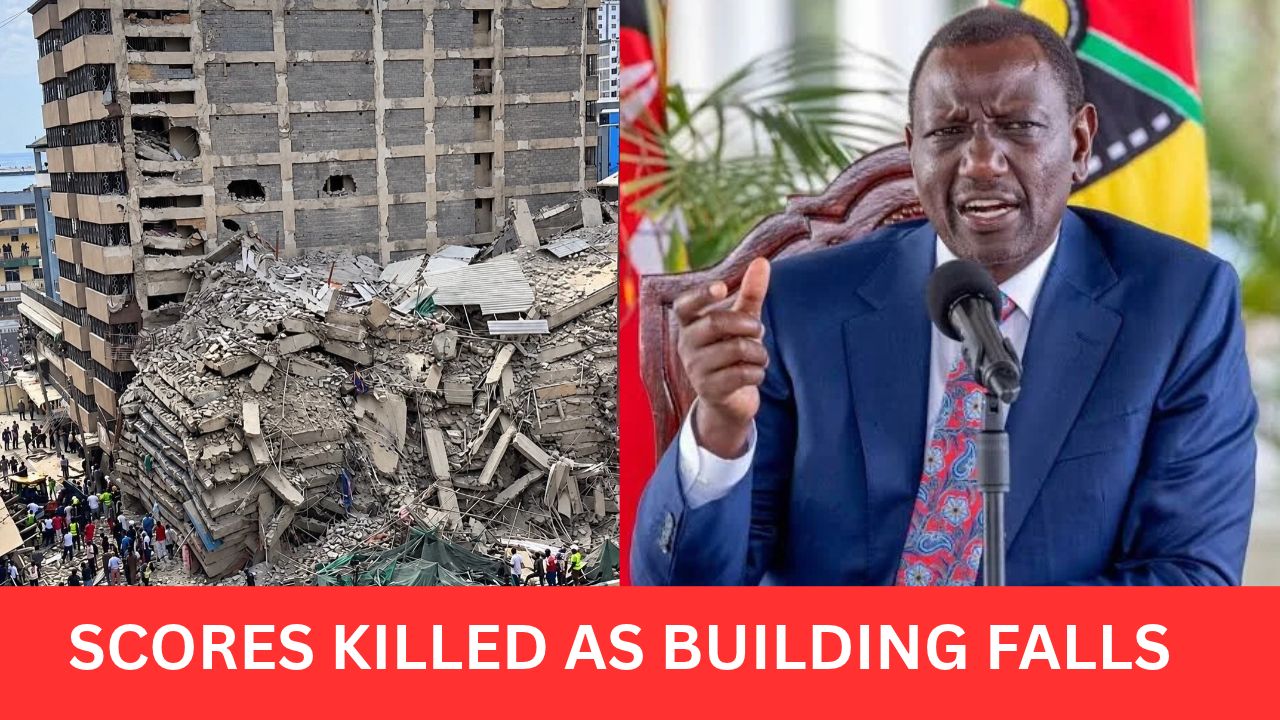
The collapse of a multi-storey building in Eastleigh, Nairobi, has renewed concerns over construction standards, enforcement of building regulations and the safety of residents in one of Kenya’s most densely populated commercial neighbourhoods.
The incident, involving a building reported to be nine storeys high, has triggered a rescue operation amid reports that people may be trapped beneath the rubble. Nairobi Governor Johnson Sakaja has promised action against the owners of the property, as emergency responders work to establish the number of casualties and determine whether survivors remain inside the debris.
The tragedy has also reignited a debate over the proliferation of buildings that allegedly violate approved construction plans, with critics questioning whether developers can continue putting up structures without adequate supervision from city authorities.
A video circulating online appears to capture the building collapsing, prompting alarm among residents and renewed calls for urgent inspections of potentially unsafe structures across the capital.
However, the final number of people killed or injured, the circumstances that led to the collapse and whether the building had the necessary approvals require confirmation from the relevant authorities. The incident should also not be taken as proof of wrongdoing by the owners before investigations establish the facts.
Sakaja promises action against owners
Governor Sakaja, who visited the scene as rescue efforts got underway, said authorities had received reports that people were communicating from inside the collapsed structure.
“We’ve heard people communicating from inside. We’re opening up a space so there’s oxygen, and then we can get the proper estimates of what else needs to be done,” Sakaja said.
His remarks underscored the urgency of the operation, with rescuers having to balance the need to reach possible survivors against the danger of disturbing unstable sections of the structure.
The governor also warned that action would be taken against the building’s owners. However, the nature of any eventual sanctions will depend on the findings of investigations into the building’s approvals, construction and compliance with safety requirements.
The building was under construction when it collapsed on Friday, October 23, along 9th Street in Eastleigh. Reports from Kenyan media differed on its precise height, with descriptions ranging from about 12 to 16 storeys, although some reports gave higher estimates. The exact number of floors should be established by investigators.
The building’s ground floor was reportedly occupied, raising additional fears that traders, workers or other people could have been caught in the collapse. Emergency teams were deployed to search the rubble, while the Kenya Red Cross urged members of the public to keep away from the site to allow responders to work.
At the time of the initial reports, officials had not confirmed the total number of casualties or established the cause of the collapse. Consequently, claims that scores had died could not yet be independently verified.
Police struggle to control crowds
The rescue operation was complicated by crowds gathering around the site, with police saying that onlookers had obstructed access routes needed by emergency responders.
Nairobi Regional Police Commander Issa Mohamud said officers had been forced to use tear gas to disperse people who had gathered around the scene.
“The public around here have given us a headache today,” Mohamud said, explaining that police needed to clear the area to allow emergency personnel to carry out their work.
“We had to use teargas to disperse them. We don’t need to do that. People should go home. Give people who are mandated to do the job space,” he added.
The police intervention illustrated the difficulties of conducting a rescue operation in a crowded commercial neighbourhood where news of a major disaster can quickly attract hundreds of curious residents and traders.
While members of the public may want to help or establish whether relatives and friends are missing, crowding the site can prevent ambulances, rescue vehicles and heavy machinery from reaching the victims.
The authorities therefore faced two immediate responsibilities: searching for people who might have survived beneath the rubble and securing the surrounding area to prevent further injuries.
Rescuers also needed to exercise caution because sections of the collapsed building and neighbouring structures could remain unstable.
Karauri’s warning returns to the spotlight
The disaster has given fresh urgency to concerns raised days earlier by Ronald Karauri over the safety of buildings in Eastleigh.
Karauri had called for a fresh round of structural inspections, warning that buildings found to be unsafe should be subjected to appropriate intervention, including demolition where necessary, before they collapse and claim lives.
His argument was that authorities should assess buildings individually rather than relying on assumptions about their safety based on their location, appearance or approved height.
Structures that pass professional inspections should be allowed to remain standing, while those found to pose an immediate danger should be dealt with before a tragedy occurs.
Karauri also distinguished between zoning violations and structural safety. A building that exceeds its approved height may violate planning regulations, but the immediate concern must be whether the structure can safely support its own weight and protect the people inside it.
The distinction is important because an unauthorised additional floor does not, by itself, establish the cause of a collapse. Equally, a building that complies with the approved height limit is not necessarily safe if its foundations, materials, design or construction are defective.
The Eastleigh incident therefore raises questions that require engineering investigations rather than political speculation: Was the building constructed according to an approved design? Were the foundations and supporting columns adequate? Were construction materials of the required quality? Were inspections conducted at the appropriate stages? And were people allowed to occupy parts of the property while work continued above them?
The answers could help establish whether the collapse resulted from structural defects, construction practices, design failures, unauthorised alterations or a combination of factors.
Ethnicity debate must not overshadow accountability
The collapse has also revived contentious discussions about developers, building ownership and compliance with construction regulations in Nairobi.
Some commentators have drawn comparisons with a separate building in the South C neighbourhood, where allegations that two additional floors had been constructed illegally raised questions about the enforcement of approved building plans.
However, the identity or ethnic origin of a developer cannot establish whether a building complies with the law. Any suggestion that members of a particular community are inherently unwilling to follow construction regulations is an unsupported generalisation that risks diverting attention from the individuals and institutions responsible.
The relevant questions are whether the Eastleigh developer obtained the necessary approvals, whether qualified professionals supervised the construction, whether the work met engineering standards and whether county officials carried out their statutory responsibilities.
If investigators establish that the developer ignored safety requirements, the appropriate response should be prosecution or other lawful sanctions, regardless of the individual’s background.
Likewise, public officials who approved unsafe plans, ignored documented violations or failed to enforce regulations should be held accountable where evidence establishes misconduct.
The tragedy should not become an excuse for ethnic stereotyping when the central issue is the protection of human life.
Nairobi’s construction oversight under scrutiny
Eastleigh is one of Nairobi’s busy commercial districts, characterised by intensive trading activity, residential developments and high pedestrian traffic. The collapse has highlighted the risks that arise when construction takes place in such an environment, particularly where businesses or other occupied spaces operate close to an unfinished structure.
The fact that the ground floor was reportedly occupied while construction continued above it raises a particularly important question about how authorities manage buildings that combine active commercial premises with ongoing construction.
Investigators will need to establish whether the occupation was authorised, what safety precautions were in place and whether the people working or trading inside had been adequately protected.
The incident also raises questions about the effectiveness of inspections. Approvals granted before construction begins are not enough on their own. Authorities must verify that the actual building corresponds to the approved plans and that changes made during construction receive the necessary professional assessment and authorisation.
A building may appear complete and functional while concealing defects in its foundations, columns, beams or concrete. That is why inspections must be supported by qualified structural engineers and meaningful enforcement.
Kenya’s National Construction Authority and relevant county agencies have responsibilities within the construction regulatory framework. Their investigations should establish whether the Eastleigh building was registered, whether the relevant professionals were involved and whether the required inspections took place.
Authorities should also examine whether neighbouring buildings face any danger from the collapse and whether nearby structures require temporary evacuation or urgent structural assessments.
From rescue to accountability
For now, the immediate priority remains finding anyone trapped beneath the debris and providing medical assistance to survivors. Families who fear that relatives may be missing also need clear information from the authorities.
Once the rescue operation is complete, a transparent investigation should establish the building’s ownership, approved plans, construction history, inspection records and the circumstances immediately preceding the collapse.
Where evidence establishes negligence or violations, those responsible should face the consequences provided for under Kenyan law. Any proposed demolition of other buildings should likewise follow professional assessments and lawful procedures.
The government should also consider publishing the results of inspections and identifying structures that require urgent repairs, evacuation or demolition. Such measures would help residents and businesses understand the risks around them instead of waiting for another disaster to expose weaknesses in enforcement.
Karauri’s warning about unsafe buildings has become more urgent following the Eastleigh collapse. The challenge now is to translate those concerns into a systematic programme of inspections and enforcement rather than another round of public statements that fades once the immediate emergency passes.
For Governor Sakaja, the promise of action against the owners must be followed by evidence-based investigations and visible accountability. For Nairobi’s construction authorities, the incident is a test of whether building regulations can be enforced before lives are endangered.
The central question is no longer simply how a multi-storey building came down, but whether the failures that allowed the disaster to happen could have been detected and prevented.
Until that question is answered, residents of Eastleigh and other rapidly developing parts of Nairobi will remain concerned about whether the buildings around them are safe.
Author Profile

Latest entries
 FeaturedOctober 23, 2026CONSTRUCTION SAFETY UNDER SCRUTINY: The Collapse Of A Multi-Storey Building Raises Fresh Questions About Construction Approvals, Structural Inspections And The Authorities’ Failure To Identify Potentially Dangerous Structures
 NewsOctober 22, 2026FUEL PRICES, DOLLAR RATES TEST PUBLIC CONFIDENCE: Rising Fuel Costs And Currency Market Pressures Are Exposing The Economic Consequences Of Eroding Confidence, With Businesses And Households Bearing The Burden
 FeaturedOctober 19, 2026CRUCIFIX CRUSHES PRIEST TO DEATH: Father Patricio Alfredo Sánchez Molinari Dies After A Massive Wooden Cross Falls On His Head During A Livestreamed Mass In Ecuador
 UncategorizedOctober 14, 2026POPE TESTS POSITIVE OF CANCER: Man of God Leo XIV’s Lung Cancer Highlights Growing Number Of Nonsmokers Diagnosed With The Disease And Younger People Too